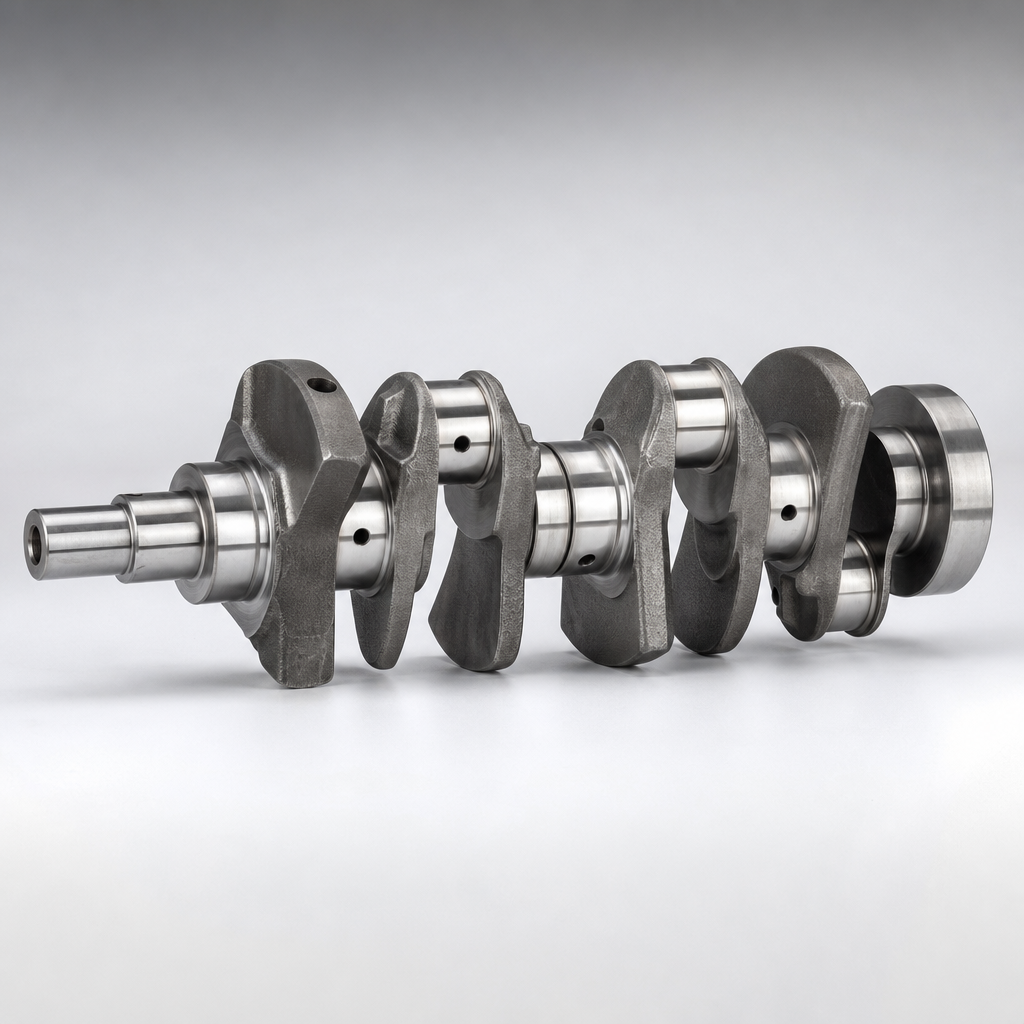
For importers and aftermarket buyers, sourcing a **crankshaft pulley Mitsubishi wholesale** programme is not a simple price exercise. This component sits at the front of the crankshaft, drives accessories, and on many applications also works as a torsional damper. If concentricity is poor, the rubber bond is unstable, or the belt groove geometry is wrong, the result is rarely minor. Buyers can end up with belt noise, premature accessory wear, installation difficulty, or vibration complaints that turn a low-cost part into a high-cost warranty problem.
That is why experienced procurement teams ask different questions first: what construction is being quoted, how bond integrity is checked, how production lots are traced, and whether the supplier can repeat the same quality level on the next shipment. They also need clarity on dimensional inspection, export packaging, corrosion protection, and whether the factory can support private label or drawing-based development without creating avoidable delays.
A useful RFQ for this category should define more than part number and quantity. In practice, buyers should include engine code, pulley type, OD, belt profile, groove count, bore or mounting dimensions, offset, damping requirement, coating target, carton quantity, label format, destination market, and annual volume. Without that detail, quote comparison becomes misleading because different suppliers may price different constructions, different inspection standards, and different packing assumptions under the same short description.
Start with the real buying decision, not the unit price
A Mitsubishi-fitment crankshaft pulley is usually purchased for one of three channels: independent aftermarket distribution, repair-chain supply, or programme-based OEM service. Each channel has different tolerance for stock risk, claims exposure, and lead-time pressure. The first decision is not price. It is whether the supplier can control the part technically and deliver it consistently.
Before comparing quotations, confirm whether the item is a simple drive pulley or a bonded harmonic balancer. They may look similar in a catalogue. They are not sourced the same way. Inspection methods, failure modes, and material requirements differ sharply.
Key first-pass checks:
Application accuracy: verify engine code, model year range, pulley diameter, rib count, mounting pattern, bore details, keyway if applicable, and offset. Even a 1.0-1.5 mm offset error can affect belt tracking on multi-rib systems.
Material construction: confirm whether the design is solid steel, ductile iron, grey cast iron, or a bonded damper with an elastomer layer. Aftermarket steel pulleys may use stamped-and-machined low-carbon steel, while damped designs often combine a machined hub with an outer inertia ring.
Runout control: ask for radial and axial runout limits, datum definition, fixture method, and inspection frequency. Many buyers use radial runout ≤0.20 mm and axial runout ≤0.15-0.20 mm as workable aftermarket reference points unless the drawing is tighter.
Bond durability: for damped pulleys, request evidence of rubber-to-metal adhesion after heat, cyclic load, and aging. The supplier should state elastomer type, hardness range, and whether post-bonding visual inspection is done on every piece.
Surface protection: confirm coating system, target film thickness, corrosion target, and packaging protection for sea freight or long storage. Common options include e-coat, phosphate plus oil, or paint systems.
Traceability: batch coding should link raw material, machining lot, bonding or vulcanisation lot, balancing stage, packaging date, and final inspection record.
Documentation discipline: quality records should align with the process expectations behind IATF 16949:2016 and ISO 9001:2015.
A strong supplier should also explain how fitment data is maintained. Catalogue breadth alone is not enough. When several Mitsubishi engine families use similar-looking pulleys with different damping or offset requirements, weak application mapping quickly turns into avoidable claims.
Commercial scope matters too. One supplier may quote a part with dynamic balance, VCI protection, and export cartons included. Another may quote only the bare part in bulk packing. A small ex-works gap can become a larger landed-cost gap once rework, relabelling, and anti-rust protection are added.
If you are building a wider engine hard-parts range, it also helps to review our catalog and related /products/engine-components.html coverage so pulley sourcing fits into a more efficient consolidated purchasing plan.
Spec details that separate a quiet install from a warranty return
For this product, dimensional match is only the start. Field performance depends on geometry, alignment, and on some applications, damping behaviour. A pulley that installs can still fail commercially if it causes belt wander, idle vibration, or early accessory wear.
Checkpoint
Typical buyer requirement
Why it matters
Outer diameter
Drawing or sample match, commonly within ±0.10 to ±0.30 mm depending on size and process
Affects belt speed and accessory drive ratio
Belt groove profile
Correct rib count, groove pitch, angle, and profile; groove pitch often controlled within ±0.05-0.10 mm
Prevents belt wander, squeal, noise, and accelerated belt wear
Bore and mounting face
Controlled fit, perpendicularity, and surface finish; typical bore tolerance may be H7-class or customer-defined
Reduces installation issues, wobble, and fretting
Offset / installation depth
Usually held within ±0.10-0.20 mm on critical applications
Keeps pulley alignment with the accessory drive plane
Radial/axial runout
Measured on fixture after machining or assembly; many buyers ask for ≤0.15-0.20 mm
Directly affects NVH, belt life, and accessory load stability
Bonded rubber hardness
Defined Shore range by application, often 60-75 Shore A for aftermarket damper designs unless OE data requires otherwise
Influences torsional damping behaviour and service life
Dynamic balance
Checked to internal specification, often by residual unbalance limit per part size
Helps limit front-end vibration at speed
Corrosion resistance
Coating validation or salt-spray benchmark, often 72-240 hours NSS depending on market and coating system
Protects inventory during shipping, storage, and warehouse handling
</tr></thead><tbody> </tbody></table>Visually similar pulleys can hide meaningful differences in damping ring dimensions, groove layout, or installed depth. That is why appearance matching is a weak sourcing method. It may pass a quick visual review and still fail in service.
Useful drawing and sample checkpoints include:
total number of grooves and belt section type
OD of each functional belt surface
hub length and overall installed depth
keyway width/depth or bolt pattern PCD where relevant
chamfer size at the bore entry for installation
inertia ring width and rubber section thickness on damped designs
mounting face flatness and burr control
Where OE cross-reference is used in catalogue management, ask for a fitment list linked to the relevant reference format, such as OE 11251…, but only where that reference is supported by the customer brief, a verified sample, or a documented mapping file. Cross-reference should support validation, not replace it.
For elastomer-containing pulleys headed to EU markets, chemical compliance should also be reviewed against REACH (EC) No 1907/2006. If substance declarations or SVHC communication will be required, settle that before artwork approval and packing release.
If a supplier cannot name the critical dimensions, their control tolerances, and the gauges used to monitor them, that is a serious warning sign. A dependable factory should be able to explain nominal values, sampling frequency, Cp/Cpk targets for key characteristics where monitored, and the reaction plan if results begin drifting toward tolerance limits.
Where wholesale pulley programmes usually go wrong
Supplier evaluation for crankshaft pulley Mitsubishi wholesale orders is really an exercise in repeatability. A cheap opening order has limited value if replenishment slips, mixed batches create fitment variation, or packaging confusion causes warehouse errors.
Failure points to probe during supplier review
1. MOQ is quoted without context Ask for trial MOQ, standard production MOQ, and private-label MOQ separately. The same factory may offer different thresholds depending on stock status, carton format, or tooling needs. In this category, buyers often see trial orders from 50-100 pcs/SKU, standard production MOQs around 200-500 pcs/SKU, and private-label packaging MOQs from 300-1,000 pcs/SKU.
2. Lead time is quoted as one number Separate tooling development, pilot-lot timing, and repeat replenishment. Also ask what happens during peak season or raw-material purchasing cycles. A realistic guide is 30-45 days for stocked or standard repeat production, 45-60 days where bonding or special coating queues apply, and 60-90+ days for new development requiring sample approval.
3. Audit access is limited to presentations A serious review should cover incoming material control, machining inspection, bonding control, dynamic balance checks, final inspection, and packaging verification. If the factory cannot show how the process runs, the paperwork alone is not enough.
4. Custom-project documentation is vague Ask what PPAP or equivalent submission level is available. Depending on the programme, buyers may need dimensional reports, certifications, process flow, PFMEA, control plan, sample approval records, or capability evidence for critical dimensions.
5. Warranty handling is reactive A credible supplier should already have a containment method, root-cause process, and corrective-action workflow such as 8D or equivalent.
Commercial checkpoints worth locking down early
Trial-order support for new account onboarding
Stable carton quantity and pallet standard for warehouse handling
Barcode, shipping mark, and label format confirmation before production
Mixed-container consolidation across engine-component lines
Agreed quantity variance on export orders, often ±5% unless otherwise agreed
Rules for packaging change control, revision control, and artwork approval
Price logic buyers can use instead of guessing
In wholesale sourcing, unit price usually moves with four variables: construction, process intensity, order quantity, and packaging complexity.
Simple solid pulleys usually price lower than bonded harmonic balancers because there is no rubber bonding or damping validation.
Low MOQs often carry setup premiums because machining fixtures, balancing, and carton preparation are spread across fewer units.
Neutral bulk or neutral boxed packing normally costs less than branded boxes, barcode stickers, inserts, and retail-style label work.
Drawing-based or sample-based development may require tooling or fixture cost amortisation across the first 1,000-3,000 pcs, depending on the project.
As a broad aftermarket reference, buyers may see ex-works pricing such as USD 8-18/pc for simpler steel pulley constructions and USD 18-45+/pc for more complex bonded damper assemblies. Final pricing still depends on weight, machining content, coating, and order volume. These numbers are not fixed market rates, but they are useful as a quick sanity check when a quote seems unusually low for the construction described.
During audits, it is also worth asking how the factory separates closely related SKUs on the shop floor and in packing. Variant mix-ups are common when multiple Mitsubishi applications share near-identical external dimensions.
At Driventus, these discussions are usually linked back to the quality system and whether the customer needs standard supply or custom manufacturing against a drawing, sample, or packaging brief.
A step-by-step validation package buyers should request
Crankshaft pulley claims in the field usually trace back to three root causes: excessive runout, bond separation, or wrong fitment assignment. That is why validation should be practical, documented, and tied to the actual application rather than a catalogue image.
Recommended supplier evidence includes:
Dimensional inspection report for OD, bore, face runout, groove geometry, installation depth, and mounting-face condition
Material certification for the metal body and elastomer compound where applicable
Bond strength or durability testing for damped pulley designs
Dynamic balance confirmation to the internal control plan or customer requirement
Salt-spray or coating performance data where storage humidity or harsh climate matters
Packaging drop and transit review for export shipments, especially when corrosion-protected surfaces must remain intact
For higher-volume programmes, ask how variation is controlled at each stage:
incoming raw-material verification
machining checks on bore, face, and groove profile
vulcanisation or bonding parameter control
balance verification and assembly confirmation where applicable
100% appearance inspection
final sample verification by batch
A practical approval flow can look like this:
1. Review critical characteristics first Confirm which dimensions the supplier classifies as critical, how they are gauged, and how nonconforming pieces are isolated.
2. Approve a pilot inspection package A useful set often includes FAI/ISIR data from 5-10 sample pieces taken from the pilot lot.
3. Check runout on the right fixture Ask for records taken on a dedicated mandrel or simulated crank-mounting fixture with dial-indicator values recorded in mm.
4. Verify balance and rubber properties For damped designs, request the dynamic balance report, rubber hardness report, and where relevant, a bond-aging test after heat exposure such as 100-150°C for 24-72 hours followed by visual and adhesion review.
5. Confirm coating and export packing Review film-thickness data, salt-spray result, and whether the packing method protects coated surfaces through ocean transit and warehouse storage.
For mass production, buyers often ask for controls such as:
100% visual inspection for appearance, marking, and obvious rubber defects
100% or frequent in-line runout checks at setup and defined intervals for critical SKUs
AQL-based final sampling for dimensions and packing, commonly AQL 0.65-1.0 for critical defects and AQL 1.5-2.5 for major/minor visual items depending on programme rules
Gauge calibration records traceable to internal or third-party calibration schedules
Where customer requirements call for extra testing, those checks should be written into the control plan and purchase specification. Procurement teams should not rely only on nominal dimensions or cross-reference lists. Actual production inspection data is far more valuable when comparing suppliers and forecasting claim risk.
If possible, validate one pilot shipment under real installation conditions. Even a 20-50 pcs field trial across representative vehicles can reveal belt-alignment issues, installation-force problems, or idle-vibration behaviour that desk-based dimensional review will miss.
A comparison model for shortlisting suppliers without regret later
A structured comparison reduces switching cost later. In crankshaft pulley Mitsubishi wholesale sourcing, the lowest quote is rarely the lowest landed-cost option once claims, delayed replenishment, and packaging rework enter the picture.
Below is a practical RFQ scorecard.
Evaluation area
What to verify
Procurement risk if unclear
Certification
IATF 16949:2016, ISO 9001:2015 status and scope
Weak process discipline
Product range
Coverage by engine family and pulley type
More suppliers to manage
Technical file
Drawings, reports, fitment mapping, traceability
Higher claim exposure
Tooling capability
New development and sample turnaround
Slow range expansion
MOQ flexibility
Trial order and mixed-SKU support
Excess stock burden
Lead time stability
Repeat-order planning window
Service-level failure
Packaging options
Neutral, private label, export pallet standard
Relabelling cost and damage risk
Corrective action speed
8D or equivalent response process
Long claim closure cycle
</tr></thead><tbody> </tbody></table>Weighted scoring helps. A fleet-repair distributor may place more weight on lead-time stability and fitment accuracy. A brand owner expanding SKUs may care more about tooling support and packaging flexibility.
One workable model is to score each category from 1 to 5 and apply weightings such as:
fitment accuracy and technical file: 25-30%
process quality and validation capability: 20-25%
price competitiveness: 15-20%
lead time and delivery reliability: 15-20%
MOQ and mixed-order flexibility: 10-15%
packaging and service support: 5-10%
For landed-cost comparison, normalise all quotes to the same basis:
ex-works or FOB term
same coating requirement
same unit box and master carton standard
same label content and barcode format
same inspection and document package
same palletisation and anti-rust protection
This is where many RFQs go off track. A supplier quoting USD 1-2/pc lower may still be more expensive once repacking, extra salt-spray protection, third-party inspection, or airfreight for delayed replenishment is added.
Supplier breadth also matters for buyers consolidating engine-component lines. If the same factory group can support pulleys, gaskets, water pumps, and related products, inbound freight planning and quality communication are usually simpler. That is one reason many distributors review our catalog before opening a new product-family RFQ.
A final filter is claim responsiveness. Ask each supplier for a standard turnaround target, such as 24-48 hours for first response, 7 days for containment feedback, and 14-30 days for a full 8D closure on routine cases. The clarity of the answer often tells you how they will behave after shipment.
When a custom pulley programme is worth the extra work
Standard catalogue supply works well for established fast movers. Custom development makes sense when the buyer needs tighter control, broader range expansion, or a product position that off-the-shelf supply cannot support.
Typical triggers include:
private-label packaging and barcode requirements
special corrosion protection for long sea transit or difficult storage conditions
market-specific fitment consolidation
customer drawing control for premium-range positioning
line expansion from sample where local OE data is incomplete
In these cases, the supplier should be able to manage drawing review, sample approval, pilot production, and repeat manufacturing under formal change control. Buyers should confirm whether deviations are recorded, tooling revisions are traceable by revision level, and approved samples are retained as master references.
Commercially, custom development works best when annual demand justifies the approval effort and when the buyer needs stronger control over branding, specification, or channel differentiation. Without a disciplined process, customisation adds complexity faster than it adds value.
Typical custom-project economics may include:
tooling or fixture charge for new machining, balancing, or bonding setup
sample lead time of about 20-45 days depending on whether new tooling is required
pilot lot MOQ often around 50-200 pcs for approval stock
mass production MOQ often 300-1,000 pcs/SKU depending on packaging and dedicated components
artwork approval freeze date before production to avoid carton or label scrap
As a rough rule, a programme at 1,000-3,000 pcs/year or more per developed SKU is usually easier to commercialise than a fragmented low-volume range, unless the margin or strategic value is unusually strong.
A workable custom RFQ package should include:
OE number or customer internal number
drawing, sample, or both
target annual and per-order quantity
destination market and compliance requirements
neutral or branded packaging specification
corrosion target and storage/shipping conditions
required reports such as dimensional, balance, material, or PPAP elements
approval deadline and launch schedule
Driventus is an independent aftermarket manufacturer; brand names are referenced for fitment only.
If you need project-based support rather than off-the-shelf supply, review our custom manufacturing process and prepare your RFQ with target annual volume, sample availability, packaging requirement, destination market, and inspection standard.
Frequently asked questions
MOQ depends on whether the part is a standard catalogue item, a trial order, or a private-label project. Buyers should ask for MOQ by SKU, mixed-order flexibility, and carton standard. In practice, trial quantities may start around 50-100 pcs per SKU, standard production around 200-500 pcs, and private-label or custom-pack orders may require 300-1,000 pcs or more depending on tooling, box printing, and dedicated stock arrangements.
At minimum, request fitment confirmation, a critical-dimension report, material or process documentation where relevant, packaging specification, and traceability details. For programme business, buyers may also ask for audit records, corrective-action workflow, control-plan evidence, dynamic balance confirmation, coating test data, and quality documentation aligned with IATF 16949:2016 and ISO 9001:2015.
Check runout control, bond durability on damped pulleys, groove-profile accuracy, corrosion protection, and batch traceability before approval. It is also useful to validate a pilot shipment under real installation conditions, for example 20-50 pcs across representative vehicles, and confirm that the supplier has a clear containment, root-cause, and corrective-action process for any returns.
If you are comparing suppliers for Mitsubishi-fitment pulley programmes, we can review your RFQ, drawings, samples, or packaging brief. Contact the Driventus team to [request a quote](/contact.html).