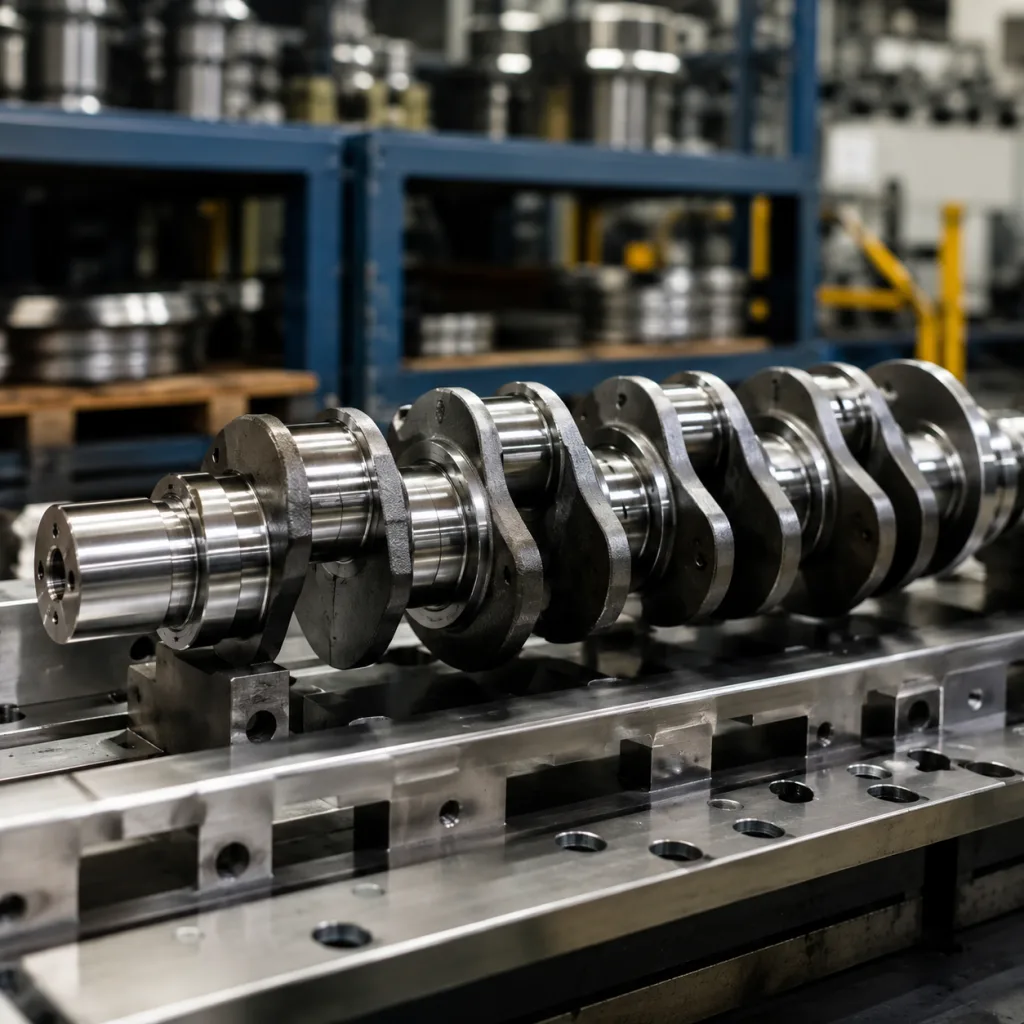
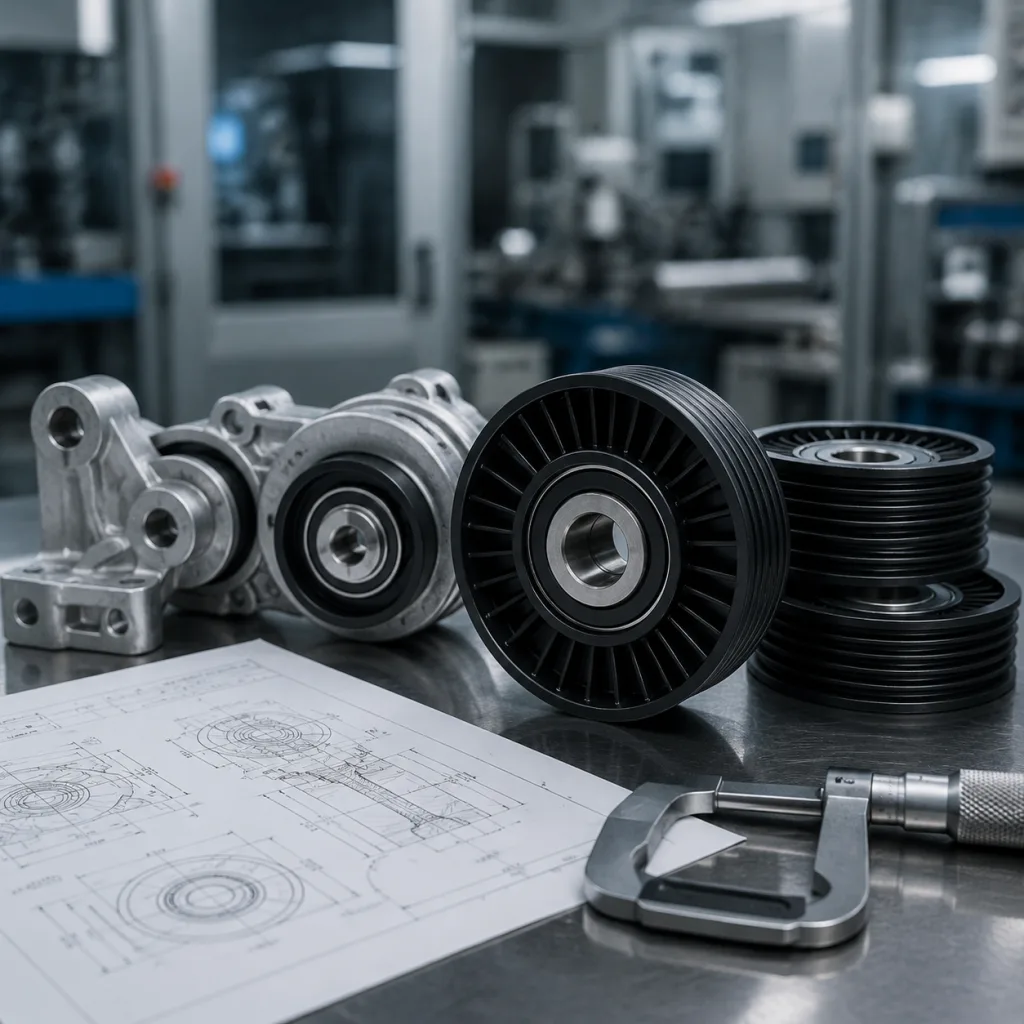
Buying crankshaft pulleys for Mini applications at wholesale level is not just about price. For distributors, importers, and repair-group buyers, the bigger risks are fitment accuracy, bonded-rubber durability, batch consistency, and export documentation. A pulley can match the basic drawing dimensions yet still fail on torsional damping, radial runout, or rubber-to-metal adhesion, and those issues can turn into warranty cost across several markets.
Early in the sourcing process, procurement teams usually need five points clarified: OE cross-reference coverage, material specification, validation scope, MOQ, and realistic production lead time. Just as important is confidence that batch traceability and engineering change control sit inside a documented quality system such as IATF 16949:2016 and ISO 9001:2015. This article outlines practical supplier checks for Mini crankshaft pulley sourcing, with attention to aftermarket wholesale programmes, private-label supply, and factory audit readiness. Driventus is an independent aftermarket manufacturer; brand names are referenced for fitment only.
What buyers should confirm before placing a Mini pulley programme
For Mini applications, the crankshaft pulley is not simply a machined wheel. In many references, it is a torsional vibration damper made up of a steel or cast-iron hub, an outer inertia ring, and an elastomer bond layer designed to absorb crankshaft torsional oscillation. That means sourcing has to cover both dimensional compliance and dynamic performance.
Before nomination, buyers should confirm more than basic vehicle fitment. The supplier also needs to understand the exact engine application and the service conditions behind it. Mini ranges often span several engine families, year breaks, accessory-drive variations, and OE supersessions, so one incorrect interchange can affect an entire wholesale programme.
Ask the supplier to confirm the following in a controlled document pack rather than through informal email wording alone:
Vehicle and engine coverage: platform, engine code, displacement, power output, year range, VIN or chassis split where relevant, and transmission relevance if the accessory drive differs
OE cross-reference mapping: OE-format references, superseded OE numbers, and equivalent aftermarket numbers, with clear note of any market-specific exclusions
Material stack: hub/ring substrate grade, elastomer family such as NR, NBR, or EPDM where applicable, hardness range in Shore A, corrosion protection type, and fastener supply scope if included
Critical dimensions: bore size, keyway or location features, overall offset, PK groove count and profile, pitch diameter, radial and axial runout limits, concentricity, and any dimensions classified as special characteristics
Validation records: torsional performance validation, rubber-to-metal adhesion testing, salt spray resistance, thermal ageing, groove-profile inspection, and balance checks
Packaging spec: unit protection, anti-corrosion measure if required, carton strength, pallet pattern, and label content including part number, batch code, and country of origin
Trade compliance: REACH (EC) No 1907/2006 disclosure where required, and any customer-specific restricted-substance declaration
It is also worth asking whether the pulley is supplied against an approved drawing, a reverse-engineered sample, or a consolidated market reference. That difference matters. A supplier working from controlled drawings, revision history, and validated process parameters is usually in a stronger position to maintain interchangeability than one relying only on visual sample matching.
For wholesale planning, buyers should also check whether the supplier’s part number structure stays consistent across catalogues, labels, outer cartons, EDI data, and shipping documents. That helps prevent warehouse receiving errors and cross-reference confusion after launch.
When a supplier cannot provide these items in a controlled document pack, the problem often shows up later as return claims, fitment disputes, or line-side delays. In crankshaft pulley mini wholesale sourcing, the strongest starts usually come from suppliers that answer technical and commercial questions with the same level of documentation discipline.
Key wholesale criteria: MOQ, lead time, tooling and audit readiness
For a wholesale buyer, commercial terms need to match the real manufacturing route. Mini pulley references may come from existing tooling, modified tooling, or fully new development. Each option changes MOQ, sample timing, PPAP-style approval content if requested, and unit economics.
One common purchasing mistake is comparing quotations line by line without understanding how the supplier intends to make the part. A low price from an adapted-tool route may bring longer validation time, higher dimensional variation risk, or less flexibility for future engineering changes. A higher opening quotation from an already validated route may reduce launch risk and warranty exposure.
Sourcing factor
What to ask
Typical procurement concern
MOQ
Opening order quantity by reference, mixed-SKU flexibility, and carton multiple
Avoid overstock on slower Mini SKUs
Lead time
Sample lead time, tooling modification time, approval window, and repeat-order replenishment
Prevent stock gaps during launch
Tooling status
Existing tool, modified tool, or new tool; ownership and maintenance terms
Clarify amortisation and replacement cost
Capacity
Monthly output by line, shift pattern, and bottleneck process
Support promotions and multi-market supply
Audit documents
Process flow, control plan, PFMEA summary, and inspection plan
Validate manufacturing discipline
Traceability
Batch-code logic and retained-record period
Manage field claims efficiently
Export pack
HS code support, carton marks, pallet standard, and loading pattern
Reduce customs and warehouse friction
</tr></thead><tbody> </tbody></table>Each of these points affects the real viability of a wholesale programme:
MOQ should be checked by part number, not only by total order value. Buyers building a broad Mini range often need slow-moving references in smaller batch quantities, such as pallet-layer or carton-multiple supply rather than full-run MOQ.
Lead time should separate sample production, customer approval, and repeat-order replenishment. A realistic pattern may be 2-4 weeks for existing-sample supply, 6-10 weeks for modified-tool samples, and 30-60 days for repeat production depending on material and coating queues.
Tooling status should cover ownership, maintenance responsibility, cavity count or fixture count where relevant, and what happens if annual demand falls below forecast.
Capacity should be tied to actual production planning, not just stated monthly volume. Ask whether output is dedicated or shared with similar damper pulley families and whether vulcanisation, machining, or coating is the bottleneck.
Audit readiness matters if the customer requires document review before nomination or if the buying group runs periodic supplier assessments.
For many importers, an early question worth asking is whether the supplier can support a mixed-container or mixed-pallet programme. In practice, that can matter more than an attractive nominal MOQ if the buyer is building a broad engine-components range. You can review our catalog to assess adjacent product families that may be consolidated in one shipment.
Audit readiness should also be judged by response speed. A supplier operating under IATF 16949:2016 and ISO 9001:2015 should be able to show revision control, nonconformance handling, calibration status, incoming material controls, gauge R&R records where critical measurements are involved, and retained inspection data without delay. Driventus publishes an overview of its quality system for this purpose.
For crankshaft pulley mini wholesale programmes, the most useful commercial discussion is rarely “what is your cheapest price?” A better question is: “What route gives us stable supply, manageable stockholding, and predictable launch timing?” That framing usually leads to better sourcing decisions.
Technical checks that matter more than catalogue fitment
Catalogue fitment is only the starting point. On a crankshaft pulley, the highest warranty costs often come from issues that do not appear in a basic interchange list.
For Mini applications in particular, the pulley can affect belt tracking, accessory-drive stability, vibration behaviour, and the long-term durability of the bonded damping section. A supplier may match an OE number and still leave the buyer exposed if runout, balance, or rubber-bond quality are not properly controlled.
Core inspection points
Radial and axial runout: excessive runout can cause belt walk, noise, and tensioner fluctuation; buyers should ask for the measurement datum and acceptance limit in mm or TIR
Dynamic balance: imbalance raises NVH risk and can accelerate wear of the belt drive and front-end accessories; the supplier should define whether control is 100% or by validated sampling plan
Rubber bond integrity: adhesion quality is critical for service life; test method should be defined, such as pull, peel, or torque-to-failure style validation depending on design
Groove profile accuracy: PK multi-rib geometry must match the specified belt section, including rib count, pitch, angle, and surface finish where controlled
Surface protection: coating thickness, coverage, and salt-spray performance affect storage stability and in-service corrosion resistance
Installation interface: hub fit, pilot diameter, keyway or location-feature tolerance, and face offset must align with the crank nose design and fastening method
Each inspection point should be tied to a defined method. Runout, for example, should be measured on a repeatable fixture with a stated acceptance limit. Groove profile should be checked by profile projector, dedicated gauge, or CMM against the required belt standard. Balance should be controlled either part-by-part or through a validated production process with reaction limits.
Validation evidence buyers can request
A technically credible supplier should be able to share at least summary-level test evidence, such as:
Dimensional reports from calibrated gauges or CMM checks
Hardness verification for elastomer and metallic substrate where relevant
Salt spray method and test duration, commonly reported in hours to a specified internal or customer standard
Thermal ageing results showing retention of hardness, bond integrity, or dimensional stability after elevated-temperature exposure
Rubber-to-metal adhesion test data with method and acceptance criterion stated
Balance records, residual imbalance limit, or equivalent production-control evidence
Where possible, ask whether the evidence comes from initial design validation, process validation, or routine production verification. A single pre-launch report is useful, but it does not replace ongoing process control.
Buyers may also want to clarify a few practical technical points that often sit outside catalogue data:
Whether the elastomer compound is specified for the expected under-bonnet temperature range and fluid exposure
Whether the coating system is suitable for long sea transit and warehouse storage without flash rust at exposed edges
Whether the pulley ships with protective features that prevent groove damage, edge knocks, or bond-surface contamination
Whether any mounting hardware is included and, if included, whether replacement guidance and tightening instructions are specified by the application data
Where the pulley is sold into road-use markets, buyers may also ask how the supplied component supports emissions-system durability indirectly through stable belt-drive operation. While ECE R-83 is not a pulley product standard, stable accessory drive can still matter in broader engine-system reliability discussions in the EU aftermarket.
If your programme needs tailored dimensions, private label, or dedicated packaging, a supplier should confirm whether custom manufacturing is available and which validation steps are included before SOP. In crankshaft pulley mini wholesale sourcing, strong suppliers are usually the ones that can explain not just what the part fits, but how the part has been verified.
How to compare suppliers for risk, not only price
A low unit price can be wiped out quickly by returns, emergency freight, warranty accrual, or regional delisting. That is why procurement teams should compare suppliers on total risk, not simply ex-works price.
The most effective approach is to treat the sourcing decision as a combined quality, supply-chain, and aftersales review. Two suppliers may quote similar fitment coverage, yet one may have clearer engineering change control, stronger packaging discipline, and faster field-claim response. Over a 12-month wholesale cycle, those differences often matter more than a small gap in unit cost.
A practical comparison framework includes:
Drawing control: Does the supplier work to approved drawings, revision history, and controlled special characteristics?
Material approval flow: Are elastomer compounds, steel or iron inputs, and coatings linked to incoming inspection and approved sources?
Process capability: Are critical dimensions measured by defined frequency, with retained results by batch or lot?
Change notification: Is there formal approval before tool, material, process, or sub-supplier changes?
Field-claim response: Can the supplier implement containment quickly and issue 8D response within agreed timing?
Logistics resilience: Can they support safety stock, forecast windows, mixed loading, and urgent replenishment?
To make this comparison more operational, many buyers use a weighted scorecard. For example:
Quality system and validation: 30%
Fitment coverage and documentation accuracy: 20%
Commercial terms and MOQ flexibility: 20%
Delivery reliability and export support: 15%
Claim handling and communication speed: 15%
This kind of structure helps internal teams explain why a slightly higher ex-works price may still deliver lower total landed risk.
For private-label importers, packaging consistency is often overlooked. Check barcode symbology, country-of-origin marking, inner-pack protection, carton compression strength, moisture protection where needed, and pallet stability. A pulley damaged by poor packaging may pass final inspection and still fail before installation. It is also worth confirming that labels, cartons, and master packs use the same product-code logic as the supplier’s invoice and packing list.
It is equally important to ask how the supplier manages changes after launch. A capable source should define:
what constitutes a controlled change
how much notice is given before implementation
whether first-off approval or customer sign-off is required
how old and new batches are segregated during transition
It can also be useful to ask whether the supplier can bundle related engine products such as seals, gaskets, or water pumps. Combining categories can reduce landed cost and simplify vendor management, especially for buyers building a wider engine components range.
For crankshaft pulley mini wholesale purchasing, the winning supplier is often not the one with the lowest opening number, but the one least likely to create hidden cost across warehousing, warranty, and replenishment.
What a capable RFQ should include
To receive a useful quotation, provide more than a keyword and vehicle model. Better input allows the supplier to confirm fitment, manufacturing route, and commercial terms much faster.
A strong RFQ saves time on both sides. It cuts down back-and-forth on basic application questions, helps the factory judge whether the requirement matches existing production or needs engineering review, and makes quoted MOQ and lead time more realistic. In crankshaft pulley mini wholesale enquiries, the quality of the RFQ often shapes the quality of the quotation.
Include these items in the RFQ:
OE-format reference if available, such as OE 11251…, plus any incumbent aftermarket number
Vehicle model, engine code, power rating, year range, and destination market
Required annual volume, opening order quantity, and forecast window
Packaging requirement: neutral, private label, or customer artwork
Certification requirement: IATF 16949:2016, ISO 9001:2015, or both
Compliance requests such as REACH (EC) No 1907/2006 declarations
Sample requirement, approval route, and target timing
Shipping term, destination port, and target launch date
To make the RFQ more actionable, add details that are often omitted but highly useful:
whether the request is for an existing market reference or a new development
whether benchmark samples, drawings, or photos can be shared
whether the programme needs mixed-SKU loading in the first order
whether label format, language, or barcode standard is predefined
whether there is a target service-life expectation or warranty requirement
whether the customer expects routine test summaries with each batch or only at launch
whether any specific dimensional checks such as runout, groove profile, or coating performance must be reported
A complete RFQ helps the factory identify whether the request fits existing production or needs modified tooling. It also allows clearer confirmation of MOQ, sample timing, and repeat lead time, which is essential for wholesale planning.
If you are comparing sources for Mini pulley supply and want a document-based quotation, use the enquiry data above when you request a quote.
Frequently asked questions
MOQ depends on whether the reference uses existing tooling, modified tooling, or a new-development route. In practice, buyers should ask for MOQ by part number, carton multiple, and mixed-order flexibility rather than one blanket figure. Existing references may support lower opening quantities than newly tooled parts.
At minimum, ask for certification status, process flow, inspection plan, traceability method, material or compliance declarations, and summary validation records. Buyers with stricter launch controls may also request PFMEA extracts, control plan, calibration evidence, and retained inspection data for critical characteristics such as runout or groove profile.
No. Catalogue fitment should be backed by dimensional reports, bond-integrity controls, runout checks, groove-profile verification, and durability evidence. For damped pulleys, elastomer quality, adhesion performance, and balance control are as important as interchange data.
If you need wholesale supply details, cross-reference review, or a factory-based quotation for Mini crankshaft pulleys, contact Driventus to discuss the programme scope at /contact.html