Crankshaft Pulley Lexus Supplier: Sourcing and Quality Guide
If you are screening a crankshaft pulley Lexus supplier, the decision should start with fitment control, material traceability, and documented runout limits. Lexus applications can use solid pulleys or elastomer-damped harmonic balancer designs, so the buyer needs more than a model-year match. Driventus is an independent aftermarket manufacturer; brand names are referenced for fitment only. For B2B sourcing, the useful questions are simple: can the supplier confirm bore, offset, groove profile, balance grade, finish, and packaging consistency; can it support export paperwork; and can it document the quality system behind the part. The links below cover our catalog, quality system, and OEM-focused services if you need a controlled sourcing path for volume programs, distributor stock, or private-label supply.
What Buyers Should Expect From a Lexus Pulley Supplier
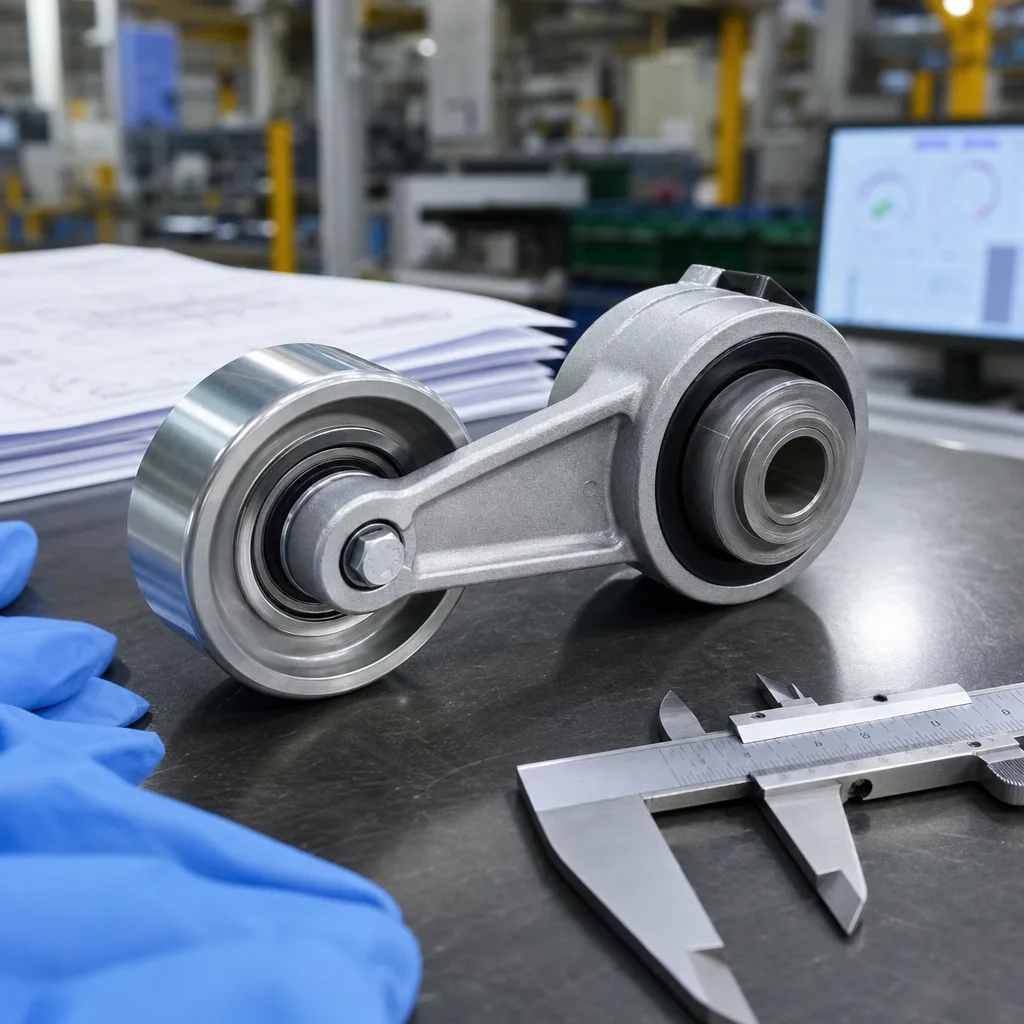
Start with our catalog and narrow the request to the exact engine family, pulley type, and model year. Lexus applications can change by bore, offset, belt rib count, and whether the part is a simple drive pulley or an integrated torsional damper. A supplier should answer with drawings, photos, material data, and the current revision status before sample approval.
For buyers who need traceable inspection records, the quality system page shows the control framework behind dimensional checks, batch traceability, and incoming and outgoing inspection. If you need a private-label run or an application-specific revision, custom manufacturing is the right path. For broader programme planning, browse engine components to align the pulley with adjacent belt-drive parts.
Fitment Data That Prevents Returns
Before RFQ, capture the details that actually control fitment:
- Engine code and VIN
- Pulley outside diameter, bore, hub depth, and offset
- Serpentine belt groove count and width
- Sensor ring or timing mark presence
- Keyway, press-fit, or bolt pattern details
- Maximum radial runout and balance requirement
If the part replaces a rubber-damped unit, ask for rubber compound type, bond method, and ageing data. A catalogue photo is not enough; the drawing revision and measurement report should match the vehicle configuration sold in your market.
Validation point
The best way to reduce claim risk is to treat the pulley as a controlled technical part, not a commodity image match. That means sample approval against the correct engine variant and a signed dimensional report before stock release.
Materials, Balance, and Durability Control
Manufacturing control should be documented to IATF 16949:2016 and ISO 9001:2015, with REACH (EC) No 1907/2006 declarations for material compliance. For elastomer-damped pulleys, ask for durability evidence that includes heat ageing, oil resistance, and ozone exposure; SAE J2527 is a useful reference for environmental durability. Balance grade and concentricity matter as much as finish, and balance practice should be stated against ISO 1940-1 where it applies.
In practice, a stable programme will define:
- Material chemistry and hardness
- Hub concentricity and face runout
- Dynamic balance method
- Surface protection or plating
- Packaging that prevents flange damage in transit
Buyers should also confirm whether the pulley is shipped with the isolator preloaded or pre-assembled, because that changes handling and install instructions.
Source Comparison: Manufacturer vs Trading Company
The table below is a practical way procurement teams can compare sources.
| Source | Typical benefit | Main risk | Best use |
|---|---|---|---|
| Direct manufacturer | Drawing control, batch traceability, repeatability | Needs audit and MOQ planning | Repeat stock and programme supply |
| Trading company | Broad part coverage, quick response | Data drift between quotes and samples | Emergency fill-in orders |
| Reworked used part | Lowest initial price | Unknown fatigue history, no document pack | Avoid for fleet or warranty supply |