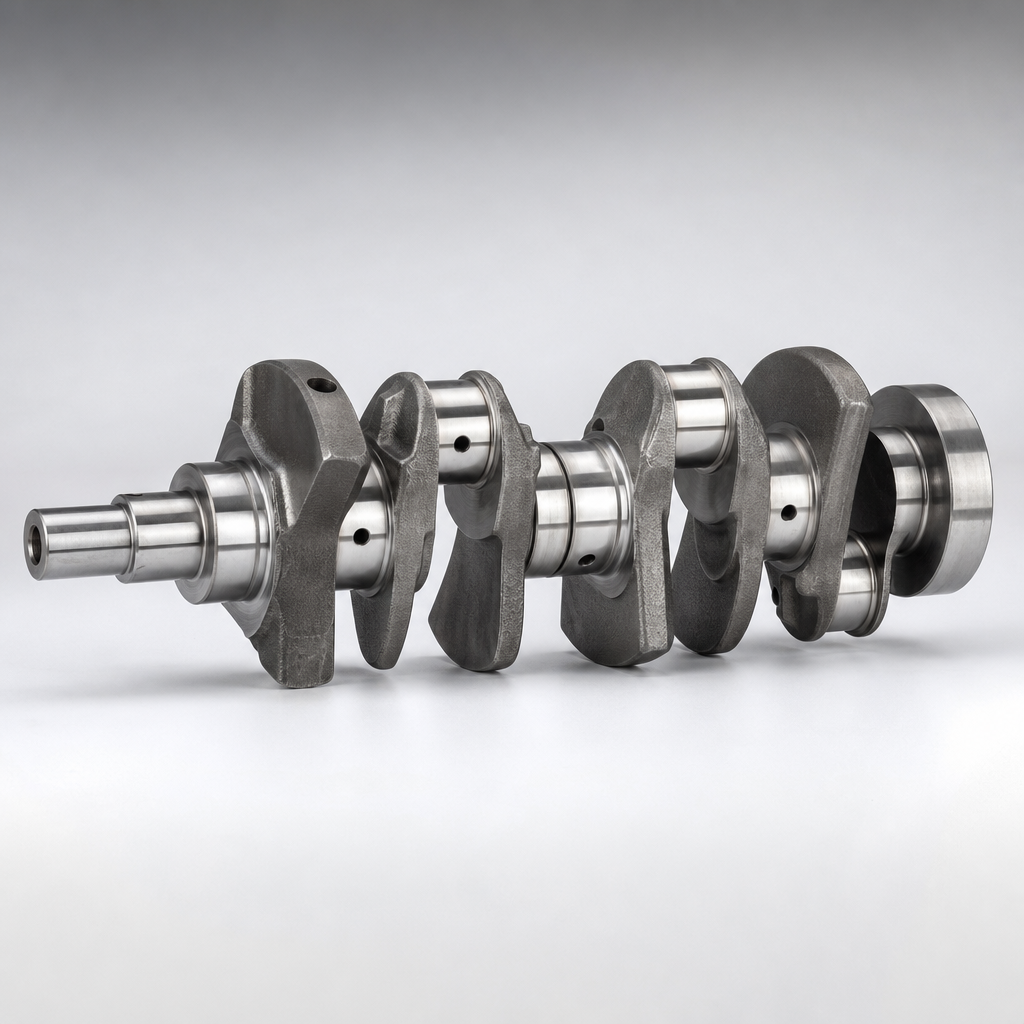
Crankshaft Pulley BMW Wholesale: B2B Sourcing Guide
Sourcing for **crankshaft pulley BMW wholesale** programs is rarely a simple unit-price exercise. For distributors, importers, and repair-group buyers, the real question is whether supply will stay consistent from batch to batch: dimensional accuracy, bonded-rubber stability, traceability, packaging control, and lead-time reliability all affect the outcome. When a pulley fails, the problem can show up as belt noise, accessory-drive vibration, unstable charging performance, or accelerated wear in neighboring components. That is why procurement decisions should be based on validation data, not catalogue claims alone.
In wholesale purchasing, buyers usually compare material specification, concentricity control, corrosion resistance on coated metal surfaces, rubber-to-metal bond durability, and fitment coverage across several BMW engine families. Many also verify whether the supplier works within IATF 16949:2016 and ISO 9001:2015 quality systems, and whether export documentation can support REACH (EC) No 1907/2006 compliance where required. This guide covers the main checkpoints B2B buyers should review before placing volume orders for BMW crankshaft pulleys.
For buyers running annual contracts, it also helps to convert technical risk into sourcing metrics before the RFQ goes out: target annual volume by OE reference, first-order trial quantity, acceptable dimensional tolerances, packaging spec, and required replenishment window. A supplier quoting USD 18.50 versus USD 21.00 per unit may still be the higher-cost option if runout variation, bond failure risk, or unstable lead times increase warranty exposure or force emergency air shipments later in the season.
Start with the decision screen, not the catalogue
For this product category, the biggest purchasing risk is usually invisible at receiving. A pulley can look acceptable on arrival and still fail early if the elastomer compound, bonding method, or machining discipline is inconsistent.
Use the RFQ stage to separate real manufacturing control from a price-only offer.
Application coverage: confirm engine code, model year range, groove profile, offset, and pulley diameter
Dimensional control: verify bore size, face runout, overall height, and belt-track alignment
Material stack: identify whether the body is steel or cast iron, plus damper material and coating type
Dynamic performance: ask how damping consistency is controlled across the stated operating range
Traceability: confirm lot coding, raw-material records, and batch-level inspection reports
Packaging standard: review corrosion protection, internal partitioning, and carton strength for export handling
Compliance documents: request declarations relevant to REACH (EC) No 1907/2006 and details of control plans under IATF 16949:2016
For BMW crankshaft pulleys, catalogue photos are not enough. Ask for installation-critical dimensions with actual values and tolerances: bore tolerance in the H7-class range where applicable, face or radial runout typically controlled within 0.10 to 0.20 mm, belt-groove pitch/profile confirmation, overall height tolerance often within +/-0.15 to 0.30 mm, and pulley offset tight enough to avoid belt walk on automatic tensioner systems. On bonded-damper designs, request elastomer hardness data such as 60 to 75 Shore A where relevant, plus the supplier's batch-to-batch acceptance range.
A serious supplier should also explain first-article approval in plain terms. In many aftermarket programs, the buyer approves 3 to 10 sample sets with a dimensional report, packaging mock-up, and cross-reference sheet before mass production. If the supplier cannot provide sample measurements, cavity or batch traceability, and a defined control plan for critical dimensions, the RFQ is still incomplete even if the unit price looks attractive.
For buyers managing multi-market distribution, it also helps to confirm support for private-label packaging, barcode requirements, and mixed-SKU consolidation. That becomes more useful when a shipment includes related rotating or front-end engine parts from the same source. You can review broader fitment coverage in our catalog and related engine categories at /products/engine-components.html.
Compare suppliers by failure mode, not by sales pitch
When comparing manufacturers for crankshaft pulley BMW wholesale supply, a structured checklist works better than a general factory profile. The question is simple: where can this product fail, and what controls are in place to prevent that?
Assessment point
What to verify
Why it matters
Quality certification
IATF 16949:2016, ISO 9001:2015
Indicates a formal system for process control, corrective action, and document management
Incoming material control
Metal chemistry review, elastomer batch verification
Helps reduce variation in fatigue life and bond durability
Machining capability
Bore tolerance control, runout inspection, balancing checks where applicable
Directly affects installation accuracy and belt tracking
100% visual inspection plus defined sampling for dimensions and bond integrity
Limits outgoing defect risk
Export readiness
Pallet standard, moisture protection, barcode or label format
Prevents transit damage and receiving delays
Capacity planning
MOQ, standard lead time, surge capacity
Important for seasonal demand, tenders, and replenishment planning
</tr></thead><tbody> </tbody></table>A capable supplier should be able to explain PPAP-style documentation logic when requested, even for aftermarket business rather than OEM direct supply. Ask how nonconforming parts are segregated, how gauges are calibrated, how process changes are recorded, and how complaints are closed with corrective action.
Then move from process claims to commercial facts. Useful benchmarks include standard MOQ for stocked pulleys of 50 to 100 pcs per SKU, private-label MOQ of 200 to 500 pcs per SKU, sample cost policy, and mass-production lead time split by stage, such as 7 to 14 days for sample preparation, 20 to 35 days for repeat stock orders, and 35 to 60 days for new packaging or fresh production runs. Also confirm whether quoted prices are based on EXW, FOB, or CIF terms, because a low EXW number can become uncompetitive once inland transport, export packing, and port charges are added.
Factory-process detail matters here. Buyers should verify whether machining and bonding are done in-house or subcontracted, whether critical gauges are calibrated every 6 to 12 months, whether coating thickness is checked per batch, and whether end-of-line dimensional sampling follows a stated AQL or control plan. A plant that can show actual records for bore measurement, runout inspection, bond testing, and packing release is usually more dependable than a trading source forwarding generic certificates.
Driventus operates under a documented quality system aligned with IATF 16949:2016 and ISO 9001:2015, with production controls designed for export aftermarket and OEM-oriented supply.
Control fitment like an engineering change process
BMW pulley demand often spans several engine platforms, so fitment discipline matters more than broad catalogue coverage. Procurement teams should request a controlled cross-reference list linked to drawing revision, dimensional records, and application notes.
Where the customer already buys against OE references, the supplier should map internal part numbers to the relevant fitment data. If an enquiry includes a reference such as OE 1123..., the reply should contain confirmed dimensions and application notes, not only a quoted price. For crankshaft pulley BMW wholesale sourcing, that level of cross-checking is necessary to avoid receiving a part that is nominally similar but not installation-safe.
Validation points to request
Installation-critical dimensions with tolerance values
Groove count and groove-profile confirmation
Pulley outer diameter and offset confirmation
Material and hardness data for the elastomer section where applicable
Coating type and corrosion test method
Sample-approval procedure before mass production
For validation, many buyers request:
Dimensional inspection reports on first samples
Rubber-to-metal bond checks under internal test procedures
Salt spray testing of coated surfaces where corrosion resistance is specified
Durability or bench-rotation tests for higher-volume programmes
Push for measurable acceptance criteria. Typical sample validation may include outer diameter confirmation within +/-0.10 to 0.25 mm depending on design, offset tolerance within +/-0.15 mm, key installation faces checked for flatness, and total indicated runout controlled within the buyer's approved limit. For coated steel pulleys, salt spray performance is often requested at 72 to 240 hours depending on coating system and market expectation. On bonded designs, suppliers may use torque-separation, peel, or internal adhesion methods to confirm bond integrity after curing and after heat-aging exposure.
Cross-reference control also needs revision discipline. If the supplier changes rubber compound, groove machining method, coating vendor, or carton dimensions, that change should be logged and communicated before shipment. For annual buyers, it is reasonable to require a sample re-approval step when any process change affects fitment, appearance, corrosion resistance, or NVH performance.
If the purchase is for a branded aftermarket line, packaging verification should be part of the approval loop as well. Outer-carton strength, unit protection, barcode accuracy, and labeling consistency are all part of supply quality, not an afterthought.
Build the landed-cost model before you discuss MOQ
Wholesale purchasing terms vary widely between suppliers, especially when the offer comes through a trader rather than directly from a manufacturer. Buyers should clarify commercial and logistics terms early so hidden cost does not appear later in replenishment cycles.
Typical points to confirm:
MOQ by SKU: often higher for new tooling, slow-moving references, or low-volume applications
MOQ by order: useful when combining several engine-component lines in one shipment
Sample lead time: commonly 2 to 6 weeks depending on tooling status and validation scope
Mass-production lead time: often 30 to 60 days after approval and deposit, though this varies by capacity and season
Tooling ownership: define whether dedicated tooling is customer-owned or retained by the supplier
Inspection terms: pre-shipment inspection, AQL level, and report format
For container buyers, mixed loading can reduce freight cost when the supplier also produces related powertrain parts. In many cases, that is more efficient than splitting smaller volumes across unrelated vendors. If you need non-standard dimensions, private-label supply, or project-based packaging development, custom manufacturing is often the practical route.
The right commercial structure depends on the sales channel. Distributors usually prioritize range depth, fill rate, and replenishment flexibility. Repair-group buyers tend to focus more on failure-rate control, packaging uniformity, and stable supply across multiple branches.
Convert the quote into landed-cost logic before placing the first order. As a working example, a neutral-pack stocked pulley might quote at USD 16 to 28 per piece at moderate volume, while a lower-volume or less common BMW application with fresh packaging and smaller runs may land in the USD 24 to 40 range. A supplier offering 100 pcs MOQ at USD 22 can be more practical than one offering USD 19 but requiring 500 pcs per SKU, especially when demand is fragmented across multiple OE references. That is why MOQ has to be evaluated against expected monthly sell-through, not just headline price.
Lead time should also be split into real process stages: drawing or sample confirmation, raw-material allocation, machining and bonding, coating, packing, inspection, and booking. For example, a repeat order may need 7 days for materials allocation, 10 to 15 days for production, 3 to 5 days for packing and final inspection, and another 5 to 10 days before vessel cutoff depending on port schedule. Buyers who need stable replenishment often negotiate a safety-stock arrangement or rolling forecast so the supplier can hold semi-finished or packed inventory for faster release.
Packaging decisions affect both damage rate and warehouse efficiency. Ask for unit-box dimensions, gross and net weight, inner-partition method, carton burst strength, and pallet loading plan. A heavier pulley packed without separators can chip coating or mark machined surfaces in transit. For export orders, it is reasonable to require rust-prevention bagging, barcode labels on both unit and master cartons, and pallet patterns that fit standard 1.0 x 1.2 m or 1.1 x 1.1 m export footprints.
A simple scenario: when the cheaper pulley costs more
For this component, a low purchase price can become expensive very quickly if pulley eccentricity, coating failure, or elastomer separation leads to returns. The downstream cost is not limited to the part itself; it can include freight claims, warranty handling, installer dissatisfaction, emergency backorders, and pressure on future sales.
A controlled factory process should include:
Defined incoming inspection for metal and elastomer materials
Process routing for forming, machining, bonding, and coating
Gauge-calibration records
Sampling plans for critical dimensions
Batch traceability from raw material to finished carton
Corrective-action records for internal and customer nonconformities
Buyers should ask for evidence rather than broad statements. Useful documents include sample inspection sheets, process-flow charts, packaging specifications, and recent production photos from the actual manufacturing line.
Driventus is an independent aftermarket manufacturer; brand names are referenced for fitment only.
For procurement teams comparing long-term suppliers, the stronger indicator is repeatability across batches, not the headline price on a single shipment. In crankshaft pulley BMW wholesale programs, a stable source with clear quality records usually performs better over a 12-month demand cycle than a cheaper source with limited process visibility.
The math is straightforward. If Supplier A is USD 2.50 cheaper per unit but cannot document runout control, bond-test records, or coating verification, that saving disappears quickly once even a small failure rate creates returns. On a program of 3,000 pcs per year, an extra USD 2.50 equals USD 7,500 in purchase cost, but only a 2% warranty event rate with reverse logistics, replacement freight, and claim handling can exceed that amount. That is why buyers should compare total cost of supply: unit price, defect risk, packaging quality, lead-time stability, and corrective-action responsiveness.
A reliable factory should be able to show how parts move through each stage: incoming material release, first-piece machining approval, bonding parameter control, curing records, coating inspection, final dimensional check, packing release, and shipment traceability. When that chain is documented, the buyer has a workable basis for annual sourcing decisions instead of relying on catalogue claims or one-time sample appearance.
Frequently asked questions
MOQ depends on tooling status, application demand, and packaging requirements. For stocked items, a common range is around 50 to 100 pcs per SKU for trial or repeat orders, while private-label or slower-moving references may require 200 to 500 pcs per SKU. Buyers should confirm MOQ by SKU, MOQ by total order, and whether mixed-SKU consolidation is allowed before approval.
At minimum, request a fitment list, dimensional report with tolerance values, material description, inspection standard, packaging specification, and certification details for IATF 16949:2016 or ISO 9001:2015 where applicable. For regulated markets, ask whether the supplier can provide REACH (EC) No 1907/2006 declarations, batch-linked inspection records, and sample approval documents such as first-article measurements, coating test results, and bond-validation records.
Yes. Crankshaft pulleys depend on controlled machining, bonding, and inspection. A factory audit helps confirm whether the supplier manages these processes in-house, how traceability is maintained, how gauges are controlled, whether critical checks such as runout and bond integrity are recorded, and how nonconforming parts are contained before shipment.
If you are reviewing suppliers for **crankshaft pulley BMW wholesale** programmes, send your target OE references, annual volume, required tolerances, and packaging requirements through our [request a quote](/contact.html) page.