Crankshaft Mini Wholesale: Supplier Checklist for Buyers
Buying a crankshaft for Mini applications is not a simple price comparison. Wholesale teams need consistent journal geometry, controlled balance, traceable material records, and packaging that survives export handling. Driventus is an independent aftermarket manufacturer; brand names are referenced for fitment only. For distributors, repair chains, and OEM sourcing teams, the supplier question is usually whether the part can be repeated to the same drawing, not whether one sample fits once. That means you need a supplier that can quote from drawings, samples, or an OE reference, and that can support the same specification across replenishment cycles. The sections below show what to verify before release, how stock and custom supply differ, and which documents matter most when you audit a new source.
What Buyers Should Expect From A Supplier
For buyers screening options, start with our catalog and engine components, then move to the supplier's process controls. A serious source should be able to quote a crankshaft from a sample, a drawing, or a cross-reference, while keeping the same control plan across repeat orders.
At a minimum, ask for:
- Material grade and heat-treatment route
- Journal diameter data and runout limits
- Dynamic balance target and inspection method
- Surface finish on bearing and seal surfaces
- Packing spec, corrosion protection, and palletisation method
- MOQ, batch size, and standard lead time
If the supplier cannot answer these points without delay, the risk is usually not the first shipment. It is the second and third replenishment, when the buyer needs the same part code, the same inspection record, and the same packaging format again.
Fitment Checks Before You Issue A PO
Fitment errors usually come from missing dimensions, not from the name on the label. Before approving a release, confirm the actual engine code, journal sizes, thrust position, and any sensor or tone-wheel features that affect installation.
Use this checklist:
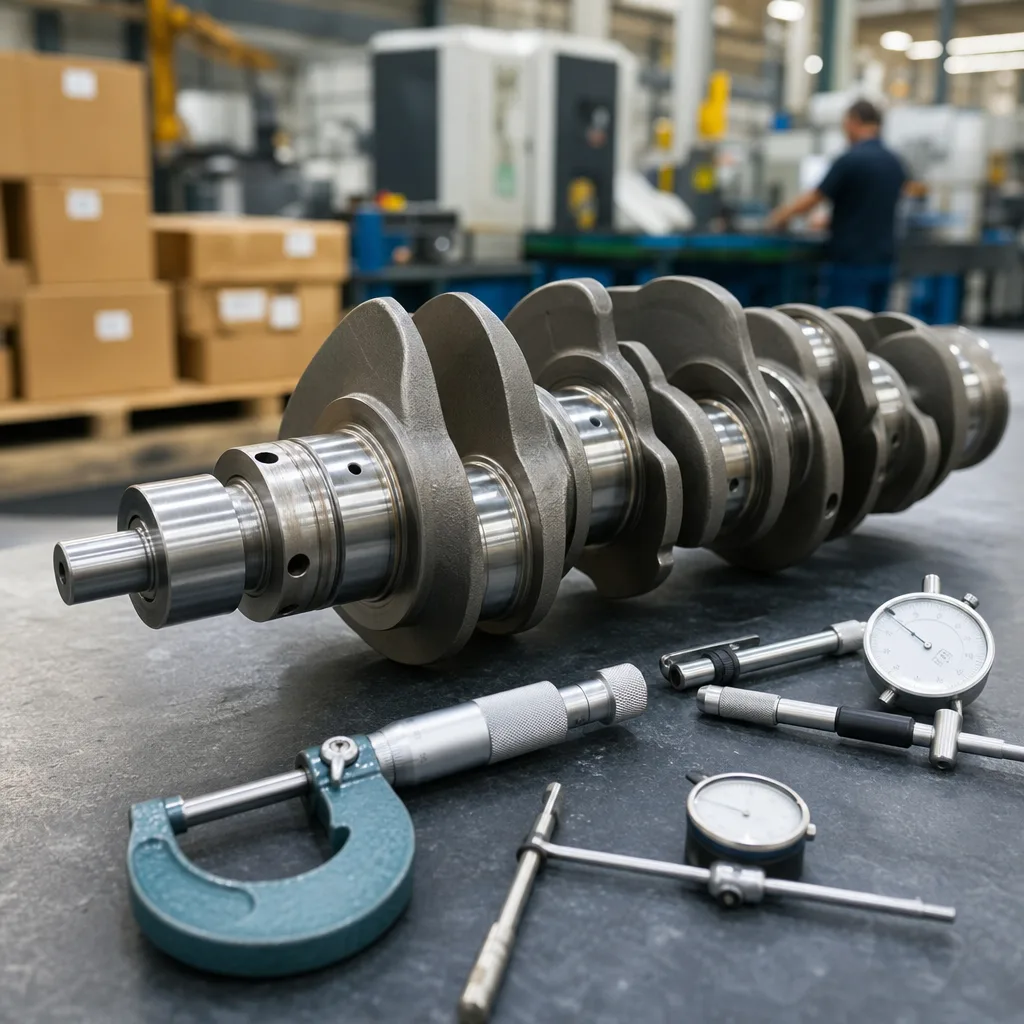
- Main and rod journal diameters measured on the physical sample
- Stroke, counterweight envelope, and overall length
- Thrust face position and oil passage drilling
- Nose, keyway, and seal land dimensions
- Balance spec and acceptable correction method
- Surface hardness and fillet treatment where specified
If a listing uses an OE cross-reference such as OE 06A107065, verify the full application data before you commit volume. That reference format is useful for sorting demand, but it is not a substitute for dimensional confirmation. For branded Mini fitments, compare the engine family, transmission pairing, and emission variant, then lock the drawing revision in the PO.
Wholesale Supply Models Compared
Not every buying program should use the same supply route. Stock items suit fast-moving demand, while non-standard builds need a different approval path. A clean sourcing plan usually combines catalogue replenishment with project-based custom work.
| Supply model | Best for | MOQ and lead time | Buyer risk |
|---|---|---|---|
| Stock catalogue | Repeat demand and urgent replenishment | Lower MOQ, shortest lead time | Limited application coverage |
| OE cross-reference batch | Familiar applications with stable volume | Mid MOQ, moderate lead time | Fitment errors if reference data is incomplete |
| Custom build | Private label, revised dimensions, special treatments | Higher MOQ, longer lead time | Requires approved drawings and sample sign-off |