Crankshaft Lexus Supplier: Sourcing Guide for Buyers
Buying from a crankshaft Lexus supplier is a sourcing decision built on dimensional control, metallurgical consistency, and export reliability. If those three are weak, the part may look correct on paper and still fail inspection, delay installation, or return under warranty. Driventus is an independent aftermarket manufacturer; brand names are referenced for fitment only. We build crankshafts for B2B buyers who need stable supply for distributors, repair networks, and OEM or Tier-1 programs. That requires documented material control, balancing, traceability, and packaging that can survive long-haul freight. If you are comparing vendors, begin with the engine family, bearing journal sizes, required hardness, and the quality documents you expect in every shipment. The sections below explain what to verify, how to compare quotations, and where supplier qualification has the biggest effect on total landed cost.
What to specify before you ask for quotes
A precise RFQ reduces price variation and shortens the quotation cycle. For crankshafts, the minimum specification pack should include the engine family, displacement, number of cylinders, journal dimensions, stroke, flange pattern, oil hole layout, fillet radius, and any balancing target. If you are replacing an existing unit, send a measured sample or a dimensional drawing instead of relying on a vehicle model alone.
For buyers comparing vendors, the first control points are usually:
- Main journal and rod journal diameters
- Overall length and thrust face position
- Runout and concentricity limits
- Surface hardness and case depth, if applicable
- Dynamic balance requirement
- Packaging and corrosion protection
- Required inspection report format
For catalogue screening, start with our catalog and then move into a drawing-based review. If you need a new variant or a private-label programme, custom manufacturing is the correct route. For production planning, ask for the expected MOQ, pallet configuration, and test sample policy before you approve the first order.
Quality controls that matter in crankshaft sourcing
A credible supplier should be able to show how each critical characteristic is controlled, measured, and recorded. For export buyers, the practical question is not whether the plant has a certificate on the wall, but whether the process data is stable enough to support repeat shipments. Driventus works to IATF 16949:2016 and ISO 9001:2015, with controls built around traceability, dimensional inspection, and controlled release.
| Control point | Typical verification | Why it matters |
|---|---|---|
| Material certification | Heat/lot traceability and mill records | Confirms the base material behind the shaft |
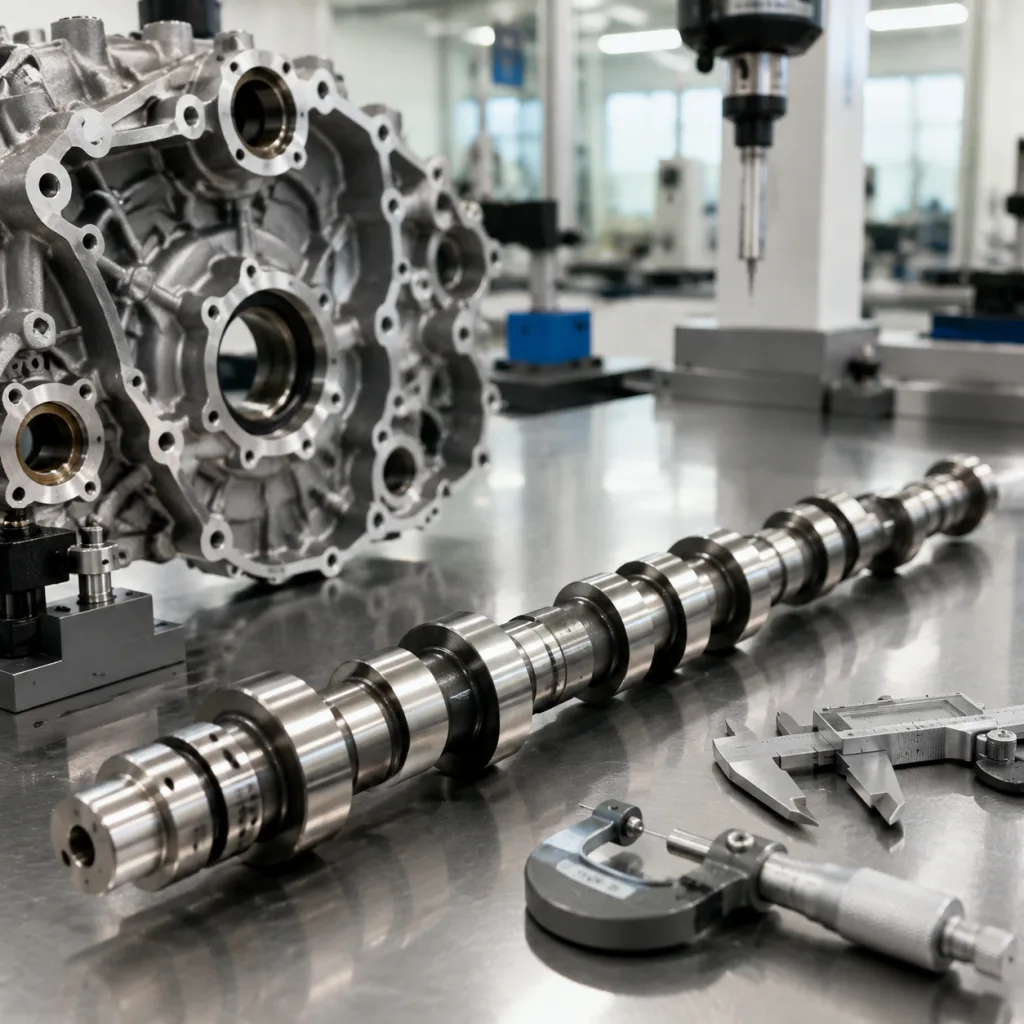
| Journal geometry | Micrometers, air gauges, CMM checks | Protects bearing fit and oil film stability |
| Runout and straightness | Dial indicator or dedicated fixture | Reduces vibration and premature wear |
| Hardness | Rockwell or equivalent method | Supports wear resistance at journals and fillets |
| Balance | Dynamic balancing report | Lowers NVH and field complaints |
| Surface condition | Visual inspection and roughness checks | Helps with bearing life and oil retention |