Crankshaft Bearing Wear Rod Bearing: Diagnosis and Replacement
Crankshaft bearing wear and rod bearing distress usually start as a thin oil-film problem and end as a teardown. For buyers and service teams, the real question is not whether the shell looks worn. It is why it wore. That answer shapes sourcing, inspection, and the replacement spec you should request. Rod bearings are not interchangeable by appearance alone; shell thickness, crush, overlay, oil-hole geometry, and coating all matter. Driventus is an independent aftermarket manufacturer, and brand names are referenced for fitment only. Before you approve a replacement, verify the OE cross-reference, dimensional match, and application duty cycle. For product families, see [our catalog](/products.html), our [quality system](/quality.html), and [custom manufacturing](/oem-services.html).
Failure pattern: what the bearing tells you
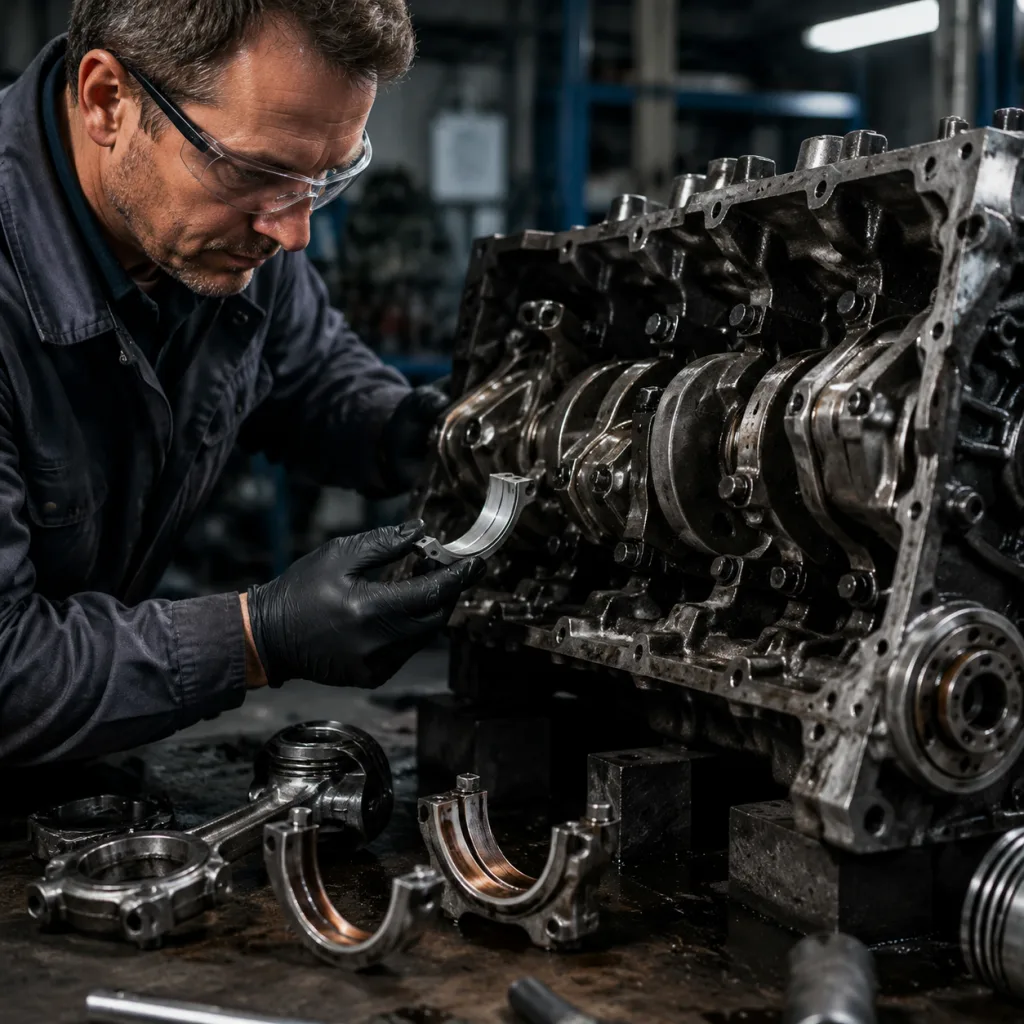
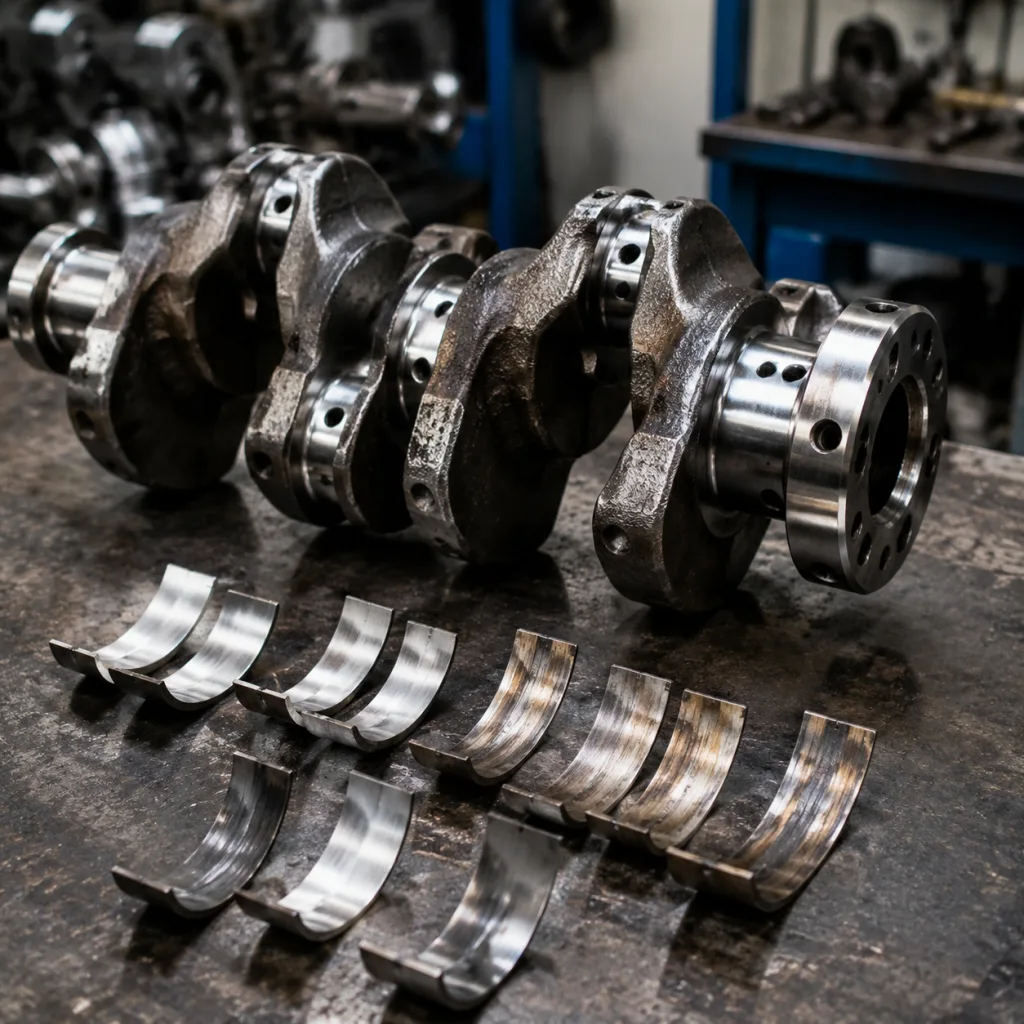
Bearing wear usually follows a recognizable path: polished overlay, wipe-through, copper exposure, scoring, and then heat discoloration or seizure. The pattern matters more than the headline symptom.
Even polishing on both crank journals often points to boundary lubrication, oil-film collapse at low rpm, or simply long service life. A single heavily worn shell with the opposite shell still intact suggests oil supply issues, misalignment, or journal geometry instead.
Common visual findings:
Polished surface: early overlay loss, often from marginal film thickness
Copper showing through: advanced wear, clearance growth, or contamination
Circumferential scoring: abrasive particles in the oil or filter bypass
Blue or dark discoloration: overheating from loss of hydrodynamic film
Edge wear: rod angularity, bore distortion, or cap misalignment
Use measurements with the visual pattern. Warning signs include oil pressure below the engine maker’s hot-idle minimum, crankpin out-of-round above 0.01 mm on precision checks, or clearance growth beyond the upper service limit in the application spec. Visual inspection alone is not enough.
Cause check: where repeat failures usually start
If a rod bearing fails from contamination or low pressure, a direct replacement often fails again unless the source condition is fixed. That is why procurement and maintenance teams need a cause-first view, not just a part number.
Main bore alignment, rod big-end roundness, cap torque, rod side clearance
Overload or detonation
Heat tint, smeared overlay
Combustion condition, rod straightness, crank runout, bearing crush integrity
</tr></thead><tbody> </tbody></table>For fitment decisions, reference OE part numbers only where the application already uses them, for example `OE 06A107065` in the buyer’s source list. If no OE number is available, require full dimensional verification instead of visual matching.
Step-by-step: inspect before you replace
Use one inspection sequence every time so the failure report stays repeatable across suppliers and rebuilders. The goal is to separate journal damage, housing distortion, and system contamination before a purchase order is released.
1. Drain the oil and inspect it for metallic debris; note particle size, color, and magnetic response. 2. Remove the oil filter and cut it open; look for copper-colored flakes and glitter. 3. Measure crankpin diameter, taper, and out-of-round at 0° and 90° positions with a micrometer. 4. Measure rod big-end bore and cap torque condition; record whether the bore stays round after torque. 5. Check bearing shell thickness, crush, and tang engagement; compare left and right halves. 6. Confirm oil clearance with calibrated tools; if used, plastigage should match the final micrometer reading within the normal tolerance band. 7. Inspect the oil pump, galleries, and relief valve; confirm pressure at cranking, hot idle, and rated speed.
Typical service targets are clearance in the engine designer’s published range, rod side clearance usually around 0.10-0.35 mm depending on engine family, and journal surface finish in the low Ra range required by the shell supplier. If the journal is still within spec but the shell is wiped, match the original bearing geometry and coating. If the crank is out of spec, a new shell alone will not solve the fault.
Procurement spec: what to lock down before ordering
For rod bearings, the purchasing spec should go beyond a part label. Ask for the engineering data that proves interchangeability, and define acceptance limits before samples are approved.
Material system: steel-backed bi-metal or tri-metal construction, with the required overlay system stated on the drawing
Overlay type: lead-free or lead-based, depending on application and regional requirements; specify minimum overlay thickness if relevant
Wall thickness: matched to OE and service-size selection, with nominal thickness and tolerance declared, for example ±0.005 mm where the design supports it
Oil groove design: full-groove, half-groove, or plain shell as required, including groove depth and feed-hole alignment
Clearance range: stated for nominal bore and crankpin size, with minimum/maximum installed clearance and preferred target value
Surface finish: controlled for break-in and oil retention, typically with a low roughness target and no local high spots
Coating: optional anti-scuff layer for start-stop or high-load duty; require coating thickness and adhesion test method
Traceability: batch code, inspection records, dimensional report, and production lot identification
A practical commercial request should also define MOQ, sample lead time, and price breakpoints. Buyers often ask for a pilot MOQ of 200-500 sets, a production MOQ of 1,000-3,000 sets depending on tooling and packaging, sample lead time of 10-20 days, and mass-production lead time of 30-45 days after approval. Driventus manufactures under IATF 16949:2016 and ISO 9001:2015 controls. For regional compliance, material declarations may align with REACH (EC) No 1907/2006 where applicable.
Validation deep-dive: which standards actually matter
A credible replacement part needs repeatable test methods, not just a dimensional claim. For engine applications, buyers usually want durability, corrosion data, and process-control documentation.
Relevant references include:
IATF 16949:2016 for automotive quality management
ISO 9001:2015 for documented quality systems
REACH (EC) No 1907/2006 for restricted substance compliance in the EU
SAE J2527 when evaluating coating or surface durability under accelerated exposure methods, where applicable to the material system
For approval, request a first-article package with hardness readings, shell-thickness measurements, bore-size verification, coating thickness if used, and lot traceability. A common buyer acceptance approach is 100% dimensional check on critical features for the pilot lot, AQL sampling for steady-state shipments, and a written corrective-action loop for any out-of-tolerance measurement. If you need a non-standard size or special coating, use custom manufacturing early in the sourcing cycle.
Sourcing scenario: how Driventus supports buyers
Driventus supplies rod bearing programmes for aftermarket distributors, OEM and Tier-1 channels, and multi-location repair chains. The practical value is consistent dimensions, controlled metallurgy, and export-ready documentation.
When reviewing a programme, our team can support:
OE cross-reference review and application mapping
Dimensional validation against customer samples
Packaging, labelling, and batch traceability requirements
For commercial planning, buyers typically compare landed unit price against annual consumption, packaging format, and warranty exposure. A small-volume programme may justify a higher per-set price if the supplier holds safety stock and ships in 7-14 days. Higher-volume contracts can justify lower unit pricing once monthly call-off quantities are stable. We work as an independent aftermarket manufacturer. Brand names are used only to identify fitment, not endorsement. For commercial enquiries, request a quote with the application, OE reference, target annual volume, preferred packaging, and any required lead-time ceiling.
Frequently asked questions
Only if the crankpin is still within size, roundness, and surface-finish limits. If the journal is scored, tapered, or heat damaged, the crankshaft must be repaired or replaced first. Confirm crankpin diameter, taper, and out-of-round before authorizing the bearing order.
The usual causes are incorrect oil clearance, poor housing-bore alignment, contamination left in the oil system, or an unresolved lubrication fault. Fitment alone will not cure those issues. Buyers should also verify oil pressure, filter bypass history, and whether the replacement shells match the correct standard or undersize journal.
Ask for dimensional reports, material specification, traceability, packaging details, MOQ, unit pricing at volume tiers, sample and production lead times, and proof of quality controls under IATF 16949:2016 or ISO 9001:2015. Match the OE reference and application data before approval.
If you are qualifying a new rod bearing source or need a fitment review, send your OE reference, target market, annual volume, desired MOQ, and lead-time target through /contact.html.