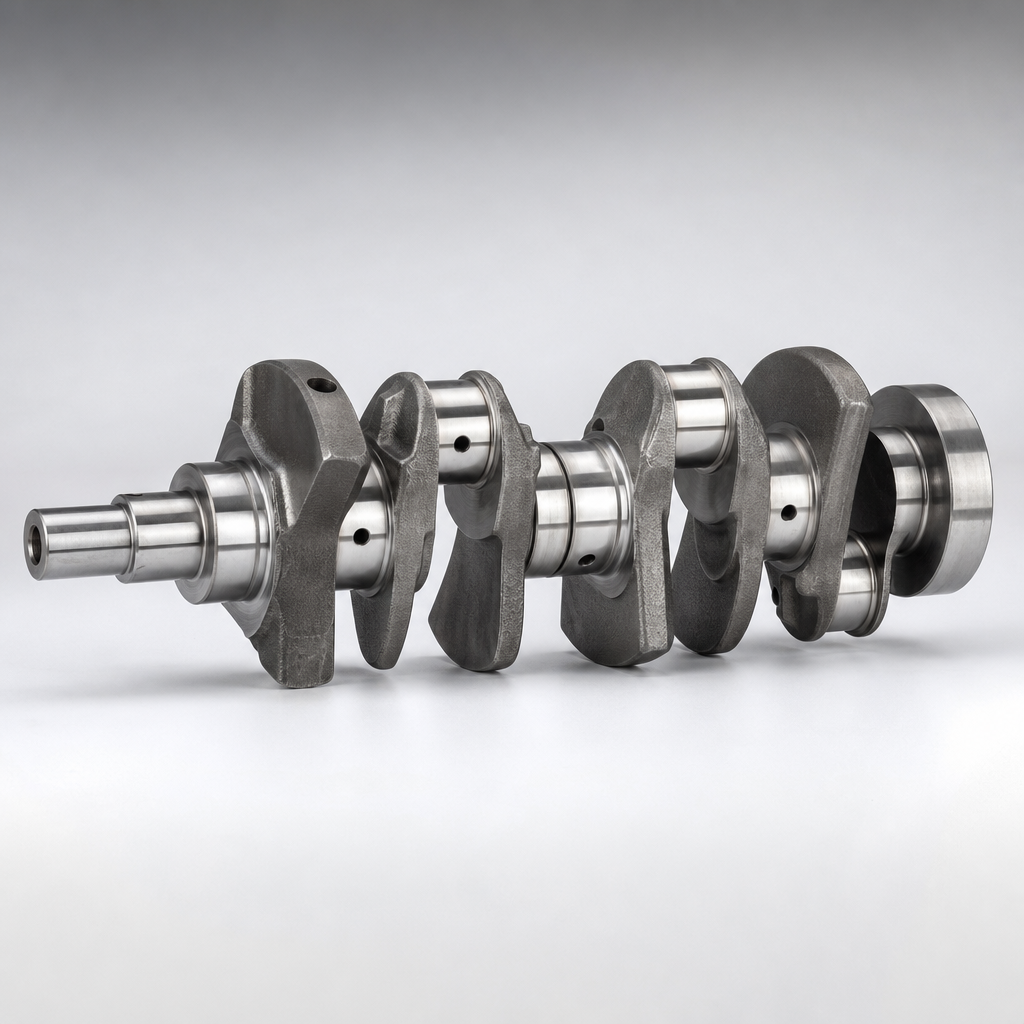
Choosing a **connecting rod Skoda OEM supplier** is rarely a price exercise alone. The real question is whether the source can hold geometry, metallurgy, traceability, and delivery discipline at the same time, across repeated batches rather than one good sample lot.
For aftermarket distributors, OE-focused buyers, Tier-1 sourcing teams, and repair networks, the exposure is practical: warranty claims, fitment drift, delayed replenishment, and documentation gaps that slow approvals. A useful review therefore starts with the part’s failure risks, then moves into process capability, validation evidence, MOQ logic, lead time structure, and audit readiness. In live RFQs, buyers should ask for measured tolerances, inspection frequency, pilot-lot terms, and the assumptions behind quoted pricing. This guide covers the checkpoints commonly used to assess a potential supplier for Skoda-fit connecting rods. Driventus is an independent aftermarket manufacturer; any brand names mentioned are for fitment reference only.
Start with the failure modes, not the catalog claim
The first screen for a connecting rod Skoda OEM supplier should be simple: what can go wrong, and what process control prevents it? That framing is more useful than broad statements about OEM quality.
Typical sourcing risks include bore instability, centre-distance variation, twist or bend outside limit, inconsistent bush sizing, bolt-control problems, and weak lot traceability. Each one creates a different commercial problem. Some lead to assembly issues immediately. Others become field failures later.
Key points to verify:
Manufacturing route: forged steel grade, heat-treatment method, and whether the design uses fracture-split or conventional cap construction where applicable
Dimensional capability: centre-to-centre length, big-end bore, small-end bush ID, bore roundness, plus defined twist and bend limits
Fastener control: bolt material grade, torque or stretch specification, and lot-level traceability
Batch records: heat number traceability from raw material through finished part
Inspection coverage: 100% visual inspection supported by in-process gauging on critical dimensions
Document package: material certificates, inspection reports, packaging specifications, and origin documents
For buyers managing wider engine-component portfolios, it also helps to review our catalog and the dedicated /products/engine-components.html section to confirm range depth across rods, pistons, rings, bearings, and gasket sets.
A capable supplier should also explain how part families are grouped by forging source, machining cell, and final inspection plan. Similar-looking references often need separate validation and separate gauge control. That is where sourcing mistakes happen.
In the first call or questionnaire, ask for actual numbers. Common checkpoints include centre-to-centre length tolerance in the range of +/-0.02 to +/-0.05 mm, big-end bore tolerance often around 0.008 to 0.015 mm depending on design and finish-hone process, small-end bush ID control commonly around 0.005 to 0.012 mm, and piece-to-piece weight matching such as +/-2 g to +/-5 g for standard aftermarket supply or tighter for matched engine-set programmes. Twist and bend are often controlled within 0.05 to 0.10 mm per 100 mm or equivalent angular limits, but the buyer should require the exact internal standard or drawing note.
The process sequence matters as much as the dimension itself. A serious supplier should be able to state whether bores are rough-machined after forging, stress relieved, semi-finished, then finish-honed after cap assembly and bolt tightening; whether bush pressing is done before or after final small-end machining; and whether crack detection is magnetic particle inspection on sampled forgings or 100% control after critical machining. Without that detail, tolerance claims are hard to trust.
Spec deep-dive: the technical data that separates real suppliers from traders
A reliable connecting rod Skoda OEM supplier should be able to discuss engineering data with precision. If the conversation stays at the level of fitment references and price per piece, the buyer still does not know whether the source can control the part.
Typical evaluation checklist
Checkpoint
What buyers ask for
Why it matters
Base material
Steel grade and heat-treatment record
Affects fatigue life and resistance to deformation
Centre distance
Nominal dimension with tolerance report
Controls compression height relationship
Big-end bore
Bore size, roundness, and cylindricity data
Influences bearing crush and oil clearance
Small-end bore/bush
ID tolerance and surface finish
Affects pin fit and wear rate
Weight control
Piece weight and matched-set tolerance
Reduces balance variation across engine sets
Twist and bend
CMM or fixture inspection results
Prevents side loading and abnormal wear
Surface condition
Crack-detection method and burr-control process
Reduces assembly risk and durability issues
</tr></thead><tbody> </tbody></table>Where a buyer requests OE cross-reference handling, the supplier should map internal numbers carefully and only against customer-provided data or approved technical records. If a sourcing brief includes a reference such as OE 06A107065, that cross-reference should be controlled in the ERP system, inspection records, and packing documents to reduce the chance of mixed variants.
Published standards and management systems are relevant, but they should be kept in scope. A connecting rod is not certified to unrelated passenger-car regulations such as ECE R-83. The factory, however, should operate within audited frameworks such as IATF 16949:2016 and ISO 9001:2015. For coatings, oils, rust preventives, and packaging materials, buyers often request conformity declarations aligned with REACH (EC) No 1907/2006.
For actionable comparison, ask for measured values on the quoted rod family. Typical data points include forged alloy steel such as C70S6, 42CrMo4, or an equivalent customer-specified grade; hardness windows such as HB 207-269 or process-specific HRC/HV targets after heat treatment; big-end bore roundness commonly held within 0.003 to 0.008 mm after finish honing; and small-end bush surface finish often in the Ra 0.4-0.8 um range for stable pin lubrication. Big-end side-face parallelism, bore cylindricity, and bolt seat flatness should also be stated, because they directly affect bearing seating and cap alignment.
Buyers should also ask how the supplier validates assembly condition. On many programmes, the rod and cap are torqued with production bolts to a defined torque-plus-angle or bolt-stretch target before final bore honing. A typical control approach is to verify bolt stretch or tightening torque on every setup change, inspect first-off parts, then monitor bore size every 30 to 100 pieces depending on machine capability. If the supplier reports final dimensions but cannot explain the clamped machining condition, the bore capability claim is incomplete.
For higher-risk projects, fatigue and metallurgical controls need equal clarity. That may include grain-flow review at the transition radius, microstructure checks after heat treatment, decarburisation limits at critical surfaces, and residual magnetic particle or ultrasonic inspection criteria where required. These details matter most when cost pressure pushes the source toward lower-cost forging routes or mixed upstream subcontracting.
Commercial reality check: MOQ, lead time, and what the quote actually means
A supplier can machine good rods and still fail commercially. That is why evaluating a connecting rod Skoda OEM supplier should include order economics, launch timing, packaging discipline, and audit support, not just drawing compliance.
Commercial and operational points to check
MOQ by part number: many programmes work better with a starting MOQ based on forging family rather than a low-volume mixed-SKU model
Lead time: planning should distinguish among tooling lead time, first-article timing, and repeat-order production timing
Safety stock policy: confirm whether the supplier can hold agreed finished-goods or semi-finished inventory
Packaging method: VCI protection, partition design, carton drop resistance, pallet standard, and barcode labelling
Audit support: process flow chart, PFMEA, control plan, gauge list, and calibration records available for review
Change management: documented notification process for raw material, tooling, process, or sub-supplier changes
A practical supplier discussion should include these baseline questions:
1. What is the standard MOQ per rod reference or forging family? 2. What is the normal repeat lead time after order confirmation? 3. Can the factory support pilot lots and dimensional approval before full release? 4. Is PPAP support available when requested by OEM or Tier-1 customers? 5. How are non-conforming lots identified, segregated, and traced?
If private-label or customer-specific packaging is required, buyers should also review the supplier’s custom manufacturing capability, especially for barcode logic, carton artwork control, and confidential drawing management.
In practice, MOQ follows forging and machining economics more than buyer preference. For an already-tooled reference, a pilot lot may start around 100 to 300 pcs for dimensional approval, while normal serial MOQ is often 500 to 1,000 pcs per part number or 1,000 to 3,000 pcs per shared forging family. When new forging dies or dedicated fixtures are required, suppliers may push MOQ higher to amortise tooling and first-article cost. Buyers should ask whether MOQ is based on one shipment, one heat-treatment batch, or one monthly production run. Those are different assumptions, and they change the quote.
Price logic also needs to be unpacked. A competitive quotation usually separates tooling cost, sample cost, and serial unit price. Unit price typically moves with four variables: annual volume, machining complexity, bolt inclusion, and packaging specification. A bulk-packed programme with standard VCI protection and annual demand above 10,000 pcs will price differently from a branded aftermarket set with individual boxes, colour labels, matched-weight sorting, and annual volume below 3,000 pcs. Buyers should request price breaks at at least three volume bands, such as 500 pcs, 2,000 pcs, and 10,000 pcs, to see the real cost curve.
Lead time should also be broken into stages. For an existing part with no new tooling, sample dispatch may be possible within 2 to 4 weeks, while repeat production often runs 30 to 45 days ex works after deposit or order confirmation. A new die set, new gauges, or PPAP submission can extend launch timing to 45 to 90 days depending on forging queue and validation scope. If sea freight is planned, transport and customs time should be stated separately instead of being folded into factory lead time.
Audit readiness is easy to test. Ask for current process flow, PFMEA revision, control plan, gauge calibration list, GR&R evidence for bore gauges, and an example of non-conformance segregation records. If those documents exist only as sales summaries rather than plant-level records, the audit claim is weak.
Validation workflow: which records matter before you approve the source
When sourcing engine hard parts, generic quality statements are not enough. A dependable connecting rod Skoda OEM supplier should maintain a structured quality system and be ready to show lot-linked evidence.
Mass consistency report for sampled production lots
Crack-detection or NDT record where applicable
Gauge calibration status
Corrective action format for non-conformance claims
Depending on the project class, validation may include:
Metallographic review of grain flow and heat-treatment condition
Big-end housing stability checks after bolt tightening
Bush press-fit verification and pin-fit assessment
Fatigue testing based on customer protocol
Salt-spray or corrosion-related checks for protected surfaces or packaging interfaces where specified
Some buyers also request examples of process discipline from adjacent automotive categories. For instance, friction materials or braking parts may use standards such as SAE J2527, but that standard does not apply directly to connecting rods. The takeaway is straightforward: component-specific validation should stay separate from broad automotive quality claims.
For buyer actionability, the document set should be tied to lot structure and inspection frequency. A useful submission package normally includes the raw material mill cert, forging lot record, heat-treatment batch record, final machining inspection sheet, and packing list with lot code linkage. On critical dimensions, buyers should ask whether the supplier reports first-off, in-process, and final-release data separately. A generic final inspection report gives limited insight into drift control.
PPAP expectations also need to be defined early. For OE-adjacent business, buyers commonly request some or all of the following: dimensional report on a fixed sample size such as 5 pcs or 10 pcs, material and hardness evidence, ballooned drawing, process flow, PFMEA, control plan, MSA or gauge R&R for critical bore gauges, initial process capability where available, and signed PSW if the programme formally requires it. Even on aftermarket projects, this PPAP-style structure makes source approval more disciplined.
Validation should include real assembly-condition checks, not just standalone dimensions. On a connecting rod, that often means verifying big-end housing size after bolt tightening, confirming bush interference fit before and after finish machining, checking pin fit under the specified clearance window, and reviewing parting-face condition or fracture-split mating quality where relevant. Buyers should also ask whether weight is controlled as total part mass only or also by end balance, because some engine builders require separate small-end and big-end weight windows.
For claims handling, the supplier should be able to trace from carton label to pallet, pallet to finished lot, finished lot to machining batch, and machining batch to material heat. In practice, a response target such as 24 to 48 hours for initial containment and 5 to 10 working days for structured 8D feedback is a reasonable commercial expectation and should be written into the quality agreement.
Side-by-side comparison: how to score suppliers without overvaluing unit price
The cleanest way to compare sources is to force the discussion into a scorecard. When evaluating a trading company, a machining subcontractor, and a vertically integrated plant, the best connecting rod Skoda OEM supplier is usually the one with the clearest process visibility and accountability, not the cheapest opening number.
Supplier factor
Trading company
Machine subcontractor
Integrated manufacturer
Process visibility
Limited
Medium
High
Raw material traceability
Often indirect
Depends on upstream forge
Usually direct or tightly controlled
Dimensional feedback speed
Slower
Moderate
Faster
Engineering change control
Variable
Moderate
Stronger when internalised
MOQ flexibility
Sometimes flexible
Moderate
Depends on line loading
Audit readiness
Document-based
Process-specific
Broad, factory-level
Warranty containment
Indirect
Partial
Usually clearer accountability
</tr></thead><tbody> </tbody></table>For many importers and programme buyers, the preferred model is the source that can manage forging oversight, machining control, inspection discipline, and export documentation within one accountable system. That usually reduces communication delay, shortens corrective-action loops, and improves lot-to-lot consistency.
Driventus exports engine and powertrain components to more than 60 countries and operates within IATF 16949:2016 and ISO 9001:2015 frameworks. For buyers evaluating supplier options for Skoda-fit connecting rods and related engine components, the sourcing objective remains the same: stable dimensions, consistent metallurgy, documented traceability, and predictable supply.
When those requirements are defined clearly at RFQ stage, supplier comparison becomes much more objective.
To make that comparison usable, buyers should score each source against weighted criteria instead of relying on headline unit price. A practical matrix might assign 25% to technical capability, 20% to quality documentation and traceability, 20% to commercial terms, 15% to delivery performance, 10% to audit transparency, and 10% to engineering response speed. This exposes when a low quote is offset by high MOQ, weak process visibility, or long launch timing.
Commercial quotes should also be normalised before review. The landed comparison should state whether the unit price includes bolts, bush, matched-set sorting, rust preventive, inner box, outer carton, pallet, and barcode label. It should also identify sample charges, tooling amortisation, and payment terms such as 30% deposit / 70% before shipment or open-account terms for repeat business. Without this normalisation, suppliers are not being compared on the same basis.
A useful supplier review meeting should end with a short list of measurable commitments: approved drawing revision, agreed critical characteristics, pilot quantity, sample submission date, serial MOQ, repeat lead time, stock policy, claim-response timing, and change-notification period. That is the point where sourcing moves from discussion to control.
Frequently asked questions
MOQ depends on forging family, machining setup time, packaging format, and whether the order is for pilot approval or serial supply. Many suppliers quote by part number or shared blank family, so buyers should ask separately for pilot-lot MOQ and repeat-order MOQ. In practice, pilot lots may start around 100-300 pcs, while repeat MOQ is often 500-1,000 pcs per reference or higher if a dedicated forging run is required.
At minimum, buyers usually request a packing list, traceable batch identification, dimensional inspection data on critical characteristics, and material certification. OE-oriented projects may also require PPAP-related documents, heat-treatment verification, and change-control records. The most useful lot package links carton or pallet labels back to the machining batch, heat-treatment batch, and raw material heat number.
Use controlled cross-reference data, confirm drawing revision status, and require approval samples before volume release. It also helps to separate visually similar rods by exact machining variant, bolt specification, bush dimensions, and packing label logic. Buyers should also lock the inspection plan for centre distance, big-end bore, small-end bore, twist, bend, and weight so that variant mix-ups are easier to detect before shipment.
If you are qualifying a connecting rod Skoda OEM supplier for Skoda-fit connecting rods, we can review drawings, target MOQ, and documentation requirements with your team. Use our contact page to request a quote: /contact.html