If you are sourcing connecting rod Ram wholesale parts, the first decision is not price. It is whether the part is actually the right fit for the engine family, and whether the supplier can prove consistent metallurgy, machining, and packaging across repeat orders. For aftermarket distributors, OEM and Tier-1 buyers, and multi-location repair groups, the common failure points are dimensional drift, inconsistent heat treatment, and export packing that does not survive transit. Driventus is an independent aftermarket manufacturer; brand names are referenced for fitment only. A sensible sourcing review starts with OE cross-reference, then checks drawing control, material verification, inspection records, and packaging validation. Buyers should also confirm IATF 16949:2016 and ISO 9001:2015 certification, export packing, and trial-order support before volume release. The sections below are structured as a decision framework, a spec check, and a supplier audit path so you can move from fitment risk to a controlled wholesale order.
Start with the fitment decision, not the quote
When evaluating connecting rod Ram wholesale supply, begin with the application and OE number. A low unit price is useless if the rod misses on bore, center distance, beam section, or bolt spec. Before discussing commercial terms, confirm center distance, big-end width, small-end diameter, rod weight, and any required weight matching across a set.
Minimum fitment checks
OE cross-reference and engine code
Big-end and small-end bore sizes
Center distance and beam section
Bolt specification and torque requirement
Weight spread per set
Surface finish and crack-test method
If the supplier cannot show drawing control and traceability, the offer is not ready for volume. Ask whether the rod is forged steel, powdered metal, or machined bar stock, and require the matching chemistry or mill certificate. For mixed fleets and resale channels, lot coding on every carton matters because it keeps returns, warranty claims, and reorder decisions tied to the same batch. If the application uses fracture-split caps, confirm that explicitly; if bolts are supplied separately, clarify that before the order is released.
Where wholesale deals usually break down
Most wholesale mistakes happen in the commercial terms, not the part itself. MOQ, lead time, sample policy, and packing format should all be written down before the first order. In connecting rod Ram wholesale programs, pricing is usually driven by material route, machining complexity, finishing steps, and export packaging rather than by weight alone.
Item
Typical wholesale expectation
What to confirm
MOQ
100-500 pcs per reference
Can it be split across variants?
Sample lead time
7-15 days
Are samples from production tooling?
Mass production lead time
30-45 days
Does it change by forging route?
Inspection
100% visual, AQL or full dimensional
Which measurements are recorded?
Packaging
Neutral cartons, barcode labels
Is export packaging tested?
Payment logic
Deposit plus balance or agreed terms
Is pricing tiered by annual volume?
</tr></thead><tbody> </tbody></table>If you need export-ready replenishment, ask for rolling forecast support and safety-stock options. Quote comparisons should be read carefully: EXW, FOB, and CIF are not interchangeable, and cartons, pallets, and fumigation may sit outside the headline price. For buyers in the EU, UK, US, Canada, Australia, and Brazil, the commercial file should also note any relevant REACH declarations for associated materials and packing. A practical quote should show price breaks at 100, 500, and 1,000 pcs, clarify whether tooling amortization is included, and state whether lead time changes for repeat orders.
Spec sheet: what the rod must prove
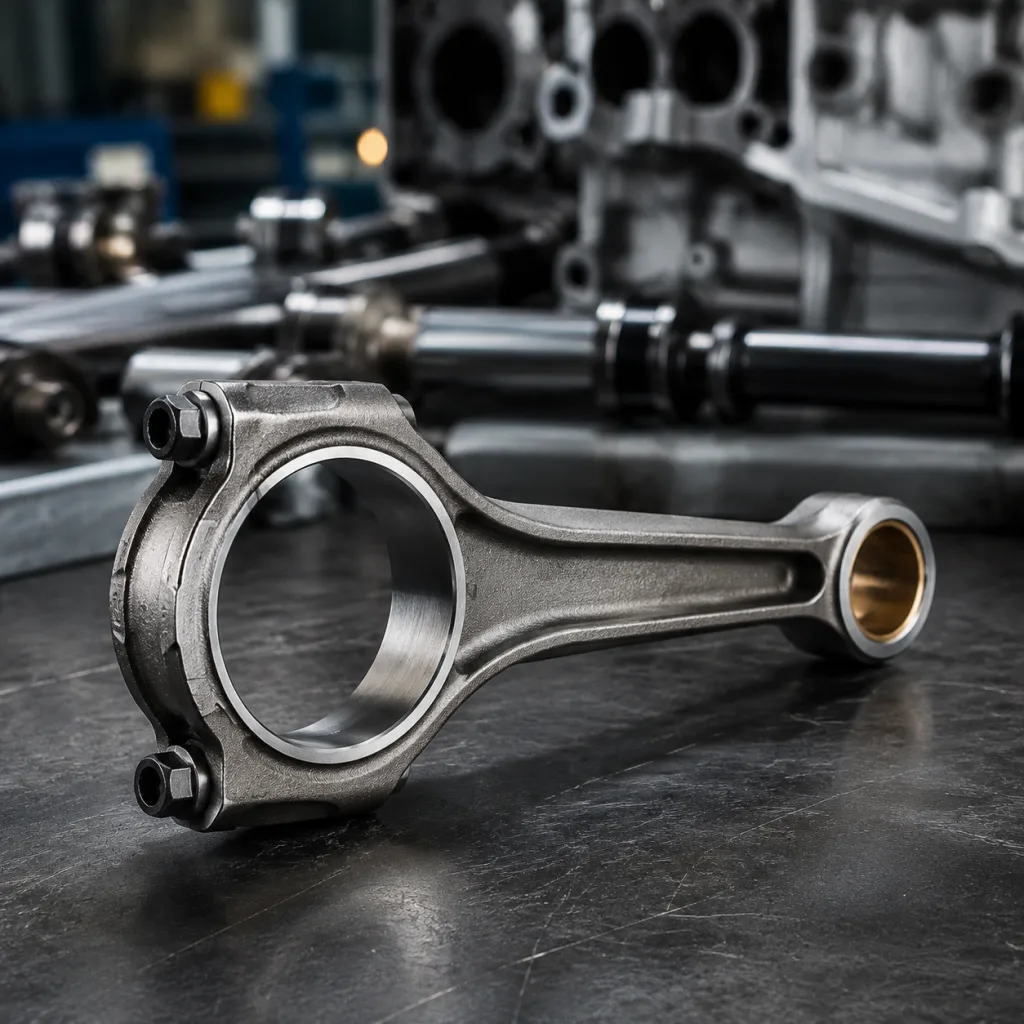
A connecting rod is a load-bearing component, so the process route matters as much as the finished dimension. Common routes include powder metallurgy, forging, and machined steel bar, depending on engine family and cost target. The technical file should show the rod material grade, the heat-treatment target hardness, and the machining sequence that produces the final bores and beam finish.
Typical technical points to confirm
Forged or sintered base material, with chemistry report
Shot-peened beam surface where specified
Big-end and small-end bores honed to drawing size
Bolt torque and stretch requirement documented
Weight matching for set balance when required
Hardness and metallographic checks on each heat lot
The key question is not whether the part looks correct. It is whether the supplier can hold tolerance across production runs and prove it with measurement records. A workable control plan should specify critical dimensions, measuring instruments, inspection frequency, and rejection thresholds. Ask for big-end bore roundness, center-to-center length variation, cap-to-rod matching, and bolt preload records, with actual measured values attached to the inspection report. For approval, first-article data and capability evidence are stronger than brochure claims. Also request hardness bands by heat lot and verify that any shot-peening or surface treatment is documented with process parameters rather than a generic statement.
How to match Ram applications without misfit risk
Fitment should be managed by engine family and OE reference, not by a broad model name. Where searches point to Ram vehicles, cross-check the engine platform, year range, and OE number before release. A reliable process is to confirm the engine code, compare the drawing against the OE sample, and then validate the part in a trial build or teardown check before it goes into resale inventory.
Driventus can support OE-style replacement parts and programme-based supply for distributors and rebuilders. Driventus is an independent aftermarket manufacturer; brand names are referenced for fitment only.
If the requirement extends beyond one part number, use our custom manufacturing route for drawing-based production, packaging changes, or private-label supply. For catalogue browsing across related engine parts, see our catalog and the broader engine range in engine components. The cleanest interchange rule is simple: use OE number first, then engine family, then verify bearing width, rod length, pin bore, and bolt spec. That order reduces misfits and speeds up reorder decisions across multiple warehouses.
Supplier audit: the checks that matter before PO release
A factory audit should verify more than certificates on the wall. It should show how the plant controls incoming material, in-process inspection, calibration, and nonconforming stock. It also needs to show whether the factory can trace a finished carton back to a heat number without improvising the answer.
Audit points for wholesale buyers
Scope of IATF 16949:2016 and ISO 9001:2015 certificates
Calibration status of gauges and torque tools
Material traceability from heat number to finished lot
Final inspection records and storage conditions
Complaint handling and containment response time
Export documentation workflow and carton labelling
If a supplier passes audit but cannot explain measurement method or rework control, the sourcing risk remains high. Ask for photos or video of packing lines, especially for container loads and mixed-SKU shipments, to confirm the process matches the paperwork. Confirm how nonconforming parts are segregated, what triggers re-inspection after process adjustment, and whether quarantine stock is physically separated from released inventory. For wholesale programs, the audit should also confirm whether the factory can hold repeatability targets such as 0.03-0.05 mm bore control, set balancing by weight class, and carton labels that identify item number, lot number, and quantity per box.
When Driventus fits the program
Driventus manufactures engine and powertrain components in Taizhou, Zhejiang, with export experience in 60+ countries. For connecting rod programs, the supply model can include OE cross-reference review, sample approval, batch production, neutral packing, and shipment documents aligned to your market. The commercial workflow is built for buyers who need repeatable supply, not a one-time spot purchase.
Commercial support options
Trial order for validation testing
Drawing review for dimensional match
Packaging and barcode customisation
Private-label and carton artwork support
Consolidated export for multi-SKU orders
If you are building a long-term replenishment programme, use our quality system to review certification, inspection flow, and traceability controls. When you are ready to compare pricing, lead time, and sample availability, request a quote. For most wholesale buyers, the fastest approval path is to send the OE reference, annual volume target, packing requirement, and destination market together so the quote reflects the real purchasing model instead of a generic list price.
Bottom line for procurement teams
Connecting rod Ram wholesale sourcing works best when commercial terms and technical controls are aligned from the start. The suppliers worth shortlisting can explain the material route, hold drawing tolerances, document inspection, and ship in a way that suits distributor or workshop networks. That is the baseline for repeatable supply.
If you need a supplier that can support volume orders, OE cross-references, and export-ready packaging, start with a controlled sample order and move into a forecast-based programme only after validation. That approach reduces rework risk and makes the wholesale relationship easier to scale. For budget planning, use the first order to validate fit, then lock the repeat-order price once the test report, packaging sample, and lead-time commitment all match the buying spec. If those items are not documented, the quote should not be treated as final.
Frequently asked questions
Yes. Share the OE number, engine code, and target market. We review dimensional match, material route, and packaging before confirming availability.
At minimum, ask for IATF 16949:2016 and ISO 9001:2015 certificates, plus inspection records and batch traceability for the supplied lot.
Yes. Driventus can support carton artwork, barcode labelling, and programme-based packaging through our custom manufacturing process.
For pricing, sampling, and technical confirmation, contact the team and send your OE reference or drawing through /contact.html