connecting rod · 2026-06-05

Connecting Rod for Land Rover Discovery Aftermarket Replacement

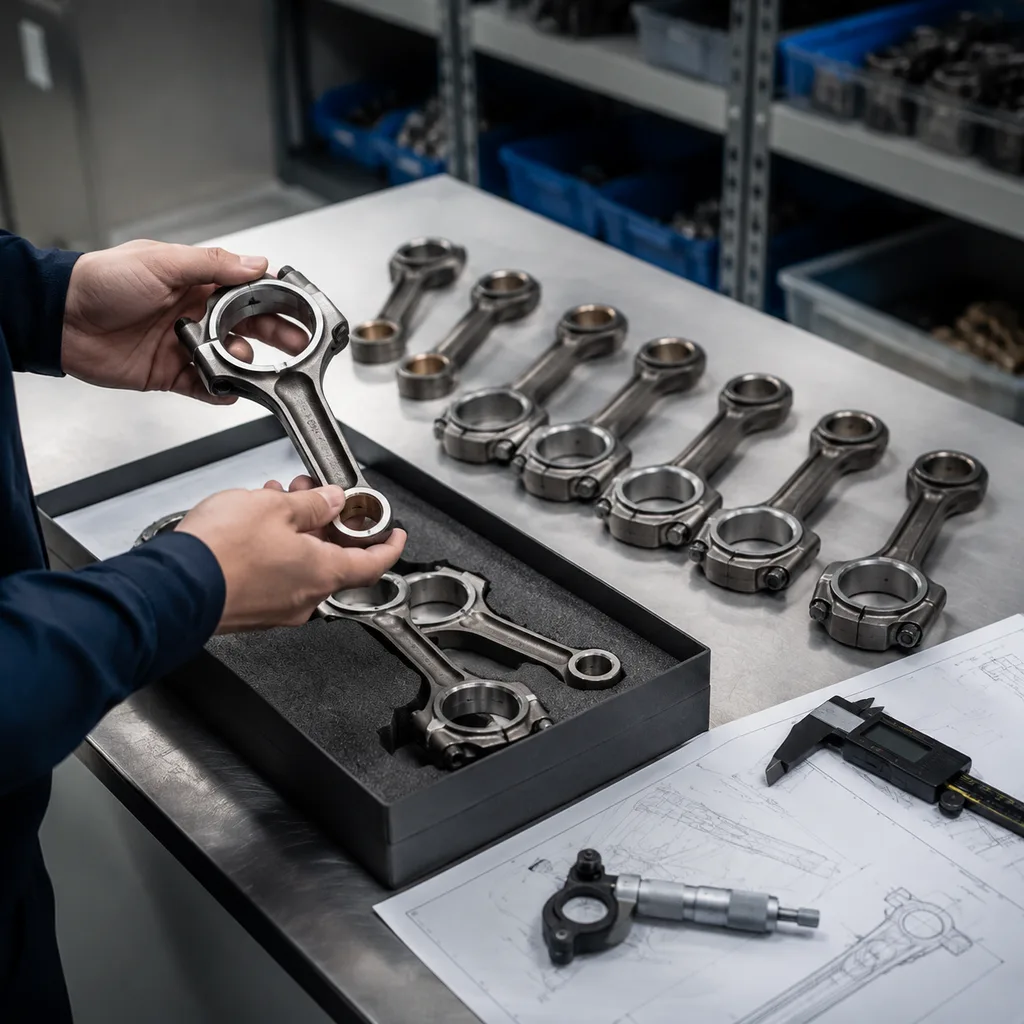
A connecting rod for Land Rover Discovery aftermarket replacement has to reproduce the original engine geometry, bearing interface, material performance, cap location, and bolt clamping behavior closely enough to support dependable rebuild work. For procurement teams, the question is not just whether a catalogue lists a Discovery model. Buyers need to confirm engine-code compatibility, controlled big-end and small-end dimensions, heat-treatment stability, the correct rod bolt specification, and repeatable weight matching across sets.

Driventus supplies connecting rods for engine rebuild, service, wholesale, and export distribution channels with a focus on OE-equivalent fitment, stable metallurgy, and inspection data that supports incoming verification. Driventus is an independent aftermarket manufacturer; Land Rover and Discovery brand names are referenced for fitment identification only.

For buyers working across the EU, UK, US, Canada, Australia, and Brazil, a robust sourcing process usually includes checking center-to-center length, big-end housing bore and width, small-end bore or bushing ID, piston pin fit, rod bolt grade and tightening procedure, bearing shell interface, side clearance, and rod weight range before release. It also means confirming that the supplier works under IATF 16949:2016 and ISO 9001:2015 quality management processes, with material certificates, dimensional reports, lot traceability, and packaging records available on request.

What buyers should verify before sourcing

For replacement programs, the part must be verified against the engine code and rebuild specification, not only the vehicle model. Land Rover Discovery vehicles have been fitted with multiple diesel and petrol engine families across generations, markets, and emissions standards. As a result, the same vehicle name can cover different connecting rod lengths, big-end housing widths, piston pin diameters, bolt patterns, cap-location designs, and bearing shell interfaces.

At minimum, procurement should confirm:

  • Engine code, displacement, fuel type, and production range
  • Center-to-center length measured from big-end bore center to small-end bore center
  • Big-end housing bore, big-end width, and crank journal compatibility
  • Bearing shell width, bearing tang position where applicable, and oil-hole alignment if used
  • Small-end bore or bushing ID, piston pin diameter, and required pin clearance
  • Rod bolt type, thread pitch, strength class, tightening method, and torque-angle requirement
  • Big-end side clearance requirement on the crankshaft
  • Rod weight range and matched-set weight spread, normally controlled separately for total weight and end-to-end balance on higher-spec programs
  • Surface finish at the bearing seats and small-end bore, with Ra values confirmed from the approved drawing where available
  • Whether the application uses cracked cap, machined cap, dowel-location, serrated split, or another cap-location method
  • Packaging, rust prevention, barcode, carton label, and lot-code requirements for warehouse and workshop issue

If the application uses an OE reference such as OE 06A107065, buyers should treat it as a fitment cross-reference only and still verify the live sample against the engine build sheet, teardown data, or approved drawing. OE references are useful for communication, but they do not replace dimensional confirmation.

This is especially important for workshop supply and rebuild kits, where a small deviation can change bearing clearance, oil film behavior, piston deck height, or noise control. In many light-duty diesel and petrol engines, finished bearing oil clearance is commonly controlled in the hundredths of a millimeter range, so a 0.01 mm housing-bore error can create assembly rework, low oil-pressure complaints, or premature bearing wear. For B2B buyers, the safest approach is to qualify the rod by engine family and measured specification, then lock that information into the purchasing record, warehouse label, and customer-facing fitment note.

Dimensional control and material specification

A replacement rod should be built to consistent geometry and stable mechanical properties. For engine rebuilds, the main concern is not only nominal size, but repeatability from batch to batch. A rod that matches the sample once but drifts in later production can create the same warranty exposure as an incorrect part number.

</tr></thead><tbody> </tbody></table>For diesel variants, fatigue resistance and cap alignment are critical because peak cylinder pressure and sustained low-speed torque are typically higher than in comparable naturally aspirated petrol applications. Rod body strength, bolt clamp load, thread quality, and big-end roundness after tightening must be evaluated together. A strong beam is not enough if the cap shifts, the bolt yields outside specification, or the bearing housing loses roundness during assembly.

Material certification and hardness results should be available for incoming inspection. Buyers should also request confirmation of forging route, heat treatment method, machining datum control, surface cleanliness, and any shot peening or surface treatment used to improve fatigue performance. Where a buyer needs a special application, Driventus can support custom manufacturing for dimensional changes, surface treatment, set matching, private-label packaging, or market-specific documentation.

Validation testing for aftermarket replacement parts

A credible aftermarket rod should not be treated as a generic forged or machined item. It should be validated with controlled tests that reflect engine duty and the way the part will be installed in rebuild environments. The objective is to prove that the rod can maintain geometry, clamp load, and fatigue performance under repeated combustion loading.

Common validation checks include:

  • First-article dimensional inspection with calibrated CMM, air gauges, bore gauges, height gauges, or dedicated fixtures
  • Big-end housing bore measurement after cap assembly and tightening to the specified torque or torque-angle method
  • Big-end roundness, taper, and cap shift measurement before and after repeated assembly cycles where required
  • Small-end bore, bushing press fit, oil-hole position, and bushing ID inspection where applicable
  • Metallurgical verification of base-material chemistry, grain flow, and microstructure
  • Hardness testing after heat treatment, recorded by furnace batch or production lot
  • Magnetic particle inspection for cracks, laps, folds, and surface discontinuities on forged or machined areas
  • Surface roughness checks on bearing seats, thrust faces, and small-end bore where the drawing specifies Ra limits
  • Static proof load and fatigue loading for the rod beam, cap area, and bolt zone on approved validation samples
  • Rod bolt thread inspection, torque-angle behavior, elongation check where specified, and torque-retention assessment
  • Total weight and end-to-end weight control across production lots and matched sets
  • Salt-spray or corrosion-resistance review for rust-preventive oil, VCI bag, or coated packaging where long sea freight is expected
  • Packaging drop, carton compression, and mixed-pallet shipment review where required

For buyers serving repair chains, engine rebuilders, or regional distributors, the goal is to reduce return rate and installation risk. A rod may appear acceptable visually but still fail because of poor heat treatment, inconsistent bolt performance, cap misalignment, uncontrolled bore geometry, or inadequate corrosion protection after ocean freight. Documented inspection records make those risks easier to screen before the parts enter inventory.

Driventus publishes its quality system documents so buyers can confirm process control, traceability, and audit readiness before placing volume orders. The company operates under IATF 16949:2016 and ISO 9001:2015 quality management systems, which are relevant to buyers who need stable lot control, calibrated inspection methods, nonconformity control, corrective-action records, and supplier consistency across multiple shipments.

Fitment risk in Discovery engine programs

The main sourcing mistake is selecting by vehicle badge alone. Discovery platforms have used different engine families across markets and model years, and connecting rod geometry can vary even when external engine size appears similar. Market-specific emissions packages, production changes, service replacements, and previous engine swaps can also complicate fitment.

Practical fitment checks

Before purchase, confirm these items from the engine identification tag, teardown notes, or rebuild record:

1. Engine code and displacement 2. Model year, VIN range where available, and target market 3. Piston pin diameter, pin length, and piston design 4. Bearing shell width, crank journal diameter, and undersize status if the crank has been ground 5. Big-end housing bore, big-end width, and side clearance requirement 6. Small-end bushing type, oil hole, and required pin clearance 7. Rod bolt style, thread, strength class, and tightening specification 8. Cap location method: cracked cap, machined cap, dowel, serration, or other locating feature 9. Whether the rod is supplied individually, as a matched set, or as part of an engine rebuild kit 10. Any previous machining on the crankshaft, block, piston assembly, or replacement short engine 11. Whether standard, oversize, or undersize bearings are being used

If the program includes mixed-market vehicles, keep each engine family separated by part number, lot code, barcode, and warehouse bin. This prevents mis-issue during workshop fulfillment and makes warranty analysis easier if a customer later reports a fitment dispute. For distributors, fitment notes should be written around the engine code and dimensional confirmation, not only the model name.

Buyers who need to broaden a platform range can review our catalog and the wider engine components section for related piston, crankshaft, gasket, bearing, valve train, and sealing component sourcing. Keeping related engine rebuild parts under a controlled sourcing program can reduce mismatch risk and improve availability for workshops.

Driventus is an independent aftermarket manufacturer; Land Rover and Discovery brand names are referenced for fitment identification only.

How procurement teams should evaluate suppliers

For B2B sourcing, the supplier decision should be based on evidence, not price alone. A lower-cost rod that fails dimensional inspection, cap alignment checks, bearing-housing roundness checks, or bolt clamp performance increases total cost through returns, labor claims, engine teardown time, freight costs, and damaged customer confidence. The right supplier should be able to show how the part is forged or manufactured, heat treated, machined, inspected, packed, labeled, and controlled after shipment.

Use this checklist during RFQ or supplier qualification:

  • Request material certificate, heat treatment record, and hardness report by batch
  • Ask for first-article dimensional reports against the approved drawing or master sample
  • Confirm the inspection method used for big-end housing bore, small-end bore, width, and center distance
  • Verify that big-end bore measurements are taken after the cap is tightened to the specified method
  • Verify rod bolt specification, thread pitch, tightening method, torque-angle response, and torque-retention checks
  • Confirm batch traceability, lot coding, barcode format, and carton labeling
  • Review corrosion protection for warehouse storage and sea freight, including VCI packaging or rust-preventive oil where required
  • Verify export packaging suitable for mixed warehouse handling, palletization, carton compression, and drop risk
  • Ask for sample lead time, production lead time, minimum order quantity, and capacity for repeat call-off orders
  • Check whether the factory supports OEM, Tier-1, distributor, and private-label documentation requests
  • Confirm whether parts can be supplied as individual rods, matched sets, or rebuild kit components
  • Ask how nonconforming parts are isolated, how root cause is analyzed, and how corrective actions are documented

If you are comparing suppliers for a new rebuild program, ask for a sample set before mass release. The sample should be inspected after bolt tightening, not only in loose form, because bearing housing geometry depends on correct cap clamping. Buyers should also keep one approved sample, signed dimensional report, or digital reference record for comparison with future shipments.

For mixed-volume orders, buyers often need one part number supplied across multiple channels, including wholesale, workshop, e-commerce, and export distribution. In that case, the most useful supplier is the one that can maintain repeatability, documentation, and shipment discipline rather than the one offering the lowest initial quotation. Stable quality lowers the real landed cost because it reduces sorting, rework, return handling, labor disputes, and warranty exposure.

When to replace rather than reuse

A rod can be reused only if it passes full inspection. In practice, replacement is usually the safer route when the engine has seen bearing failure, oil starvation, hydrolock, overheating, detonation, overspeed, or high-temperature seizure. These events can bend the beam, twist the rod, distort the big-end housing, weaken the bolt, reduce bearing crush, or create small cracks that are difficult to identify without proper inspection.

Replace the rod if any of the following are found:

  • Bent or twisted geometry after teardown, confirmed on a rod alignment fixture or CMM
  • Ovality, taper, scoring, or loss of bearing crush at the big end
  • Small-end wear, bushing movement, bushing scoring, or piston pin looseness
  • Rod bolt stretch, thread damage, corrosion, or unknown torque-to-yield history outside specification
  • Cap fretting, cap walk, mismatched cap, or poor cap seating
  • Surface cracks at the beam, shoulder, bolt hole, parting face, or cap area
  • Discoloration from heat damage or evidence of local overheating
  • Evidence of bearing spin, oil starvation, debris embedment, or lubrication breakdown
  • Measured total weight or end-to-end weight outside the matched set target
  • Unknown history in a high-mileage, fleet, imported, or previously rebuilt engine

For rebuild shops, the main commercial benefit of a verified aftermarket replacement is reduced downtime. A correctly controlled rod saves time during assembly because it does not require rework, repeated measurement, or uncertain reuse decisions. It also helps technicians maintain bearing clearance, piston deck height, and rotating assembly balance within the intended range.

For volume buyers, stable specification reduces the number of returns caused by fitment disputes and lowers the risk of workshop claims. The most efficient replacement program combines clear engine-code identification, approved dimensional data, matched-set control, controlled rod bolt specification, corrosion-safe packaging, and traceable shipment records.

If you need a replacement program, request a quote with engine code, OE reference, annual volume, target market, packaging requirement, and any available sample dimensions so the correct part can be matched before shipment.

Frequently asked questions

No. Model name is not enough. Confirm the engine code, center distance, big-end housing bore and width, piston pin diameter, bearing journal sizes, side clearance, and rod bolt specification before ordering. The same Discovery badge can cover multiple engine families and part configurations.

They need equivalent validated performance, not necessarily the same exact alloy name. What matters is controlled chemistry, hardness, fatigue resistance, dimensional stability, bolt clamp behavior, and consistent heat treatment across batches.

Ask for first-article dimensional reports, material certificates, heat treatment and hardness records, bolt specification details, traceability information, and quality system evidence. For larger orders, request sample approval, lot control data, corrosion-protection details, and packaging confirmation before release.

If you are sourcing a connecting rod for Land Rover Discovery aftermarket replacement, send your engine code, OE reference, target market, annual volume, packaging requirement, and any available sample dimensions for a technical quotation. Contact Driventus here: /contact.html

Request a Quote
Check item Typical procurement requirement Why it matters
Center-to-center lengthMatch OE print or approved master sample; tolerance normally defined by drawingControls compression height and piston position
Big-end housing boreMeasured after cap installation and bolt tightening to the specified procedureAffects bearing crush, oil clearance, and load distribution
Big-end widthMatch crankshaft and bearing arrangementPrevents side-clearance problems and bearing edge loading
Small-end bore or bushing IDMatch piston pin fitment and lubrication designPrevents pin seizure, knock, or excessive clearance
Small-end bushingCorrect bronze or equivalent bushing material, press fit, oil groove, and finish where requiredSupports lubrication and pin movement
Bore geometryRoundness, taper, and cylindricity controlled after final honingProtects oil film and prevents local bearing overload
Rod weight variationMatched set, commonly within 2–5 g depending on program and engine requirementSupports smooth operation and rotating assembly balance
Bolt performanceVerified bolt grade, thread quality, torque-angle response, and clamp-load retentionReduces cap walk, fretting, and separation risk
Material conditionForged steel or validated equivalent grade, with chemistry and mechanical properties recordedSupports fatigue strength under cyclic combustion load
Heat treatmentControlled hardness and microstructure; hardness results recorded by lotHelps maintain strength without brittleness or soft spots
Cap alignmentStable location after tightening and repeat assemblyProtects bearing crush, bore roundness, and cap seating