Connecting Rod for Honda Pilot Replacement Sourcing
A connecting rod for Honda Pilot replacement is usually sourced after bearing failure, hydro-lock, piston seizure, or a high-mileage engine rebuild. For importers, wholesalers, and engine rebuild distributors, the risk is broader than unit price. The rod must match the original dimensional envelope, hold correct big-end bore geometry after cap assembly, and tolerate repeated tensile and compressive loading in a V6 petrol engine.
Driventus supplies connecting rods within engine component programmes for aftermarket distributors, repair-chain rebuild centres, wholesalers, and private-label buyers. The sourcing emphasis is OE-equivalent fit, controlled metallurgy, repeatable machining, and documented inspection rather than vehicle-manufacturer approval. Driventus is an independent aftermarket manufacturer; Honda and other brand names are referenced for fitment identification only.
Replacement Fitment Priorities for Honda Pilot V6 Engines
Honda Pilot models are commonly equipped with V6 petrol engines, so a replacement connecting rod should be evaluated as part of the complete rotating and reciprocating assembly, not as a standalone forging. Before confirming a purchase order, buyers should verify the engine code, production year, crankpin diameter, piston pin design, bearing width, and rod centre-to-centre length.
For a connecting rod for Honda Pilot replacement programme, the core procurement checks include:
Centre-to-centre length matched to the target engine family drawing.
Big-end bore diameter measured after cap bolting and final honing.
Small-end bore diameter, bushing specification, or pin-fit requirement confirmed against the piston pin design.
Cap joint geometry, dowel location or fracture-split configuration, and bolt grade compatibility.
Big-end and small-end width checked against crankshaft and piston clearance needs.
Weight control by piece or by set to reduce balancing work during rebuild.
Bearing housing and pin bore surface finish suitable for oil-film stability.
Aftermarket distributors should avoid mixing rods from different weight groups or machining batches unless the engine builder will rebalance the full rotating assembly. Even modest variation in reciprocating mass can increase vibration, bearing load, noise complaints, and warranty exposure.
OE-Equivalent Design Does Not Mean OE Approval
For replacement sourcing, the term OE-equivalent should be used precisely. It means the part is engineered to match the functional dimensions, material intent, installation behaviour, and service requirements of the original application. It does not mean approval, endorsement, or supply status from the vehicle manufacturer.
Driventus uses buyer drawings, samples, and verified fitment references to align aftermarket parts with the required engine application. Where catalogue data is used, cross-references should remain generic unless the customer provides a validated number. For example, an internal listing may state compatibility by model, engine family, displacement, and production range rather than inventing a brand-owned reference. If a buyer already works with a catalogue convention such as OE 11251..., Driventus can map that reference against the supplied application data for quotation, sample review, and packaging setup.
Buyers can review related engine components in our catalog and the engine component range at /products/engine-components.html. For application-specific drawings, material changes, inspection plans, or private-label packaging, Driventus also supports custom manufacturing.
Material, Machining, and Inspection Requirements
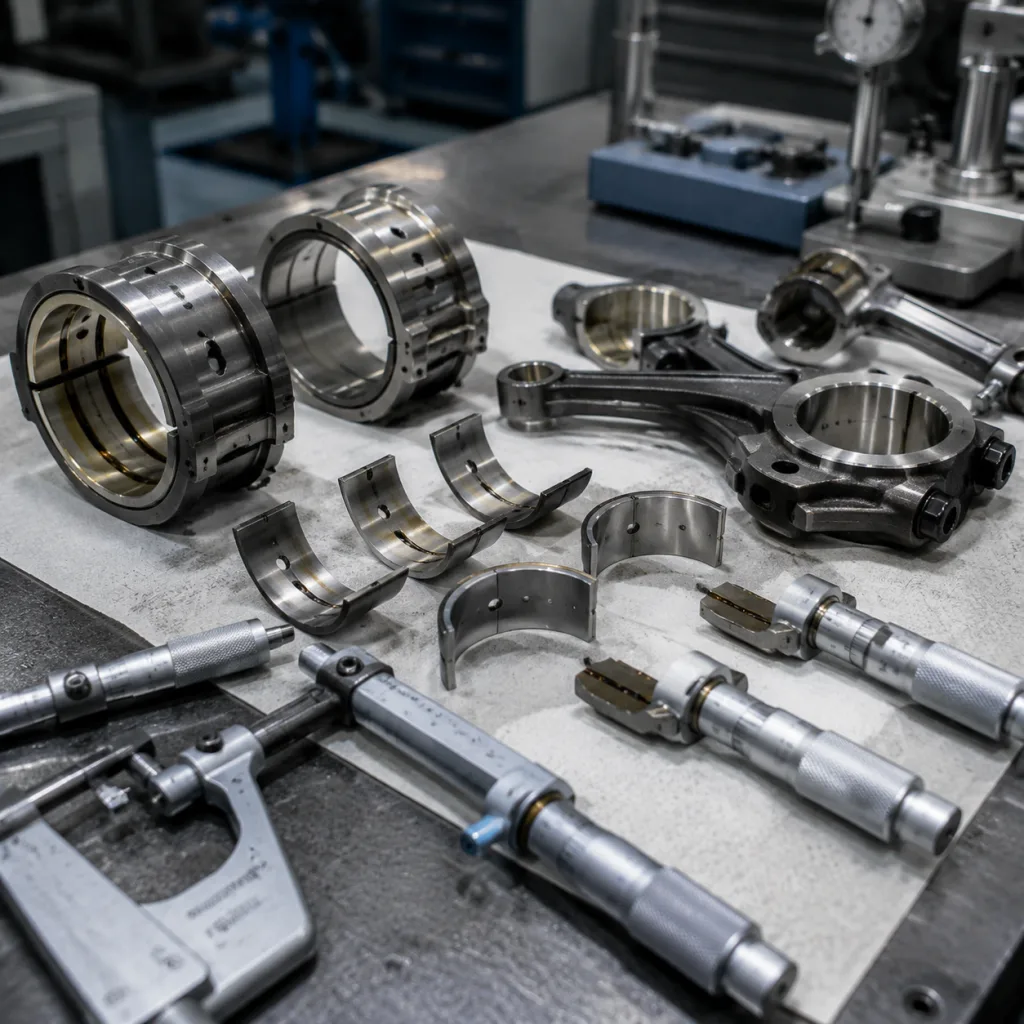
A connecting rod works under alternating tensile and compressive loads, with stress concentration around the big-end housing, small-end eye, bolt seats, parting faces, and beam transitions. For Honda Pilot replacement demand, sourcing teams should request evidence of material control, heat treatment, machining capability, and dimensional inspection before committing to regular stock.
Procurement item
Typical requirement to verify
Why it matters
Material route
Forged steel or specified equivalent
Supports fatigue strength and dimensional stability
Heat treatment
Batch-controlled hardness and microstructure
Reduces variation between production lots
Big-end bore
Measured after cap assembly and final honing
Controls bearing crush and oil clearance
Small-end bore
Pin-fit or bushing-fit specification confirmed
Prevents pin noise, seizure, or accelerated wear
Rod width
Big-end and small-end width within drawing limits
Protects side clearance and piston alignment
Rod weight
Set matching or stated tolerance band
Limits balance correction during rebuild
Bolt seating
Contact face, thread quality, and torque process checked
Maintains clamp load under high-cycle operation
</tr></thead><tbody> </tbody></table>Driventus production control is aligned with IATF 16949:2016 and ISO 9001:2015 principles, including incoming material checks, in-process inspection, final inspection, and lot traceability. Compliance declarations can also be discussed for market requirements such as REACH (EC) No 1907/2006 when material and substance information is requested by the importer.
Validation Tests Buyers Should Request
Procurement teams should ask for validation data that reflects the real failure modes of a connecting rod. A dimensional report is useful, but it is not enough for a rotating engine component exposed to high-cycle loading, bearing load variation, oil temperature changes, and assembly stress.
A practical validation file for a connecting rod for Honda Pilot replacement order can include:
Chemical composition certificate for the steel batch.
Hardness test record after heat treatment.
Metallographic or microstructure confirmation where applicable.
Magnetic particle inspection or equivalent crack detection on sampled parts.
Big-end and small-end dimensional inspection report.
Bolt torque, thread condition, and clamp-load process confirmation.
Fatigue or endurance test summary for the part family.
Surface roughness record for bearing and pin contact areas.
Packaging drop, anti-corrosion, or humidity protection check for export shipments.
For repair-chain buyers, consistency between batches is especially important. One failed rod can damage the crankshaft, piston, cylinder wall, oil pump, and catalytic system. Emissions standards such as ECE R-83 address vehicle emissions rather than connecting rod design, but poor internal engine repair can still contribute to oil consumption, misfire, catalyst damage, higher emissions, and customer returns.
Commercial Sourcing Notes for Distributors
A replacement connecting rod programme is usually purchased by model-year and engine-family coverage rather than as occasional single pieces. Distributors should build demand forecasts around engine population, rebuild frequency, regional repair habits, and stocking strategy. Slow-moving rods may still be necessary where the customer base includes engine rebuilders, fleet workshops, insurers, or repair chains handling mechanical damage claims.
Key sourcing points to clarify before ordering:
Application list by model year, engine displacement, engine code, and market region.
Minimum order quantity by part number or mixed engine-component batch.
Sample approval process before mass production.
Whether rods are supplied individually or weight-matched in sets.
Inclusion of bolts, bushings, bearing shells, or small-end finishing.
Neutral, buyer-branded, or Driventus packaging.
Barcode, label, carton, and pallet requirements for warehouse handling.
Inspection documents required for customs, warranty files, or incoming QC.
Driventus exports to more than 60 countries and supplies B2B customers including aftermarket wholesalers, OEM and Tier-1 supply chains, and multi-location repair networks. The quality system is designed for repeatable production, traceable batches, and distributor-level supply rather than one-off workshop machining.
Incoming Inspection Before Warehouse Release
Importers should run a clear incoming inspection plan before releasing stock to repair customers. This reduces receiving disputes, confirms the shipment matches the approved sample, and creates a useful record if a warranty case appears later.
Recommended receiving checks include visual inspection for corrosion, dents, handling marks, burrs, parting-face damage, and packaging condition. The warehouse team should verify quantity, label data, application information, batch number, and document consistency before stock is booked. Dimensional sampling should cover big-end bore, small-end bore, rod width, centre distance, and, where relevant, bushing finish. For matched sets, record the weight spread across the set before repacking or distribution.
The connecting rod should also be checked with the intended bearing shell, crankshaft journal specification, piston pin, and bolt torque procedure. Engine builders should follow the service manual for final assembly, lubrication, torque sequence, side clearance, oil clearance, and rotation checks. Driventus supplies the component, but installation quality, cleanliness, and correct measurement remain major factors in field durability.
Frequently asked questions
Yes. Depending on the programme, rods can be supplied individually or as weight-controlled sets. Buyers should confirm engine family, quantity, bolt requirement, packaging preference, and whether final small-end bushing work is required before quotation.
No. OE-equivalent means the aftermarket part is designed to match the required fit and function for the application. Driventus is an independent aftermarket manufacturer; Honda and other brand names are referenced for fitment only.
Typical documents include a material certificate, dimensional inspection report, heat-treatment record, batch traceability details, packaging information, and applicable quality documentation under IATF 16949:2016 and ISO 9001:2015 processes.
For application confirmation, sample review, MOQ, and lead-time details, buyers can request drawings or share their fitment list before ordering. Please [request a quote](/contact.html).