Connecting Rod for Honda Fit OE Equivalent Guide
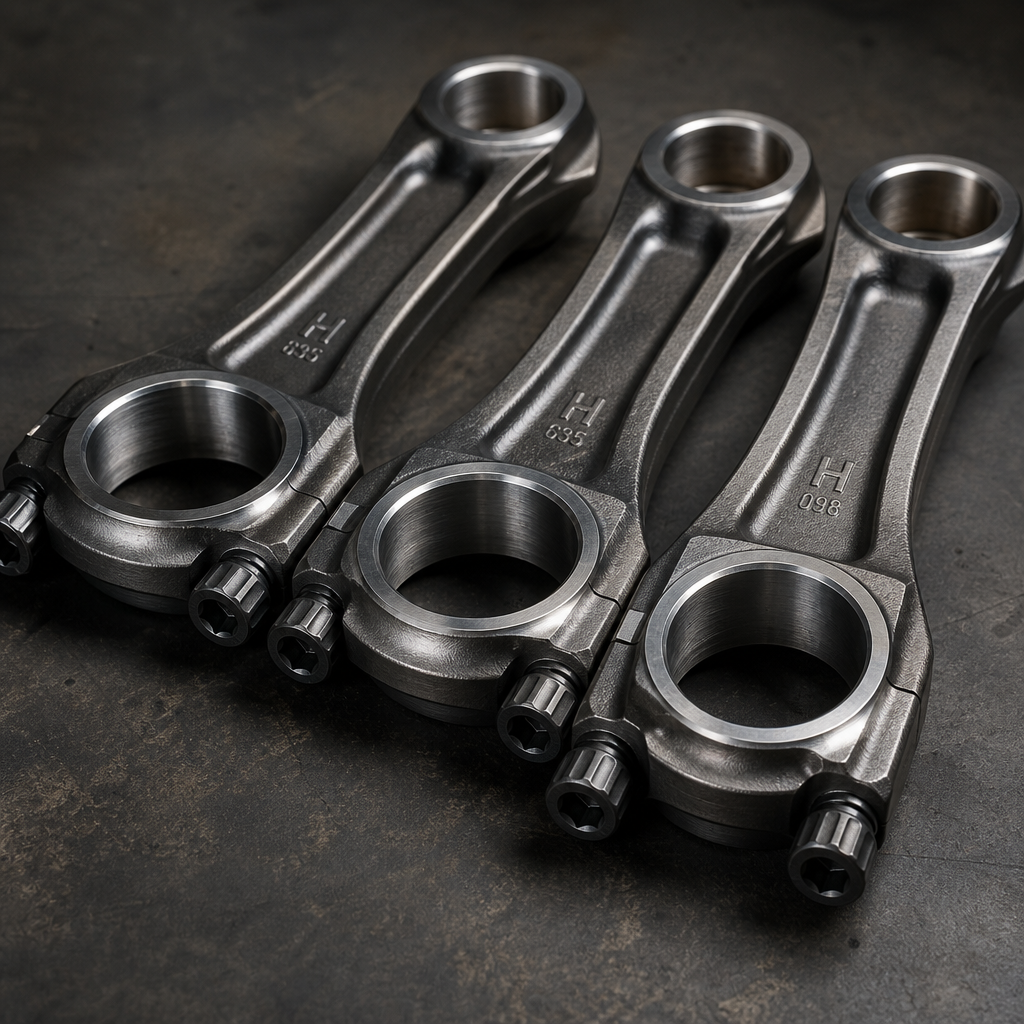
When buyers source a **connecting rod for Honda Fit OE equivalent** replacement, the decision usually fails or succeeds on engineering discipline, not on the label in the box. The part has to match OE function closely enough to survive real rebuild conditions: correct geometry, stable bore sizing, controlled material properties, predictable bolt behavior, and batch-to-batch consistency that does not disappear after sample approval.
That makes this a sourcing problem with technical consequences. Distributors, engine rebuilders, and repair networks need more than nominal fitment. They need traceable metallurgy, repeatable machining, and verification around centre-to-centre length, big-end bore, pin bore, side width, cap stability, bolt stretch behavior, and bearing crush conditions. They also need documents that stand up during supplier qualification, incoming inspection, customs and compliance review, and warranty analysis.
This guide approaches connecting rod for Honda Fit OE equivalent sourcing from the buyer's side: where approval decisions usually go wrong, which dimensions and process controls deserve real scrutiny, how to compare quotations without being misled by a low unit price, and what should be written into the RFQ before a purchase order is ever released. Driventus is an independent aftermarket manufacturer; brand names are referenced for fitment only.
Start with the approval question: what does OE-equivalent actually need to match?
For a replacement connecting rod, OE-equivalent does not mean dealer-supplied or identical in every commercial sense to the vehicle maker's service part. It means the rod matches the original application's functional requirements closely enough to perform reliably in service and across repeated production lots.
For buyers evaluating a connecting rod for Honda Fit OE equivalent programme, that usually comes down to six checks:
- Dimensional compatibility with the exact engine code and production range
- Material consistency in the forging or powder-forged blank, depending on design
- Machining accuracy at the big-end bore, pin bore, side faces, and bolt-seat areas
- Mass control for total weight and balance behavior across engine sets
- Fastener reliability including bolt material, thread quality, and clamp-load repeatability
- Surface integrity after machining, crack inspection, and any specified shot peening
A buyer should not approve the rod from model name alone. Honda Fit applications can vary by market, engine family, displacement, and year. The safer path is drawing-level confirmation: centre-to-centre length, crank journal size, wrist-pin diameter, cap style, side width, and whether the small end is bushed or unbushed.
There is also a commercial side to OE-equivalence that gets missed in weak sourcing projects. One acceptable sample is not enough. The supplier has to hold the same critical dimensions lot after lot. In practice, many buying teams want evidence around big-end bore and pin bore capability, plus internal limits on rod-to-rod weight spread within an engine set to reduce assembly complaints.
Where private-label packaging, matched-set packing, or application-specific machining is required, those requirements can be built into custom manufacturing after technical review.
Where rod programmes usually fail: the pre-order checks buyers skip
A connecting rod is a high-load engine component, so small geometric errors can turn into oil-clearance problems, uneven loading, NVH issues, or early wear. The most common sourcing failure is approving from a catalogue description and a few photos instead of asking for controlled inspection data.
| Check point | Why it matters | Typical buyer verification |
|---|---|---|
| Centre-to-centre length | Affects compression height and piston deck position | Drawing review, fixture measurement, and first-article report |
| Big-end bore diameter | Controls bearing crush and oil clearance | Bore gauge record, roundness data, and capability summary |
| Small-end pin bore | Affects wrist-pin fit and lubrication | Pin-fit inspection, roundness check, and finish verification |
| Big-end side width | Influences crank journal side clearance | Micrometer check and stack-up review |
| Bore alignment/twist | Prevents uneven loading and wear | CMM or dedicated rod alignment fixture |
| Rod weight tolerance | Supports engine balance consistency | 100% batch weighing or defined sampling report |
| Bolt seat geometry | Affects clamp load distribution | Visual plus dimensional inspection |
| Evaluation area | Lower-risk supplier profile | Higher-risk supplier profile |
|---|---|---|
| Application matching | Confirms engine code and dimensional drawing | Relies only on model-year description |
| Material traceability | Batch certificates available | No clear heat or lot traceability |
| Dimensional control | First article and in-process records shared | Only final visual inspection claimed |
| Bolt quality | Defined grade and inspection method | Bolt source unspecified |
| Certification | IATF 16949:2016 and ISO 9001:2015 in place | No audited system stated |
| Packaging | Corrosion protection and lot coding | Generic packing without traceability |
| Engineering support | Drawing review and sample validation | Catalogue-only sales support |