Connecting Rod for Genesis G80 Replacement: Fitment Guide
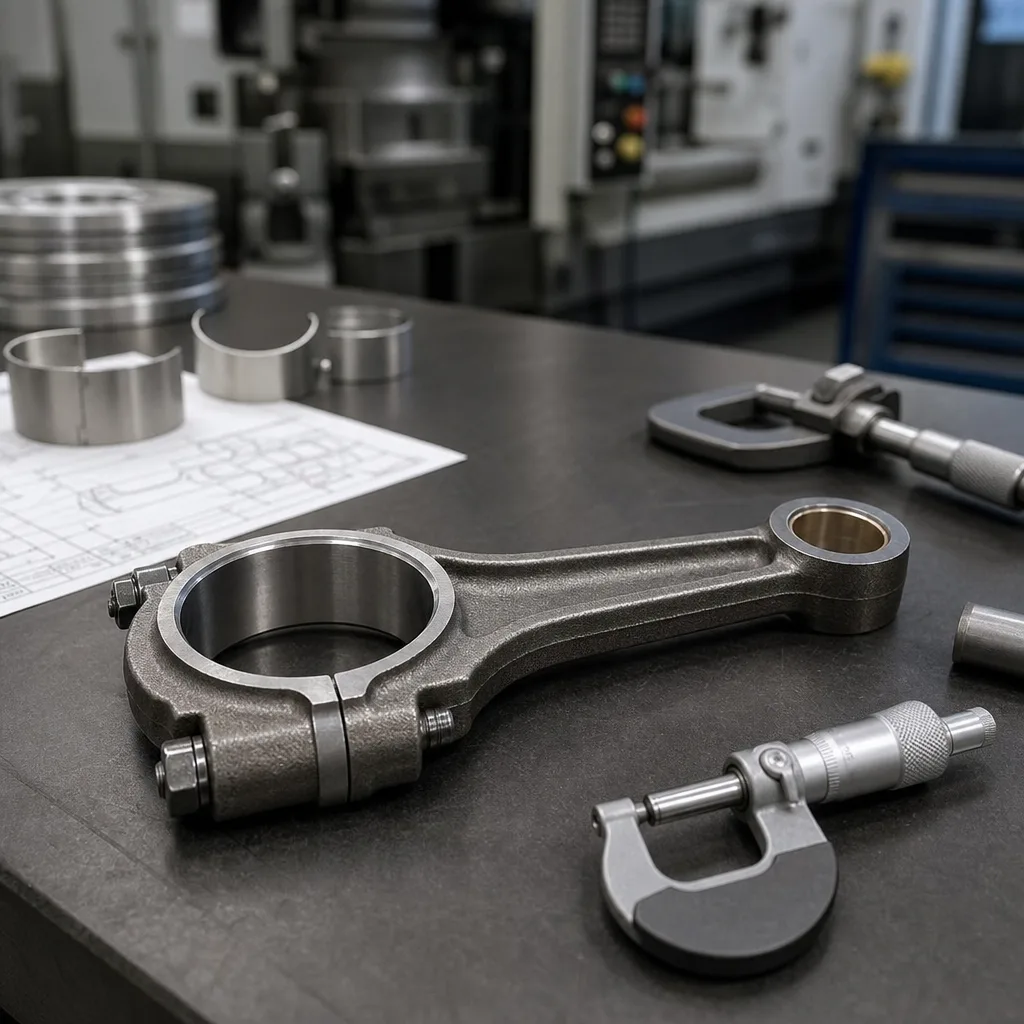
A connecting rod for Genesis G80 replacement has to do more than fit the bore and bolt pattern. For procurement teams, the practical question is whether the part matches the engine family, rod length, centre-to-centre geometry, big-end bore, small-end bore, and bolt specification well enough to support reliable rebuild outcomes. Driventus supplies engine components for B2B buyers who need documented dimensions and repeatable manufacturing control, not guesswork. Driventus is an independent aftermarket manufacturer; brand names are referenced for fitment only. For Genesis G80 programs, the replacement route should start with engine code confirmation, then move to dimensional verification, material specification, and batch traceability. That is the only defensible way to source parts for repair networks, wholesale channels, and engine rebuilders that need predictable installation results and low comeback risk.
What defines a usable replacement
A replacement rod is usable only when the geometry and load path match the engine specification closely enough to maintain bearing clearance, compression height, and crank-to-rod alignment. For the Genesis G80, that means matching the engine variant first, then confirming the rod set against measured samples or the buyer's drawing package.
Check point
What to verify
Why it matters
Centre distance
Rod length and tolerance band
Affects piston position and deck height
Big-end bore
Roundness and size after machining
Controls bearing crush and oil film
Small-end bore
Pin fit and bush condition
Prevents pin noise and wear
Beam profile
Forging or fracture-split design
Affects strength and mass consistency
Bolt spec
Grade, thread, and stretch method
Governs clamp load under combustion load
</tr></thead><tbody> </tbody></table>For buyers comparing a connecting rod for Genesis G80 replacement across suppliers, the question is not only nominal size. It is whether the supplier can document dimensional repeatability and confirm that the rod set is built for the correct engine family, not just the same displacement class.
Fitment checks before you place the order
Before purchase, lock down the engine code, model year range, and whether the application is for a complete rebuild or a single-cylinder repair. In mixed inventories, that step avoids the common error of ordering by vehicle name alone.
Use this checklist:
Confirm engine code from the VIN, build sheet, or teardown record.
Measure the removed rod if the engine has already been opened.
Verify the crank journal size, bearing shell part number, and piston pin diameter.
Check whether the rod uses a standard cap, fracture-split cap, or matched pair caps.
Confirm whether the application requires a complete set or one matched replacement rod.
If the buyer needs interchange support, our catalog can help narrow the part family: our catalog. For broader engine coverage, see engine components. This is the point where a purchase order should stop being generic and become a controlled replacement order with recorded fitment data.
Material and process controls that matter
A rod used in passenger car service needs stable metallurgy and repeatable machining. The core controls are forging quality, heat treatment, shot peening where specified, and final machining accuracy. For procurement teams, those controls matter more than advertising claims.
Typical controls to request from the supplier:
Material declaration for the base steel or powdered-metal route used.
Heat-treatment record with hardness range.
Dimensional inspection report for big-end and small-end bores.
Weight matching across the set.
Traceability by batch, shift, or heat number.
Where the part is produced under an audited system, ask for documented alignment with our quality system. Driventus operates under IATF 16949:2016 and ISO 9001:2015 principles for production control and inspection discipline. For customers that need a non-catalog specification, custom manufacturing is appropriate when the target is dimensional equivalence, not redesign.
Comparison of replacement options
Not every sourcing route carries the same risk. Buyers should compare the options on fitment certainty, inspection depth, and lead time rather than unit price alone.
Option
Strengths
Trade-offs
OE-equivalent new rod
Best path for dimensional match and repeatability
Requires clear engine-code verification
Reconditioned rod
Can work for limited rebuild programs
More variability in history and prior wear
Low-cost generic rod
Often easy to source
Higher risk of mass spread, bore drift, and clamp variation
</tr></thead><tbody> </tbody></table>For repair chains and distributors, the best choice is usually a new OE-equivalent rod with measured tolerances and batch traceability. For OEM and Tier-1 buyers, the sourcing spec should include PPAP-style evidence, incoming inspection criteria, and rejection limits. That is the practical difference between a part that fits on paper and a part that performs consistently in service.
Validation and standards buyers should request
The replacement part should be validated against the engine's service demands, not just installed once and assumed correct. For the buyer, the key evidence is dimensional inspection, hardness data, and fatigue-related process control.
Relevant standards and compliance references include:
IATF 16949:2016 for automotive quality management in production.
ISO 9001:2015 for documented quality system control.
REACH (EC) No 1907/2006 for chemical compliance in the EU supply chain.
SAE J2527 where corrosion and durability test methods are relevant to component evaluation.
ECE R-83 where the overall vehicle context requires emissions-conscious repair decisions.
Validation should also cover packaging, rust prevention, and transit damage control. If a buyer needs a defined cross-reference process for an unknown or legacy application, request a quote with the engine code, photos, measured dimensions, and the target market. That gives engineering and purchasing a common reference point before sampling or mass order release.
Frequently asked questions
Start with the engine code, then verify rod length, big-end and small-end bore, bolt specification, and piston pin diameter. Vehicle name alone is not enough for controlled sourcing.
Both are possible depending on the engine family and the matching rule required by the buyer. For rebuild consistency, many customers prefer a full matched set with weight control.
Yes. Buyers can request dimensional inspection data, traceability records, and quality documentation aligned with IATF 16949:2016 and ISO 9001:2015. Brand names are referenced for fitment only.
If you need a verified replacement path, send the engine code, quantities, and target market details through /contact.html so we can confirm fitment and prepare a quotation.