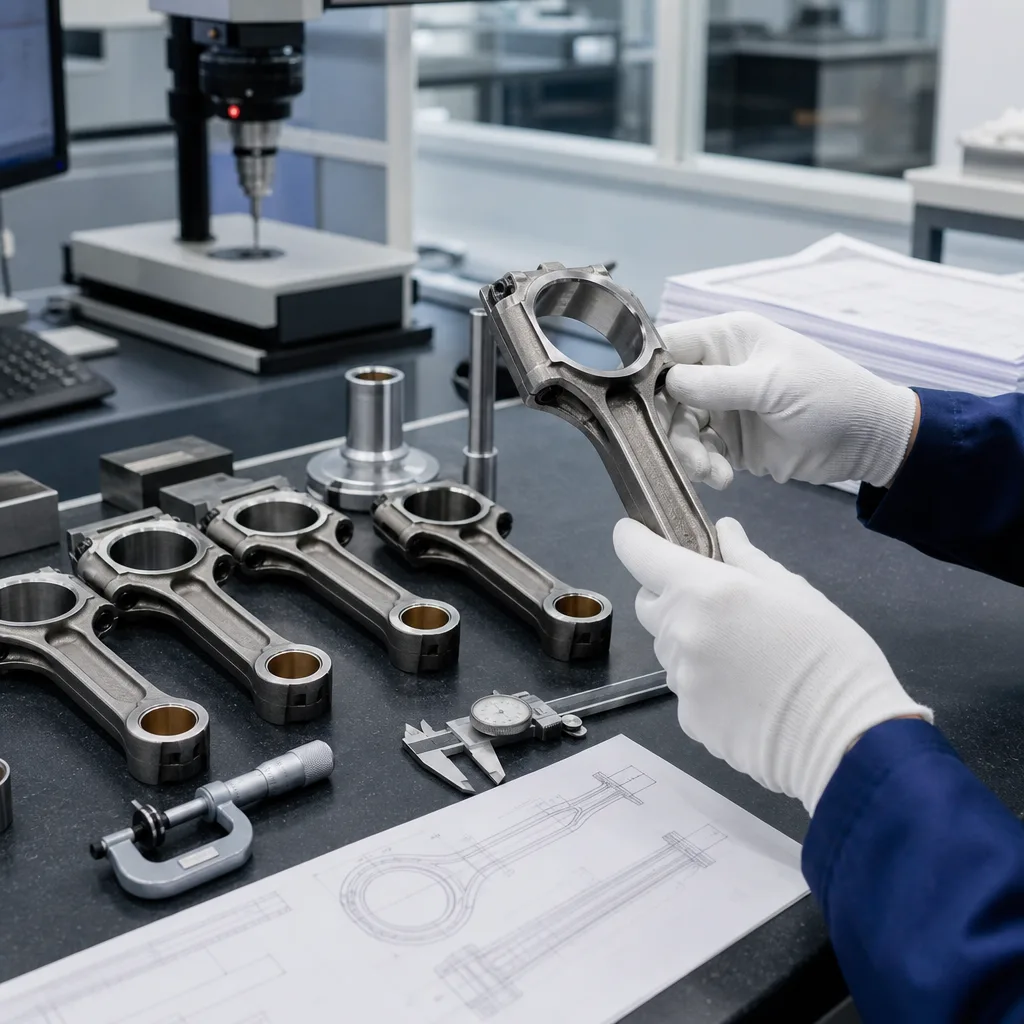
Connecting Rod for Genesis G80 Aftermarket Replacement
A connecting rod for Genesis G80 aftermarket replacement must match the engine application, geometry, and material specification used in the original assembly. For procurement teams, the main risk is not the part name but the exact engine code, rod length, big-end and small-end dimensions, weight class, and bearing bore condition. A rod that looks correct can still fail if it differs in centre-to-centre length, bend, twist, or cap alignment. Driventus supplies independent aftermarket engine components for B2B buyers who need dimensional consistency and documented quality control. Driventus is an independent aftermarket manufacturer; brand names are referenced for fitment only. This article explains what to verify before purchase, which standards matter, and how to compare replacement options for the Genesis G80 platform without relying on assumptions about trim or market region.
What the replacement part must match
For a connecting rod for Genesis G80 aftermarket replacement, the first step is to confirm the exact engine family and OE cross-reference. A G80 platform can use different engines by model year, displacement, and market. Do not source from chassis description alone.
Core match points
Centre-to-centre length
Big-end bore diameter and roundness
Small-end bore diameter and bush specification
Pin diameter and press-fit or full-floating design
Rod bolt grade and torque specification
Beam profile, mass, and balance class
Cap mating face and parting line geometry
If the replacement rod does not match these values, the assembly can create bearing wear, oil film loss, or secondary crankshaft damage. For procurement, ask for dimensional records and the relevant OE cross-reference, such as OE 06A107065, only when the engine family confirms that identifier.
Material and heat treatment requirements
Replacement rods are usually supplied as forged steel or powder-forged steel, depending on the original application. The correct choice depends on engine load, combustion pressure, and target service life.
Item
What to verify
Typical procurement note
Material
Forged steel or powder-forged steel
Match OE material class where possible
Heat treatment
Hardness profile and core strength
Request batch hardness records
Surface finish
Shot-peened or treated beam surface
Helps fatigue resistance
Rod bolts
Grade, coating, and torque angle method
Bolts are not interchangeable across designs
Bush
Copper alloy or sintered bush
Must suit pin fit and lubrication
</tr></thead><tbody> </tbody></table>For aftermarket replacement, the key question is whether the part meets the same fatigue and dimensional envelope as the OE rod. Driventus validates against internal drawings and inspection records, with process control aligned to IATF 16949:2016 and ISO 9001:2015.
Dimensional checks that matter in purchasing
A correct-looking rod can still be out of spec. Buyers should request measurement data for every lot, especially when replacing parts for a high-value engine such as the Genesis G80 application.
Minimum inspection points
1. Centre-to-centre length tolerance 2. Big-end bore after cap tightening 3. Small-end bore and bush concentricity 4. Bend and twist values 5. Side clearance and beam width 6. Weight matching across sets
A practical receiving standard is to confirm that rods supplied as a set fall within the agreed weight window and that bores remain stable after cap torque. If the supplier does not provide inspection data, the risk shifts to your rework and warranty cost. For engineering teams, this is the point where a sourcing file should include drawing revision, gauge method, and accepted tolerance band before release to production or warehouse stock.
Testing and compliance expectations
Procurement managers should separate fitment from compliance. Fitment confirms the part can be installed. Compliance confirms the part was produced under a controlled process and can be traced.
Driventus recommends checking for:
Material traceability by batch
Dimensional inspection records
Rod bolt torque verification
Hardness or tensile test evidence
Packaging traceability and lot coding
Sample validation against a master rod or OE drawing
Where export documentation is needed, confirm that supplied materials and coatings meet applicable chemical restrictions, including REACH (EC) No 1907/2006 for EU shipments. If the part is used in an exhaust-adjacent or emission-related assembly in a broader engine programme, buyers may also need to consider vehicle-level testing protocols such as ECE R-83 or durability references such as SAE J2527, depending on the programme scope. Those standards do not certify a connecting rod by themselves, but they are relevant when the rod is part of a larger validation package.
When to choose stock replacement versus custom manufacturing
For most aftermarket buying, a stock replacement rod is the lowest-risk option if the OE geometry is confirmed. For older variants, export-specific engines, or discontinued catalog numbers, a stock part may not be available in the exact revision needed.
In that case, custom manufacturing becomes the better route. This is useful when you need:
A verified OE-equivalent rod for a hard-to-source engine code
A revised bushing or bolt specification
Set balancing by weight class
Packaging and labelling aligned to your warehouse standard
A controlled sample for validation before bulk release
Driventus also supports related engine parts through our catalog, and buyers can review broader engine component options when bundling purchases by platform. For process control details, see our quality system.
How procurement teams should qualify a supplier
A valid supply decision for a connecting rod for Genesis G80 aftermarket replacement should include technical and commercial checks.
Supplier qualification checklist
Confirm exact engine application and OE cross-reference
Review IATF 16949:2016 and ISO 9001:2015 certificates
Request dimensional report and material declaration
Ask for sample approval before mass order
Verify carton count, lot coding, and export packing
Confirm MOQ, lead time, and re-order stability
If your programme requires a modified beam, alternate bolt specification, or private-label packaging, Driventus can support custom manufacturing. For a quote on matched replacement rods or related powertrain parts, use our request a quote page. Driventus is an independent aftermarket manufacturer; brand names are referenced for fitment only.
Frequently asked questions
Match the exact engine code, OE cross-reference, centre-to-centre length, bore sizes, and rod bolt specification. Chassis name alone is not enough because the G80 platform uses multiple engine variants.
Yes, if it matches the OE geometry, material class, heat treatment, and dimensional tolerance, and if the supplier provides inspection and traceability records for the batch.
Ask for the drawing revision, dimensional report, material declaration, hardness or tensile data, certificate copy, lot traceability, and sample approval records before release.
If you are sourcing a verified replacement rod or building a platform-based parts programme, send your engine code and target quantity through /contact.html and we will review fitment and supply options.