Connecting Rod for Ford F-150 Replacement: Fitment Checks
When a Ford F-150 engine needs a rod replacement, the purchasing decision should rest on verified geometry, material condition, validation data, and batch control, not catalogue wording alone. The F-150 nameplate covers many gasoline and diesel engine families across model years. Those engines can differ in center-to-center rod length, pin diameter, big-end width, cracked-cap or machined-cap design, bushing specification, and fastener torque method. A connecting rod for Ford F-150 replacement therefore has to be checked against the exact engine family and a measured OE reference part, especially for rebuild centres, wholesalers, fleet maintenance programmes, and private-label distribution.
For procurement teams, the practical question is not whether the part looks right in a catalogue photo. It is whether the replacement stays within the OE design envelope closely enough to assemble correctly, maintain bearing crush and oil-film geometry, control reciprocating mass, and withstand the engine's tensile and compressive load cycle in service. A small mismatch in housing-bore roundness, beam offset, bolt clamp load, or gram weight class can lead to piston slap, bearing edge loading, unstable oil film, fretting at the cap face, or repeat teardown costs.
Driventus is an independent aftermarket manufacturer; brand names are referenced for fitment only. We supply connecting rods for replacement programmes with controlled machining, traceable batches, and documentation aligned to IATF 16949:2016 and ISO 9001:2015. This article explains what to verify before ordering, which tests and records matter, and how to avoid receiving a part that appears compatible but fails during assembly, hot testing, or field service.
What a valid replacement must match
A valid replacement is not defined by appearance. It is defined by fitment, mass, and strength inside the engine builder's tolerance window. For a connecting rod for Ford F-150 replacement, the first step is to identify the exact engine application before discussing price, stock, or packaging. The F-150 nameplate has been used with inline, V6, V8, turbocharged, naturally aspirated, hybrid, and diesel engine options, and those engines can use different rod architectures even when the vehicle description sounds similar.
Buyers should confirm the engine family, model-year range, displacement, aspiration, fuel system, and rebuild specification before releasing an RFQ. In practice, that means comparing the replacement rod with a physical OE sample, a validated drawing set, or a teardown report that includes the engine code, OE cross-reference, and journal/pin measurements. A part that fits one build may not suit another if the pin bore, big-end width, cap design, beam offset, or bearing tang position differs.
Minimum checks before purchase:
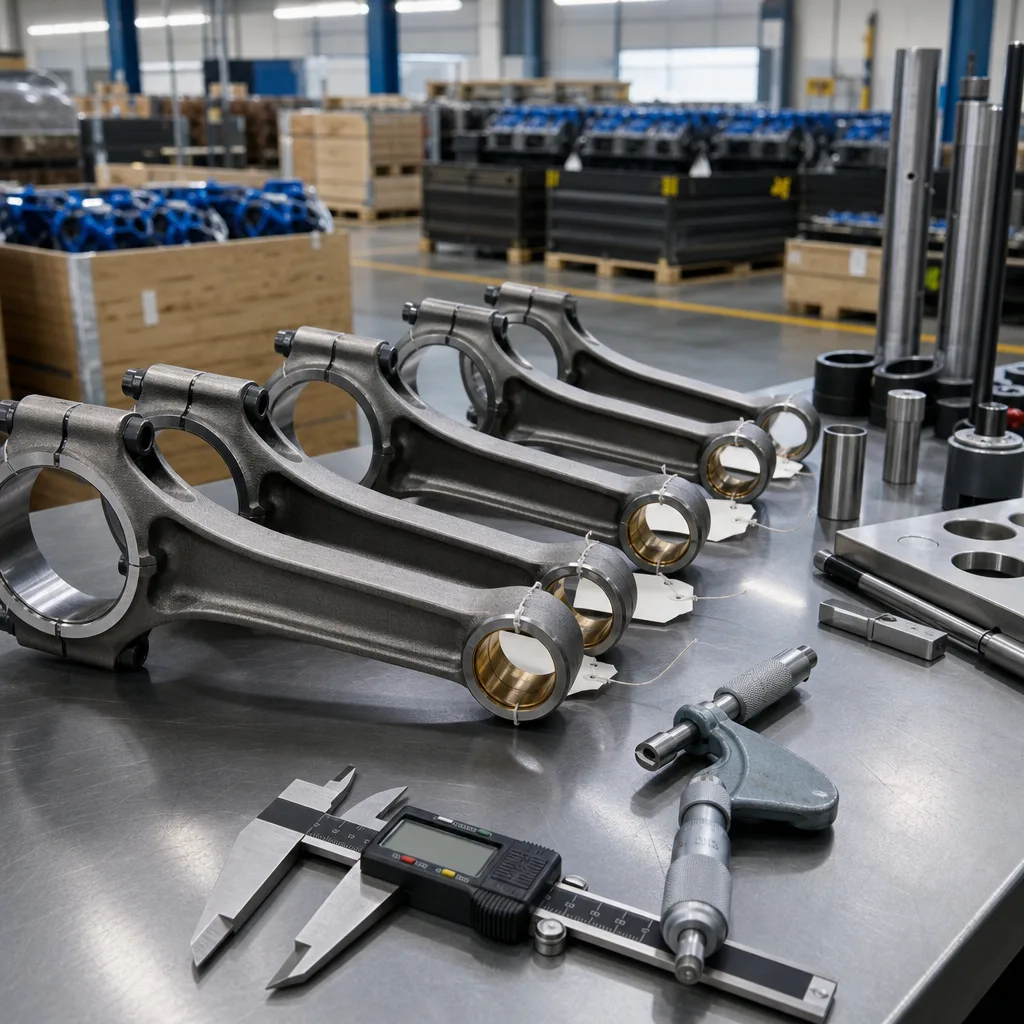
- Center-to-center length from big-end bore axis to small-end bore axis, measured on a fixture or CMM
- Big-end bore diameter, width, roundness, taper, and housing-bore stability after bolts are tightened to the specified torque-angle or stretch method
- Small-end bore diameter, wrist-pin fit class, bushing material, bushing oil hole position, and lubrication groove where applicable
- Beam offset, cap orientation, bearing tang position, chamfer direction, and shell compatibility
- Total rod weight and end-to-end weight split for big-end and small-end balancing
- Fastener diameter, grade, thread engagement, under-head radius, lubrication condition, torque method, stretch range, and clamp-load target
- Surface finish at the bearing seat, pin interface, cap face, and parting line, with Ra/Rz values where specified by the drawing
- Side-clearance compatibility with the crankshaft journal width and adjacent rod arrangement
The replacement must also preserve the engine's functional relationships. Center-to-center length affects piston deck position, quench clearance, and compression relationship. Big-end geometry affects bearing crush, bearing back contact, and hydrodynamic oil-film control. Small-end fit affects pin movement, cold-start noise, and scuffing risk. Weight and balance affect vibration, crankshaft loading, and NVH. These details look small on paper, but they become expensive when they are wrong in a production rebuild programme.
If the part is being sourced for a rebuild programme, ask for the sample rod, engine code, OE cross-reference, and inspection notes from the teardown report. That avoids ordering by vehicle badge alone and gives both buyer and supplier a measurable fitment target.
Driventus supports replacement programmes where dimensional match matters more than catalogue language. For a wider view of the parts we supply, see our catalog and engine components.
Dimensional checks buyers should request
The quickest way to reject a poor substitute is to compare the measured part with the OEM sample or the validated drawing set. For procurement, dimensional inspection should be a release condition, not a paperwork formality. A connecting rod can look correct, carry the right catalogue description, and still create assembly problems if the housing bore, cap alignment, or weight class is outside the agreed range.
The table below shows the checks that matter most when qualifying a connecting rod for Ford F-150 replacement.
| Check | Acceptable replacement | Risk signal |
|---|---|---|
| Center-to-center length | Matches the validated sample within the drawing tolerance, typically verified from bore axis to bore axis | Changes piston position, quench clearance, compression relationship, or deck clearance |
| Big-end bore | Round, stable, correctly aligned, and measured after fasteners are tightened using the specified lubricant and torque-angle or stretch method | Out-of-round, taper, poor bearing crush, fretting, or unstable housing bore after retorque |
| Big-end width | Compatible with crank journal width and side-clearance specification | Excess side clearance, heat, noise, oil throw variation, or contact under load |
| Small-end bore | Correct wrist-pin clearance, bushing geometry, oil feed position, and surface condition | Excess clearance, tight pin fit, bushing shift, scuffing, or noise at first start |
| Beam offset | Matches OE orientation, chamfer direction, and crank-piston alignment | Piston misalignment, bearing edge loading, crank cheek contact, or skirt interference |
| Cap fit | Clean parting faces, correct cap register, matched cap identity, and repeatable alignment after assembly | Cap walk, poor bore repeatability, uneven bearing contact, or mixed cap risk |
| Beam weight | Within the agreed gram class and matched by set where required, including big-end/small-end split | Requires rebalancing beyond normal rebuild limits or creates cylinder-to-cylinder imbalance |
| Fasteners | Same load path, thread engagement, torque/stretch behaviour, and clamp target as the approved sample | Different clamp load, thread failure, bolt yield, or bore distortion after tightening |
| Surface finish | Bearing and pin interfaces finished to the required Ra/Rz texture and cleaned to remove machining debris | Oil-film instability, early wear, embedded debris, or pin/bearing scoring |
| Side clearance | Compatible with the crank and adjacent rods after final assembly | Noise, heat build-up, low oil control, or physical contact under load |