Connecting Rod for Ford Explorer OE Equivalent: Buyer Guide
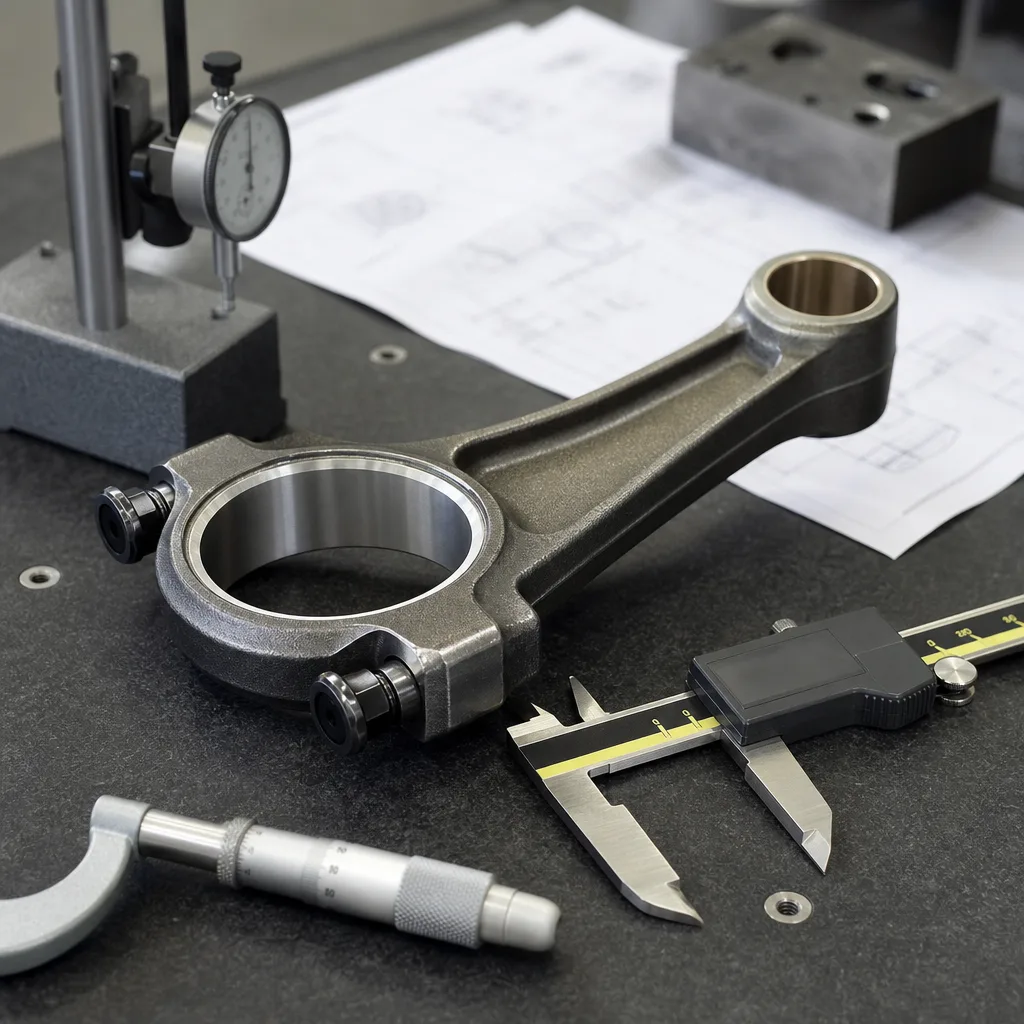
Procurement teams sourcing a connecting rod for Ford Explorer OE equivalent usually need three things: dimensional match, material consistency, and repeatable validation. The correct part must fit the engine family, maintain the intended centre-to-centre length, big-end and small-end geometry, and hold up under cyclic load without distortion. For replacement programmes, the focus is not on marketing claims. It is on whether the rod matches OE-critical dimensions, surface finish, hardness, and crack-free manufacture. Driventus supplies engine components from Taizhou, Zhejiang, with production controlled under IATF 16949:2016 and ISO 9001:2015. Driventus is an independent aftermarket manufacturer; brand names are referenced for fitment only. This article explains what buyers should verify before approving a replacement programme, which standards matter, and how to compare OE-equivalent options for aftermarket distribution, repair chains, and cross-border supply.
What OE-equivalent means for a Ford Explorer connecting rod
For buyers handling mixed aftermarket demand, it is also important to confirm the supplier can support OE part-number cross-reference only as a fitment reference, not as a claim of endorsement. Driventus can support enquiries through our catalog and related engine families in engine components.
Key specifications buyers should verify before ordering
A replacement rod must be validated against the engine’s mechanical envelope. The table below shows the checks procurement teams should request from the supplier before purchase order release.
Inspection item
What to verify
Why it matters
Centre-to-centre length
Match to engine specification within drawing tolerance
Prevents piston height error and compression imbalance
Big-end bore
Diameter, roundness, and housing bore alignment
Controls bearing fit and oil film stability
Small-end bore
Bushing internal diameter and pin fit
Prevents wrist-pin noise and scuffing
Weight class
End-to-end mass within matched set tolerance
Reduces vibration and balance correction work
Rod bolt grade
Material, thread quality, torque angle or torque spec
Directly affects clamp load and fatigue life
Material
Forged steel, powdered metal, or micro-alloy steel
</tr></thead><tbody> </tbody></table>Where available, ask for inspection data tied to the batch lot. A supplier working under IATF 16949:2016 should be able to provide PPAP-style documentation or equivalent production controls for critical dimensions. For aftermarket buyers, consistency across cartons matters as much as the first-article sample.
Material and manufacturing choices that affect service life
Connecting rods used in light-duty petrol and diesel engines are commonly produced by forging, powder metallurgy, or fracture-splitting processes. Each route has trade-offs.
Forged steel rods
Forged steel offers strong fatigue resistance and is often selected for higher load applications. Buyers should ask for material designation, forging route, and heat-treatment confirmation. Forged parts may also require post-forge machining checks for bore geometry and straightness.
Powder metal or fractured-cap rods
These are used where the original engine design prioritises repeatable cap location and high-volume production efficiency. The fracture surface improves cap repeatability, but the supplier must control cap fit, bolt tension, and bearing bore concentricity.
What to request from the supplier
Material certificate or heat lot traceability
Hardness range by component family
Magnetic particle or crack detection method, if used
Dimensional report for first article and production sampling
Corrosion-prevention packaging for export storage
For buyers in the EU and UK, material declarations should also support REACH (EC) No 1907/2006 where applicable to the finished component and packaging materials. If your programme needs a non-standard beam section, bolt upgrade, or bearing-seat adjustment, custom manufacturing is the correct route rather than forcing a close substitute.
Validation testing that supports OE-equivalent replacement
A replacement rod should not be approved only on catalogue fitment. It should pass validation that reflects real engine duty cycles. The most relevant test references for buyers are load-based and corrosion-based methods, depending on the programme.
Common validation requests include:
Dimensional inspection against controlled drawing
Hardness verification on body and cap where specified
Fatigue or cyclic load testing using supplier internal methods
Surface roughness measurement on bearing and pin interfaces
Salt spray or corrosion exposure for coating and packaging evaluation
Fit-check with matching piston and bearing set
For turbocharged petrol or diesel applications, the rod sees higher peak cylinder pressure and more demanding tensile loads. In those cases, procurement should request evidence of engine-family validation rather than a generic part description. If the application references a specific OE code such as OE 06A107065, use it only as a fitment cross-reference and confirm the engine variant before ordering.
Driventus operates a documented quality system aligned to IATF 16949:2016 and ISO 9001:2015, which supports controlled inspection, traceability, and export batch management.
How buyers should compare suppliers on this part
When comparing sources for a connecting rod for Ford Explorer OE equivalent, price per unit is not the only variable. Imported engine parts generate cost risk when bore geometry, bolt quality, or batch traceability is inconsistent.
Use this comparison approach:
1. Confirm engine application by year, displacement, and code. 2. Request controlled drawings or dimensional sheets. 3. Check material and heat-treatment evidence. 4. Ask whether the rod is supplied as a single piece or matched set by weight. 5. Verify packaging and rust-prevention methods for ocean freight. 6. Review the supplier’s corrective-action response time for nonconforming lots.
A supplier with stable process control can support aftermarket distributors, multi-location repair groups, and OEM/Tier-1 programmes differently, but the baseline expectation is the same: consistent geometry and documented traceability. If you need a quotation or technical review, use request a quote with the engine code, quantity, and target market. That shortens confirmation time and reduces revision cycles.
Procurement checklist before purchase order release
Before you release a PO, verify the following points with the supplier:
Exact vehicle and engine application
OE reference used only for fitment, not endorsement
Rod type: forged, powder metal, or fractured-cap
Dimensional tolerance sheet attached to the offer
Batch traceability and inspection record availability
Packaging suitable for export and warehouse storage
Compliance statement for REACH (EC) No 1907/2006 where required
Lead time, MOQ, and rework policy
This checklist is particularly useful for buyers managing service parts for regional warehouses, because a single part number may cover several engine variants. For that reason, validation must include the full engine context, not only the visible vehicle badge. Driventus is an independent aftermarket manufacturer; brand names are referenced for fitment only.
Frequently asked questions
Yes, if it matches the engine-specific dimensions, bore geometry, mass class, and bolt specification. Buyers should still verify the exact engine code and request inspection data before approval.
No. OE-equivalent describes fitment and functional similarity. It does not imply vehicle manufacturer approval or endorsement. Brand names should be treated as fitment references only.
Ask for a controlled drawing, dimensional inspection report, material or heat-lot traceability, packaging details, and the supplier’s quality documentation under IATF 16949:2016 or ISO 9001:2015.
If you need a verified fitment review, batch quote, or custom specification check, send your engine details and target quantity through /contact.html.