Connecting Rod for Audi TT Aftermarket Replacement: Key Checks
A connecting rod for Audi TT aftermarket replacement must match the engine’s OE geometry, mass class, and small-end and big-end interfaces. For procurement teams, the decision is not only about price. It is about dimensional equivalence, fatigue life, surface integrity, and repeatable supply. Driventus supplies engine components to distributors, OEM and Tier-1 buyers, and repair networks that need stable fitment and documented quality control. Our parts are produced under IATF 16949:2016 and ISO 9001:2015 systems, with material and process controls aligned to export market requirements. Driventus is an independent aftermarket manufacturer; brand names are referenced for fitment only. Before ordering, confirm engine code, OE cross-reference, centre-to-centre length, bore sizes, and required bolt specification. That prevents installation delays and reduces the risk of repeat failure after rebuild.
What an OE-equivalent replacement must match
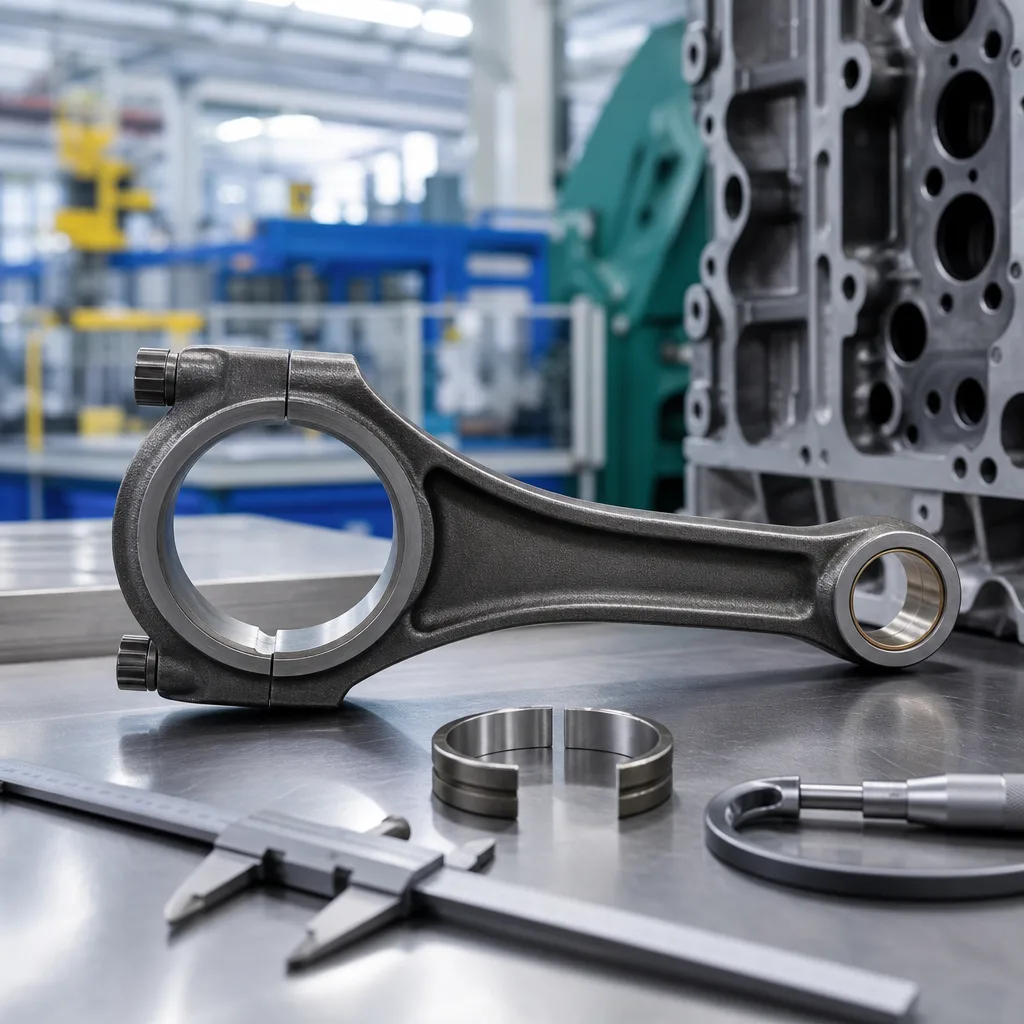
For a connecting rod used in Audi TT engine repair, the replacement must match the original part on geometry and load path, not only on overall length. Buyers should confirm the following points before release:
Centre-to-centre length
Big-end bore diameter and width
Small-end bore diameter
Big-end cap split style and bolt type
Rod weight class and pair balancing requirement
Material grade and heat treatment route
OE part-number cross-reference, if available
A mismatch in any of these areas can change bearing crush, piston height, and engine balance. For procurement, the key question is whether the supplier can hold dimensions within the same functional window used by the original application. Where the program requires an OE reference, it should be documented as OE 06A107065 only when the buyer’s specification already cites that number.
Validation points for replacement sourcing
Replacement sourcing should be based on measurable checks. The most relevant items are listed below.
Small-end and big-end diameters within drawing tolerance
Ensures correct pin and bearing fit
Weight
Rod mass within lot target
Reduces imbalance in multi-cylinder engines
Surface finish
Bearing seat and shank finish are controlled
Supports fatigue resistance and assembly quality
Bolts
Correct grade, thread, and torque process
Prevents cap separation and fretting
Traceability
Heat number and batch record available
Supports incoming inspection and claim handling
</tr></thead><tbody> </tbody></table>For repeat purchases, ask for inspection records, dimensional reports, and material certificates. A supplier that can provide lot traceability and gauge records is easier to qualify for distributors and rebuilders working across multiple branches.
Materials and manufacturing route
Most forged connecting rods for passenger-car applications use alloy steel processed through forging, machining, heat treatment, and final inspection. The material route matters because fatigue performance is driven by grain flow, hardness control, and residual stress management. Buyers should ask for the following:
Common technical requirements
Forged steel blank with controlled chemistry
Heat treatment record with hardness range stated on the inspection sheet
Machined big-end and small-end bores with controlled roundness
Shot peening or equivalent surface strengthening, where specified
Magnetic particle inspection or crack detection on critical lots
Driventus manufactures under documented process controls and can support programs with dimensional checks, hardness data, and export packing suitable for warehouse and line-side supply. When buyers need application-specific changes, our custom manufacturing service can support drawing-based production, subject to technical review and validation.
How procurement teams should validate fitment
Fitment validation should be done before bulk release, not after arrival. A practical approval flow is:
1. Confirm engine code and application range. 2. Verify OE reference and replacement drawing. 3. Compare length, bore sizes, and bolt specification. 4. Review mass and balancing requirements. 5. Check packaging, corrosion protection, and labelling. 6. Install pilot samples and inspect bearing contact pattern. 7. Record torque, clearances, and first-run observations.
For import managers, the best practice is to retain one approved sample from each lot and link it to the batch certificate. This simplifies warranty handling and makes reordering from the same specification more reliable. If your team needs a wider engine programme, you can review our catalog or engine components for related parts.
Quality and compliance expectations
A replacement rod sold into the EU, UK, US, Canada, Australia, or Brazil should be supported by a documented quality system and material compliance file. At minimum, ask the supplier to confirm:
IATF 16949:2016 and ISO 9001:2015 certification
Material declaration suitable for REACH (EC) No 1907/2006 where applicable
Batch traceability and inspection records
Dimensional control against the buyer’s drawing or OE reference
Packaging that protects machined surfaces during transport
For buyers managing supplier approval, the quality system page should show how nonconforming product is handled, how gauge calibration is maintained, and how traceability is assigned to production lots. Driventus does not claim vehicle manufacturer approval or endorsement. Brand names and OE references are used for fitment identification only.
What to ask before placing a purchase order
Before issuing a PO, procurement should confirm the commercial and technical details in one document set. A clean order file usually includes:
Application: Audi TT engine variant and model year range
OE cross-reference, if the buyer has one on file
Quantity, target lead time, and carton requirement
Inspection standard or customer-specific checklist
Sample approval requirement for first lot
Country of destination and marking rules
If the application is not fully covered by an existing part number, Driventus can review drawing samples and support development through custom manufacturing. For buyers needing a quotation or technical confirmation, use request a quote to send the engine code, OE reference, and target annual volume. That allows the supplier to confirm tooling, testing, and production feasibility before release.
Frequently asked questions
Yes, if it matches OE geometry, bore sizes, weight class, and bolt specification, and if the supplier provides traceable inspection records. Fitment must be confirmed by engine code.
Ask for dimensional inspection data, material certificate, heat-treatment record, traceability information, and certification under IATF 16949:2016 or ISO 9001:2015.
Yes. We support drawing-based and sample-based programmes, subject to technical review, validation, and commercial agreement.
If you need a verified replacement specification or a bulk quotation for your programme, send the engine code and OE reference through /contact.html.