Connecting Rod Fiat Replacement: OE-Equivalent Sourcing
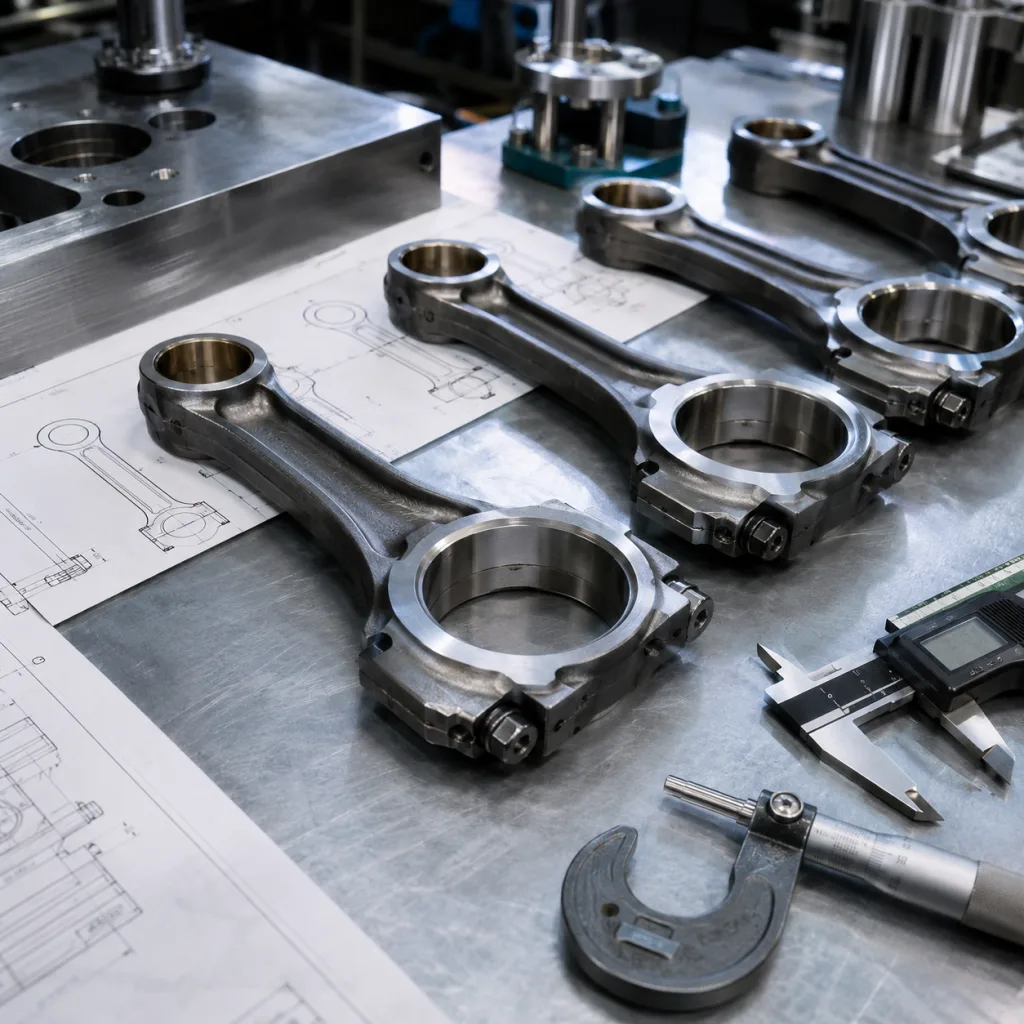
A connecting rod Fiat replacement must do more than look like the original component. It has to match the application on geometry, mass, bore size, centre-to-centre distance, bearing interface, fastener behaviour, and material performance under repeated combustion load. For procurement teams, the largest sourcing risk is often not the basic forging or machined blank, but inconsistent control of critical dimensions such as big-end bore roundness, cap alignment, small-end bush fit, and bolt clamp retention after tightening.
Driventus supplies replacement connecting rods for selected Fiat applications as independent aftermarket parts. Validation is based on OE-equivalent fitment requirements, production traceability, and quality controls aligned with IATF 16949:2016 and ISO 9001:2015. Driventus is an independent aftermarket manufacturer; brand names and OE references are used only to identify compatible applications.
When cross-referencing OE 06A107065 or similar family-style catalogue numbers, buyers should not rely on the reference alone. Always verify the exact engine code, piston pin diameter, centre distance, big-end bearing shell specification, and any design differences between engine variants. The guidance below is written for sourcing engineers, category buyers, distributors, and import managers who need stable supply, repeatable inspection results, and practical documentation for export markets.
What a Fiat connecting rod replacement must match
A correct replacement is defined by fitment and measured performance, not by appearance. Connecting rods are highly loaded engine components, so small deviations can affect bearing life, piston position, vibration, and long-term durability.
Critical characteristics include:
Centre-to-centre length
Big-end bore diameter, roundness, and width
Small-end bore diameter and pin clearance
Overall mass and weight spread within a matched set
Beam section, cap design, and material grade
Bolt specification, thread quality, and tightening behaviour
Bush material and interference fit, where a bush is used
Parting face quality and cap alignment
For Fiat applications, the rod must also be checked against the engine family, displacement, piston pin size, bearing thickness, and whether the engine uses a standard rebuild configuration or a variant-specific component. A small dimensional error can alter the effective compression height, piston deck position, rod angularity, and bearing load distribution.
Practical procurement rule
If the supplier cannot state the rod’s centre distance, bore sizes, width, mass tolerance, and fastener specification, the part should not be treated as OE-equivalent. Visual similarity is not enough for engine rebuild work, especially when parts are being purchased for distributor inventory or warranty-sensitive repair channels.
Key specifications buyers should verify
Use the following comparison points during sourcing, sample approval, and incoming inspection. The goal is to confirm that the replacement rod matches the intended engine configuration and can be assembled without forcing downstream workshops to correct avoidable variation.
Item
What to verify
Why it matters
Centre-to-centre length
Matches application data for the exact engine code
Controls piston position, compression relationship, and rod angularity
Big-end bore
Diameter, roundness, width, and alignment after cap torque
Affects bearing crush, oil film stability, and crankshaft journal life
Small-end bore
Diameter, bush fit, and piston pin clearance
Controls pin movement, noise, wear, and lubrication behaviour
Mass
Individual weight and matched-set spread
Reduces vibration, imbalance, and inconsistent cylinder loading
Bolt specification
Grade, thread form, tightening method, and clamp retention
Helps prevent cap movement, stretch loss, and high-rpm separation risk
Surface finish
Machining quality at bores, parting faces, and thrust areas
Supports bearing seating, assembly accuracy, and repeatable torque results
Material / process
Forged steel, sintered design, or other specified construction
Influences fatigue life, elongation resistance, and crack behaviour
Traceability
Batch number, production date, and inspection reference
Helps isolate issues and support distributor warranty control
</tr></thead><tbody> </tbody></table>A procurement file should also record packaging traceability, batch number, inspection status, and any dimensional report supplied by the manufacturer. For EU and UK shipments, ask for REACH (EC) No 1907/2006 compliance statements where applicable to coatings, protective oils, packaging materials, or ancillary substances.
For repeat orders, keep an approved drawing or specification sheet on file. This prevents silent substitutions when the same catalogue reference is used across more than one engine variant.
Validation testing for replacement confidence
Replacement connecting rods should be supported by validation evidence, not assumption. A sourcing decision is stronger when the supplier can show how the part is measured, how the process is controlled, and how nonconforming parts are contained before shipment.
At minimum, buyers should request evidence of:
Dimensional inspection using calibrated gauges, bore gauges, and CMM records where required
Material verification for forged, sintered, or machined blanks
Heat-treatment confirmation where the design depends on controlled hardness or strength
Bolt torque, stretch, and clamp retention checks
Big-end bore measurement after cap assembly and tightening
Fatigue or endurance testing aligned with expected engine duty
Surface hardness checks where hardening or local treatment is applied
Fitment verification against the target engine family
For aftermarket sales into regulated or warranty-sensitive markets, the supplier should be able to demonstrate process control under IATF 16949:2016 and ISO 9001:2015. These systems do not by themselves prove that a rod fits a specific Fiat engine, but they help show that production, inspection, corrective action, and traceability are managed consistently.
If the part is intended for emissions-related engine rebuilds, confirm that the replacement does not alter the engine’s certified configuration. Standards such as ECE R-83 and SAE J2527 may be relevant in broader vehicle, emissions, or durability discussions, but the rod itself is normally validated through dimensional accuracy, material conformity, fastening performance, and mechanical durability testing.
How Driventus supports procurement teams
Driventus manufactures powertrain components in Taizhou, Zhejiang, with export supply to more than 60 countries. For connecting rods, our focus is repeatable production, dimensional consistency, batch traceability, and documentation that supports distributor, importer, and workshop channels.
We support buyers with:
OE cross-reference review by engine family and application data
Production control aligned with IATF 16949:2016 and ISO 9001:2015
Batch traceability for export shipments and aftersales follow-up
Dimensional and material documentation for sample approval
Custom packaging and labelling for regional distribution
Engineering support for non-standard, discontinued, or hard-to-source applications
Communication support for consolidated orders across multiple engine component lines
For buyers managing a broader engine programme, connecting rods can be sourced alongside related powertrain components to simplify consolidation and supplier qualification. If you need broader coverage, see our catalog or the wider engine components range. For projects that require drawing changes, material selection changes, private labelling, or branded packaging, use our custom manufacturing service.
Common sourcing risks and how to avoid them
Replacement failures often come from specification drift rather than an obvious manufacturing defect. A rod may look correct in a catalogue photo but still be unsuitable once the cap is torqued, the bearing is installed, or the piston pin clearance is checked.
The most common sourcing issues are:
1. Wrong rod length for the actual engine code 2. Small-end bush size outside tolerance or not matched to the pin 3. Big-end bore not measured after cap torque 4. Excess mass variation across a matched set 5. Incorrect bolt grade, thread quality, or tightening instruction 6. Reused fasteners supplied or recommended where new bolts are required 7. Mixed batches without clear traceability 8. Catalogue interchange based only on vehicle model or year
To reduce risk, confirm the exact Fiat engine code, not only the model name, trim, or production year. Then check whether the replacement is intended for standard rebuilds, oversize piston applications, remanufactured engines, or performance use. These use cases may require different acceptance criteria, even when the basic application appears similar.
A qualified supplier should provide clear interchange data and should reject any request to guess-fit based on model name alone. For procurement teams, the cleanest approach is to lock the approved part number, dimensional drawing, sample approval record, packaging specification, and acceptance criteria before the first commercial order ships.
Ordering and documentation checklist
Before placing a PO for a Fiat connecting rod replacement, request a documentation pack that allows your receiving team and technical team to verify the part without relying only on catalogue claims.
Recommended items include:
Engine code and application list
OE cross-reference or catalogue equivalence statement
Full dimensional drawing with centre distance, bore sizes, and widths
Material and heat-treatment declaration
Bolt specification and tightening information
Inspection report for the first batch or sample submission
Batch traceability format and marking method
Packaging and labelling specification
Country-of-origin data and export documentation requirements
Compliance statements for coatings, oils, or packaging where applicable
If you are consolidating supply for distributors, workshops, engine rebuilders, or import warehouses, ask for a sample submission pack before mass order approval. That pack should help confirm bore sizes, mass range, cap fit, bolt behaviour, packaging strength, and label compatibility with your warehouse receiving process.
To review options or start a technical enquiry, you can request a quote. Include the engine code, target OE reference, annual quantity estimate, destination market, and any packaging or documentation requirements so the quotation can be checked against the correct application.
Frequently asked questions
Match the exact engine code, centre-to-centre length, big-end and small-end bore sizes, mass range, bearing specification, and bolt details. Do not buy from vehicle model alone. Ask for a drawing and inspection report before approving a batch.
No. Driventus is an independent aftermarket manufacturer; brand names and OE numbers are referenced for fitment identification only. Parts are supplied as replacement components, not OEM-approved items.
Request dimensional data, material and heat-treatment details, bolt information, batch traceability, and quality evidence aligned with IATF 16949:2016 and ISO 9001:2015. For export, also confirm packaging, country-of-origin data, and compliance statements where needed.
If you need a validated Fiat replacement rod or a quotation for a specific engine family, send your application details, target OE reference, destination market, and target quantity through our contact page: /contact.html