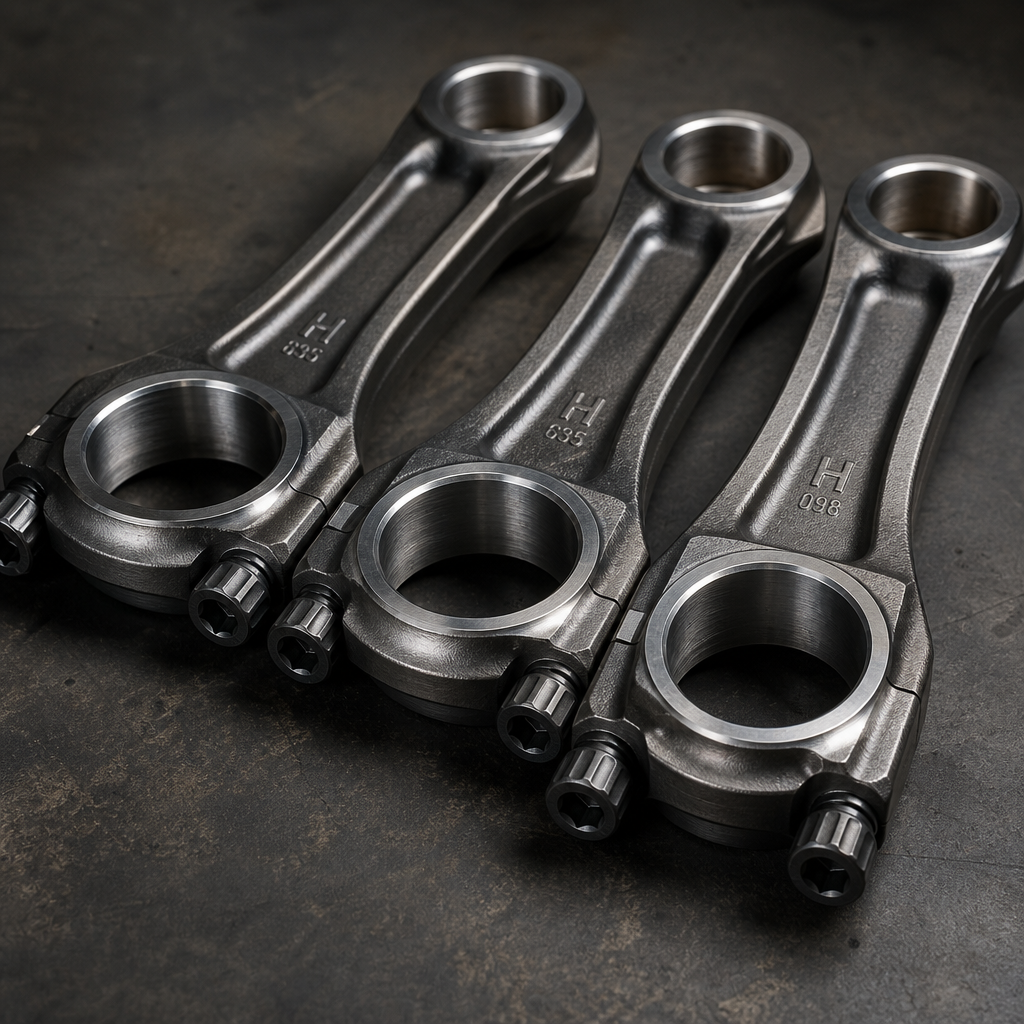
A connecting rod for BMW X3 aftermarket replacement is not a routine catalog item. It lives in one of the highest-load zones in the engine, transferring combustion force to the crankshaft through constant cyclic stress, oil heat, and changing rpm. For B2B buyers, the real question is not whether the part can be installed. It is whether the rod matches OE-critical geometry, metallurgy, bore condition, and fatigue behavior closely enough to support repeatable engine rebuilds without comeback risk.
That changes how the part should be sourced. Independent workshops, remanufacturers, distributors, and importers need more than a fitment claim; they need measured values and process evidence. The useful checkpoints are centre-to-centre length, big-end bore after bolt tightening, twist and bend, pin-bore condition, weight spread within a set, hardness range, and batch traceability. Commercial terms matter too, but only after the technical baseline is clear. Driventus manufactures engine components for export markets and supports B2B replacement demand with controlled production and inspection. Driventus is an independent aftermarket manufacturer; brand names are referenced for fitment only.
Start With the Decision: What Actually Makes One Rod Acceptable
For BMW X3 rebuild work, the first decision is simple: is this part being bought as a low-risk replacement, or as a low-price experiment? A connecting rod that is merely installable is not necessarily acceptable. Small variation in rod length, bore roundness, or mass can change piston deck height, bearing support, oil clearance behavior, vibration, and long-run durability.
That is why experienced buyers qualify the part in this order:
Application match first: engine code, displacement, production year, fuel type, and piston pin configuration
Geometry second: centre-to-centre length, big-end bore size, big-end side width, and small-end bore condition
Assembly condition third: bolt specification, tightening method, and bore size after cap assembly
Mass control fourth: total rod weight, end-weight spread, and consistency within an engine set
Material and finish last: forged steel grade, heat treatment, shot peening where specified, and edge finish around stressed areas
This sequence matters because many field failures do not start with a dramatic visible defect. They start with a rod that was "close enough" on paper but wrong in one critical dimension. In rebuild programs following oil starvation, piston seizure, or spun-bearing damage, the labor cost of a second teardown usually overwhelms any small saving on part price.
When sourcing a connecting rod for BMW X3 aftermarket replacement, the RFQ should read like a technical qualification brief, not a generic parts inquiry. At minimum, it should state the engine application, whether bolts are included, whether rods are purchased singly or as matched sets, the expected annual volume, and which inspection results must accompany shipment.
Use a Failure-Mode Screen Before You Compare Suppliers
A better sourcing brief does not ask suppliers to confirm they can "make the part." It asks them to show how they control the failure modes that create warranty cost.
Measured nominal and tolerance band; CMM or fixture report
Big-end bore out of size after bolt tightening
Bearing crush or oil-clearance problems
Final bore report taken after cap assembly
Poor big-end roundness/cylindricity
Uneven bearing load and localized wear
Roundness limit and inspection method
Small-end bore or bushing mismatch
Wrist-pin fit problems, noise, lubrication issues
Bore ID data and pin-fit specification
Twist or bend outside limit
Piston misalignment in the cylinder
Alignment fixture results and release criteria
Weight spread within one set
Balance variation, NVH increase, uneven loading
Total-weight and end-weight sorting standard
Unstable bolt preload
Cap movement risk under cyclic load
Torque-angle, stretch, or other preload control method
Metallurgy inconsistency
Reduced fatigue life
Material certs, hardness records, microstructure checks
</tr></thead><tbody> </tbody></table>This approach is especially useful for a connecting rod for BMW X3 aftermarket replacement because visually similar parts can hide meaningful differences in pin diameter, beam section, cap architecture, or bore geometry. A photo match is not a technical match.
Useful sourcing questions include:
What is the measured big-end bore range after final bolt tightening?
What roundness limit is used for release?
Is the rod weight sorted 100%, by sample, or only by batch average?
What bolt tightening method is used during final bore machining?
Which characteristics are checked on every piece, and which are checked by sampling?
Two suppliers may quote the same application and still deliver very different product consistency. For connecting rods, the process route often tells you more than the product photo or cross-reference list.
What a credible process chain should include
Forged steel material specification with incoming verification against the declared grade
Controlled heat treatment with recorded hardness range by batch
Cap and mating-face machining under defined process control
Final big-end bore machining after bolt assembly
Shot peening or equivalent surface treatment where the program requires it
Visual inspection for burrs, cracks, and handling damage
Batch traceability from forging lot through packing
Defined dimensional inspection frequency, such as first-off, patrol, and final audit
What validation separates a catalog seller from a real manufacturing source
A professional rebuild program usually wants evidence, not broad claims. That can include:
Capability data on critical dimensions
Hardness and tensile checks on material lots
Fatigue or durability validation aligned with customer requirements
Bolt preload consistency testing
Metallographic review after heat treatment
Magnetic particle inspection or other crack-detection control where required
Cleanliness and export-packaging checks
For destination markets and larger accounts, the production-control environment matters as much as the part itself. Buyers commonly expect documented compliance with IATF 16949:2016 and ISO 9001:2015 because those systems support traceability, corrective action, and repeat production discipline. Where material compliance applies, substance control should also align with REACH (EC) No 1907/2006.
For a connecting rod for BMW X3 aftermarket replacement, asking "what material is it?" is not enough. The sharper questions are: when is the bore finished, how is the bolt tightened during machining, what hardness window is released, and what batch data follows the shipment?
Driventus operates under a documented quality system and supports project-specific inspection requirements for B2B customers.
Fitment Deep-Dive: Where BMW X3 Programs Commonly Go Wrong
BMW X3 applications span multiple engine families and production periods. That is where many purchasing errors start. The category looks narrow, but the fitment risk is not.
The most common mismatch points are:
Petrol versus diesel application
Engine code and build period
Rod length and beam profile
Piston pin diameter and small-end design
Big-end width and bore size
Bearing shell specification
Rod bolt design and tightening method
Fracture-split cap versus conventional machined cap construction
A practical workflow is to confirm the engine code, request VIN-derived application data where permitted, collect sample-part photos, and verify critical dimensions against the intended build. If an OE cross-reference is available, record it clearly in the inquiry instead of leaving it as workshop shorthand.
For importers and distributors, it helps to standardize the front-end data capture. A useful inquiry form should include:
Vehicle model and year range
Engine code and displacement
OE number or customer cross-reference
Bolt inclusion or separate sourcing status
Order quantity and annual forecast
Destination market and packaging language needs
Sample-approval requirement before mass order
When buying a connecting rod for BMW X3 aftermarket replacement, this step is where return rates are either reduced or created. A pin-bore mismatch or big-end width error may stay hidden until assembly. By then, the buyer has already paid freight, warehouse handling, and schedule delay.
For importers building a broader replacement program, custom manufacturing may be relevant when you need customer-specific packing, barcode control, matched rod-set grading, or dedicated inspection templates.
A Practical Buying Sequence for MOQ, Samples, and Repeat Orders
Once fitment and technical controls are clear, the commercial discussion becomes more useful. This is where B2B buyers should stop treating the first order like a normal replenishment purchase and treat it like a controlled qualification stage.
A workable sequence usually looks like this:
1. Send the application list with engine codes, cross-references, and target quantities. 2. Request technical confirmation on critical dimensions, bolt inclusion, process route, and inspection scope. 3. Review sample or pilot-lot data before committing to a larger shipment. 4. Place a controlled first order with traceable lot coding and agreed documentation. 5. Track field feedback from installers or rebuilders. 6. Move to repeat scheduling only after fitment and claim performance are stable.
What buyers should expect from the supplier during this process:
Defined MOQ by application and packing format
Lead times for stock orders versus new production
PPAP-style documentation support when requested
Critical-dimension inspection reports
Material and hardness records by batch
Neutral or private-label packing options
Corrosion protection suitable for sea freight and storage
A traceable non-conformance process
The commercial logic is usually straightforward:
MOQ tends to be lower for stock programs and higher for private-label or non-stock production
Price changes with volume, bolt inclusion, inspection level, packaging, and matched-set requirements
Lead time extends when first-article approval, special labels, or dedicated inspection formats are added
Sampling reduces fitment risk before larger commitments
Claim handling depends on lot coding, retained records, and response discipline
For a connecting rod for BMW X3 aftermarket replacement, this staged buying model is practical because the cost of error shows up in engine teardown labor, workshop downtime, and customer trust, not just in the replacement value of the rod itself.
Driventus supplies engine and powertrain components to distributors, OEM-related customers, and repair networks in multiple export markets. For replacement programs, customers often begin with sample evaluation, dimensional confirmation, and pilot orders before scaling to regular container planning. Depending on the program, buyers may request bulk industrial packing, boxed retail packing, laser-marked traceability, or shipment with batch-linked inspection records.
If you are qualifying a supplier for a connecting rod for BMW X3 aftermarket replacement, the most useful first step is to share the target application list, annual volume, required documentation level, and destination-market standards. That makes supplier comparison more accurate than comparing piece price alone.
Frequently asked questions
Ask for critical-dimension reports, material or hardness records, traceability details, and the supplier's quality certifications such as IATF 16949:2016 and ISO 9001:2015. For tighter-control programs, request measured values for centre-to-centre length, big-end bore after bolt tightening, small-end bore, weight data, and the bolt tightening specification used during final machining. For EU supply, material compliance information relevant to REACH (EC) No 1907/2006 is also useful.
No. BMW X3 models use different engine families across petrol and diesel applications. Rod length, pin bore, big-end dimensions, beam shape, and cap design may vary. Always verify engine code, production period, and any OE cross-reference before ordering. Also confirm whether the rod is supplied with bolts and whether it matches the intended bearing and piston specification.
Weight variation affects reciprocating balance, vibration, and load distribution across cylinders. Tight control of total rod mass and end balance helps maintain engine smoothness and reduces the risk of uneven cranktrain stress after rebuild. In B2B purchasing, buyers often ask for the allowed weight spread within one engine set and whether 100% sorting or sample-based checking is used.
If you are sourcing replacement connecting rods for BMW X3 programs, send your application list, annual volume, and technical requirements to [request a quote](/contact.html). We can review fitment data, inspection needs, MOQ and lead-time expectations, and supply options for your market.