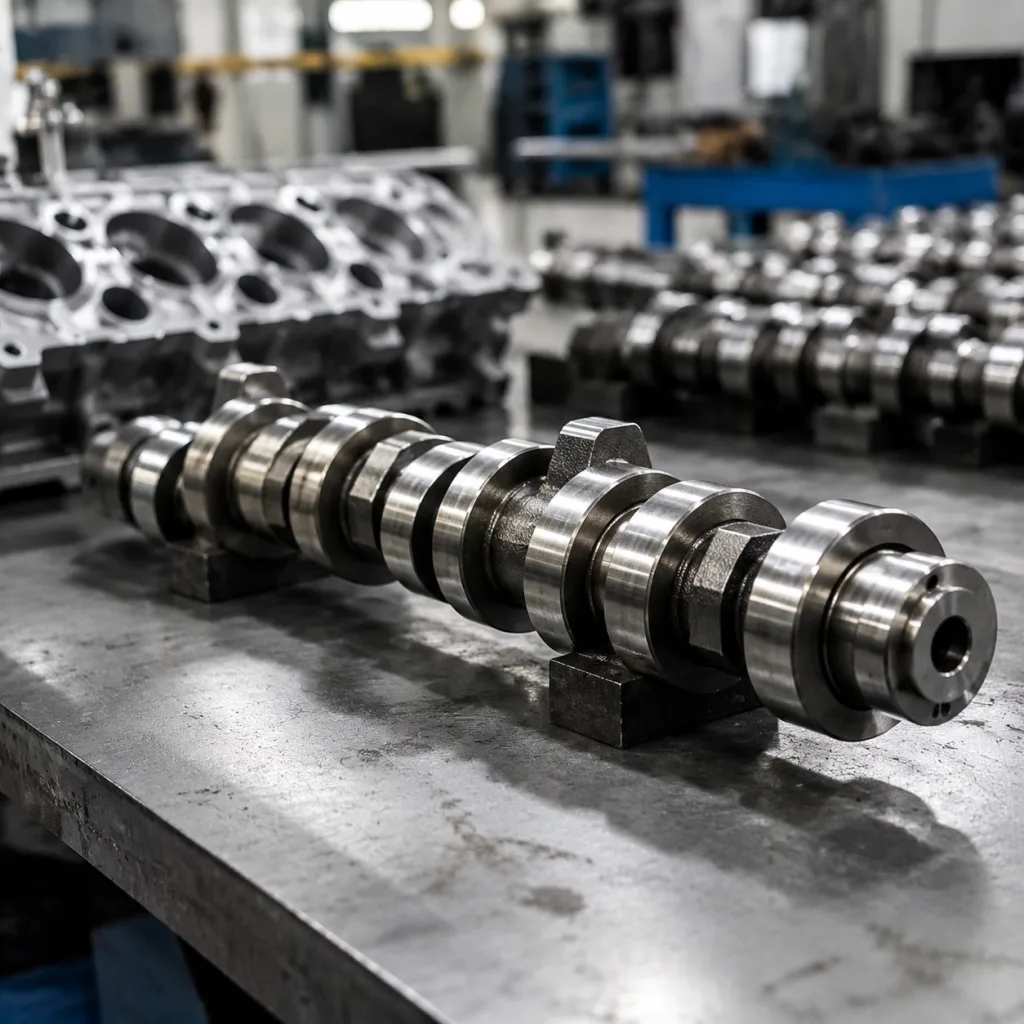
Connecting Rod for Audi Q7 Aftermarket Replacement
A connecting rod for Audi Q7 aftermarket replacement is not a model-name purchase. It is an engine-code, dimension, material, bolt, and validation purchase. Two rods can look alike on a bench and still differ enough in big-end geometry, pin-bore finish, cap location, or set weight to create bearing noise, oil-clearance issues, imbalance, or warranty claims after installation.
For B2B buyers, the decision is rarely “which rod is cheapest?” The better question is: which supply route gives repeatable fitment, controlled inspection evidence, stable packaging, and a claim process that can support distribution or repair-chain use? A 3–5 g mismatch inside an engine set, a bore measured without final bolt tightening, or an unclear bolt instruction can cost more than the saving on the part.
Driventus manufactures engine components for B2B supply programmes, including connecting rods for passenger car and light commercial applications. Our production approach is built around OE-equivalent dimensional control, material traceability, stable machining processes, and batch validation within an IATF 16949:2016 and ISO 9001:2015 quality framework. Existing catalogue references normally have lower MOQ and shorter lead time because tooling, gauges, and packaging structures are already available. New or private-label programmes need sample review, drawing confirmation, first-article approval, and launch planning before repeat supply.
Driventus is an independent aftermarket manufacturer; brand names are used only to identify fitment requirements. The sections below turn Audi Q7 connecting rod sourcing into a practical procurement decision: what to confirm, what fails, how to compare quotations, and which evidence should be in the approval file.
Decision framework: approve the engine, not the vehicle name
Start with a hard rule: do not source a connecting rod by “Audi Q7” alone. Q7 applications vary by generation, market, production year, fuel type, displacement, emissions generation, and engine family. A rod that fits one V6 or V8 application is not automatically correct for another engine with a similar catalogue description.
A usable buying file should identify the rod by engine code and functional dimensions. Record measured values and tolerances, not only catalogue wording. The minimum technical identity should include displacement, piston pin diameter, crankpin diameter, centre-to-centre length, big-end width, small-end design, bushing status, rod bolt configuration, and whether the rod is supplied as a single piece, bank set, or complete engine set.
The approval sequence should be simple:
1. Confirm application by engine code and production range. 2. Freeze the approved reference: drawing, OE-style sample, or validated aftermarket master sample. 3. Define critical dimensions and measurement conditions. 4. Confirm material route, heat treatment, hardness range, and traceability. 5. Decide whether bolts are included and how they must be tightened during inspection and installation. 6. Set weight-matching rules for engine sets. 7. Approve packaging, labelling, and corrosion protection. 8. Agree MOQ, lead time, documentation, and claim handling before volume order.
For aftermarket buyers, the target is OE-equivalent function. The rod must assemble with the specified crankshaft, piston, piston pin, bearing shell, and fastener stack without installer machining or improvised correction. Controlled features usually include centre distance, big-end finished bore after bolt tightening, big-end width, pin-bore diameter, bushing wall condition where used, bend, twist, cap offset, and mass. The exact numbers depend on the engine code and approved reference, but the control level should be in microns for bores and in grams for weight grouping.
A robust sourcing file should include:
Application range by engine code, displacement, fuel type, and production period
OE-style part-number cross-reference where available, using references supplied or approved by the buyer
Critical dimensions, tolerances, and inspection method, including gauge type and assembled-bolt condition
Material grade, heat-treatment route, hardness range, and lot traceability
Rod bolt specification, inclusion status, coating, lubrication condition, and tightening method
Weight grouping policy for cylinder-bank sets or complete engine sets, with maximum spread stated in grams
Packaging method for corrosion prevention, cap protection, and bore protection during ocean freight
Traceability format, batch marking, retained samples, and inspection documentation expectations
Commercial basis: MOQ, quotation unit, tooling or fixture charges, sample cost, lead time, and reorder lead time
Repeat shipments must remain consistent. Wholesalers, rebuilders, and repair chains should not need to revalidate every delivery before selling or fitting the part. If a programme uses mixed sourcing, do not combine rods from different production lots in one engine set unless weight group, bore size, and bolt specification have been confirmed compatible.
For existing validated aftermarket items, MOQ is usually lower because tooling, gauges, and packaging are already established. For a new Audi Q7 engine-code programme, plan for sample evaluation, fixture confirmation, pilot production, first-article inspection, and packaging approval before mass supply. Driventus supports application matching through our catalog and engine-component discussions through /products/engine-components.html. Custom packaging, part marking, barcode labels, inspection reports, and private-label supply can be reviewed through custom manufacturing.
Spec deep-dive: the dimensions that decide bearing life and installer confidence
The dangerous dimensions are not always visible. A forged rod may look correct but still fail the sourcing decision if the big-end bore changes after cap tightening, the pin bore has the wrong finish, or the cap and body do not locate repeatably. Procurement teams should request a drawing-level comparison against the target OE sample, buyer-approved specification, or validated aftermarket reference. If no drawing is available, measure and freeze a controlled master sample.
Checkpoint
Why it matters
Typical control method
Centre-to-centre length
Controls compression height and piston deck position; variation can affect compression balance between cylinders
CMM, height gauge fixture, or dedicated centre-distance gauge
Big-end bore diameter and roundness
Determines bearing oil clearance and affects bearing life under hot running load
Air gauge or precision bore gauge after final bolts are tightened to the specified method
Small-end bore diameter
Controls piston pin fit, oil film behaviour, pin float, and cold-start noise risk
Precision bore measurement, plug gauge confirmation, and finish check
Big-end width
Prevents crank cheek interference and maintains side clearance
Micrometer, comparator, or dedicated width gauge
Rod twist and bend
Affects piston alignment, ring seal, cylinder wear, and skirt contact pattern
Dedicated alignment fixture or CMM check
Set weight variation
Reduces imbalance after rebuild and improves set matching for V6 or V8 engine sets
0.1 g or 1 g resolution scale depending on control plan, then grouping by total mass and, where required, end mass
Bolt seat geometry
Supports repeatable clamp load and cap location; poor seating changes bolt stretch
Visual, profile, and dimensional inspection of seat flatness and contact surface
Parting-face condition
Influences cap alignment and bore stability after tightening
Surface inspection, cap shift check, and assembled bore verification
Surface roughness
Affects bearing seating, pin movement, oil retention, and friction
Roughness tester on functional bores and machined thrust faces where specified
</tr></thead><tbody> </tbody></table>For a connecting rod for Audi Q7 aftermarket replacement, the big end should be measured with the correct rod bolts installed and tightened by the defined method. Measuring the cap and body separately is not enough. Bearing oil clearance is created under assembled conditions, and those conditions are influenced by cap shift, parting-face quality, fastener friction, bolt stretch, and final honing.
Do not approve bore diameter alone. Roundness, taper, and repeatability after loosening and re-tightening are just as important. A rod can meet a single diameter reading and still create bearing distress if the assembled bore is unstable.
Useful tolerances must be written as numbers. Exact limits depend on the engine and approved reference, but buyers commonly define finished-bore control in micron ranges, surface roughness in Ra values, bend and twist with fixture limits, and complete set weight spread within a stated gram range. A rebuild-chain specification may, for example, require every rod in one engine set to come from the same batch, carry the same weight group, and be packed together to prevent warehouse mixing.
Also decide how the part is sold. Individual rods suit open distribution, but V6 or V8 rebuild programmes often benefit from matched sets. Matched packing reduces installer time, avoids mixed-weight assemblies, and makes workshop QC more predictable. If rods are sold individually, the carton label should show application, batch, weight group, and bolt inclusion status so visually similar but technically different parts do not get mixed in stock.
Failure modes: where cheap rods usually become expensive
Connecting rods are high-cycle fatigue parts. They live under repeated tensile and compressive loading from cold start to full-load acceleration. The failures that matter in procurement are usually built into the process long before the carton reaches the warehouse.
Common failure paths include:
Uncontrolled steel input: chemistry, heat number, or certificate mismatch weakens traceability and can hide material variation.
Poor forging control: unstable billet weight, forging temperature, die condition, or fibre flow can reduce fatigue margin.
Heat-treatment drift: hardness outside the approved range may create brittleness, low strength, or inconsistent machining behaviour.
Insufficient crack detection: discontinuities around beam transitions, big-end shoulders, bolt seats, or cap interfaces may escape visual inspection.
Cap movement during machining: if cap assembly and bolt tightening are not controlled before final boring and honing, the finished bore may not be stable.
Tool wear in honing: bore size, roundness, taper, and surface finish can move gradually across a batch.
Inadequate cleaning: abrasive or machining residue can damage bearings and pins after assembly.
Weak packaging: corrosion, cap damage, or bore contamination during ocean freight can turn acceptable production into rejected stock.
A credible supplier should be able to explain the process route without vague language. The route usually includes incoming steel verification, billet cutting, forging, trimming, heat treatment, hardness checks, shot blasting or shot peening where specified, crack detection, CNC machining, controlled cap assembly, finish boring, honing, cleaning, rust prevention, and export packaging.
Process claims need records. A practical batch file normally includes the steel mill certificate, heat-treatment chart or batch record, hardness readings, dimensional inspection report, crack-inspection result, operator or line identification, and packaging date. For private-label or warranty-sensitive programmes, buyers can request retained samples from each production lot and agree on the retention period.
Driventus applies process controls under its quality system, aligned with IATF 16949:2016 and ISO 9001:2015. These standards do not approve a part for a specific vehicle, and they should not be presented as vehicle manufacturer endorsement. They do, however, define expectations for process control, traceability, corrective action, document control, internal audit, supplier management, and continual improvement.
For EU and UK importers, material declarations and chemical compliance may also be relevant under REACH (EC) No 1907/2006, depending on contract scope, article classification, and supplied documentation.
Commercially, every process choice affects the quote. A rod supplied with bolts, bushing, weight matching, magnetic particle inspection, individual anti-rust packaging, private-label cartons, and batch reports will not price the same as a loose unpacked component. Quote the complete specification. Otherwise, the lowest price may simply be the quote with the most missing controls.
Driventus is an independent aftermarket manufacturer; brand names are referenced for fitment only. No approval, sponsorship, or endorsement by any vehicle manufacturer is implied.
Validation sequence: from sample approval to repeatable shipment
A first-article report is useful, but it is not the whole validation plan. One good sample does not prove that the material route, machining process, packaging, documentation, and repeat production are stable. For a higher-value Audi Q7 engine repair programme, validation should be agreed before tooling release or purchase order confirmation.
Recommended validation evidence includes:
Dimensional first-article inspection: Full measurement of critical dimensions against the approved drawing, master sample, or buyer-approved reference. The report should state the measuring equipment, environmental conditions where relevant, and whether the big end was measured with the final bolts tightened.
Material certificate review: Chemical composition and mechanical property confirmation for the steel batch, linked to heat number and production lot.
Hardness testing: Verification after heat treatment at defined locations and acceptable ranges. The method and scale, such as HRC or HV, should be stated in the inspection plan.
Magnetic particle or equivalent crack inspection: Screening for forging or machining-related discontinuities on critical areas such as beam transitions, big-end shoulders, bolt seats, and cap interfaces.
Surface finish report: Confirmation for the pin bore, bearing bore, and other functional surfaces where required, recorded as Ra or another agreed parameter.
Bolt clamp evaluation: Evidence that the specified tightening method produces repeatable clamping force without thread damage, cap movement, or bore distortion beyond the approved limit.
Assembly fit review: Trial assembly with representative bearings, piston pins, bolts, and, where practical, crankshaft and piston samples for high-risk applications.
Weight and balance report: Confirmation of total rod mass and, when required, big-end and small-end mass distribution for each rod in an engine set.
Fatigue or durability assessment: Programme-specific testing for higher-volume, higher-risk, or private-label projects, especially where the buyer expects long warranty coverage.
Packaging validation: Corrosion resistance and bore protection for sea freight, handling, and extended warehouse storage, including checks after vibration or drop simulation where required.
A practical release path is:
1. Sample measurement. 2. Master-sample approval. 3. Pilot run. 4. First-article report. 5. Controlled installation trial. 6. Packaging approval. 7. Mass-production release. 8. Shipment review and early field feedback.
New programmes need a longer launch window than stock items. Gauges, machining offsets, bolt instructions, labels, packaging, and inspection reports must be confirmed together. Catalogue reorder lead times are usually shorter than new-development lead times. Private-label cartons, special reports, and country-specific labels can add time even when the rod itself is already validated.
For multi-location repair chains, installation feedback should be part of validation. Early rebuild data can reveal bearing-fit concerns, unclear bolt tightening instructions, labelling mistakes, or packaging damage before national rollout. For distributors, the same feedback reduces warranty exposure and gives technical teams faster answers for trade customers.
If the buyer has an OE-style reference such as OE 06A107065 in an internal system, use it only if it is relevant to the actual engine family being sourced. Cross-references are often copied across catalogues. Dimensions, engine code, and application data must confirm the part. A cross-reference should start the investigation, not replace the engineering approval file.
Quotation comparison: normalise MOQ, packaging, bolts, and documentation
A connecting rod for Audi Q7 aftermarket replacement should be purchased against clear acceptance criteria before the order is placed. This matters most when the part will be sold under a private label, stocked in multiple warehouses, or fitted by repair networks that expect low return rates and repeatable installation results.
The purchase order should reference the approved drawing or master sample, inspection plan, packing method, and shipment documentation. Without those references, two suppliers may be quoting completely different products under the same part name.
Use the following checklist during supplier qualification:
1. Confirm engine code, displacement, fuel type, production range, target market, and emissions generation where relevant. 2. Request a drawing, critical-dimension sheet, or approved master-sample record before purchase order approval. 3. Define whether supply is by individual piece, cylinder-bank set, or complete engine set, and specify how sets will be packed and labelled. 4. Confirm rod bolt inclusion, bolt grade, coating if applicable, lubrication condition, and tightening instructions. 5. Agree weight grouping limits, set matching rules, end-mass requirements if needed, and marking method. 6. Ask for current IATF 16949:2016 and ISO 9001:2015 certificate copies where applicable. 7. Review the inspection plan, sampling level, control points, measuring equipment, calibration status, and retained-sample policy. 8. Specify corrosion protection for ocean freight, customs delays, humid warehouses, and long storage periods. 9. Confirm inner packaging, carton labelling, barcode format, language requirements, batch code, and country-of-origin marking. 10. Agree claim handling process, evidence requirements, response timing, containment action, and corrective-action format. 11. Clarify MOQ by part number, by weight group, and by packaging version. A private-label carton or barcode version can create a higher practical MOQ than a neutral-pack order. 12. Confirm price basis: rods only or rods with bolts, bushing, inspection report, set matching, export carton, palletisation, and documentation. 13. Confirm lead-time basis: sample lead time, pilot-run lead time, mass-production lead time, and repeat-order lead time after approval. 14. Agree Incoterms, destination port, pallet specification, carton weight limit, and whether mixed references are allowed in one shipment.
Do not compare unit price until the offer is normalised. One quote may include bolts, magnetic particle inspection, matched engine sets, private-label cartons, barcode labels, and batch reports. Another may be a loose neutral-pack rod with limited documentation. The higher unit price may have the lower operating cost if it reduces warehouse sorting, installer uncertainty, corrosion claims, and warranty exposure.
MOQ is also not controlled by forging alone. Existing catalogue rods may support smaller trial quantities because tooling and inspection fixtures are already available. New references, private-label packaging, special weight grouping, 100% inspection, and extra documentation raise setup work and may require higher MOQ. Ask for separate pricing lines for sample approval, pilot batch, and volume order so landed cost is clear.
Driventus can supply standard aftermarket connecting rods where validated applications exist, or review drawings and samples for private-label programmes. Buyers can request a quote with engine code, annual volume, target packaging, destination market, preferred Incoterms, expected launch date, and available OE-style cross-reference. This helps avoid misquoting parts that appear similar but differ in pin diameter, big-end width, small-end structure, or bolt arrangement.
Q&A for high-risk sourcing calls before purchase order release
Can the part be sourced by vehicle name alone? No. Audi Q7 applications vary by market, emissions generation, production year, and engine family. Model-only sourcing can produce incorrect stock, workshop delays, and expensive disputes after the part has entered distribution.
Is visual similarity enough for approval? No. Important differences can be hidden in bore geometry, cap alignment, surface finish, heat treatment, bolt seat machining, small-end bushing specification, and set balancing. The target is repeatable fitment and predictable service performance, not a rod that only looks right.
What is usually missing from a low-cost quote? Often the quote excludes rod bolts, small-end bushings, corrosion protection, individual sleeves, labels, inspection reports, or set matching. If repair chains must reuse unsuitable bolts, repackage locally, sort weights before installation, or handle corrosion claims, the low price becomes expensive.
Why do bolt instructions matter? Some connecting rods require specific tightening procedures, such as torque-plus-angle methods, defined lubrication on threads and seating surfaces, or replacement bolts after one use. If the supplier includes bolts, the bolt specification and tightening instruction should be controlled and available to the repair chain. If bolts are not included, the quotation and packaging should state this clearly.
What should happen if one batch is mixed with another? Do not assume compatibility. Weight group, bore size, bolt specification, and inspection status must be checked before rods from different production lots are assembled into one engine set. For rebuild programmes, same-batch matched sets are safer and easier to control.
How should buyers compare suppliers fairly? Build the comparison on landed cost, expected reject rate, sorting labour, warranty exposure, documentation, packaging, and reorder stability. A loose rod in neutral packaging is not the same offer as a matched set with bolts, crack inspection, barcode labels, and batch reports.
What file reduces disputes later? A disciplined approval file. It should hold the accepted specification, inspection requirements, MOQ logic, lead-time assumptions, packaging expectations, documentation, and claim process. This file protects the importer, distributor, workshop, and supplier because everyone is working from the same approved definition.
Frequently asked questions
No. Buyers should confirm engine code, displacement, production range, piston pin size, crankpin size, big-end width, centre distance, and rod bolt configuration. Model-only sourcing increases the risk of incorrect fitment.
IATF 16949:2016 and ISO 9001:2015 are important for automotive process control and quality management. They do not represent vehicle manufacturer approval, but they support traceability, corrective action, documentation control, supplier management, and production discipline.
Yes, subject to application review, volume, drawing or sample availability, and validation requirements. Packaging, marking, inspection reports, barcode labels, labelling, MOQ, price basis, and documentation can be discussed for distributor and repair-chain programmes.
For Audi Q7 connecting rod sourcing, send engine code, target volume, destination market, required packaging, bolt requirement, expected lead time, and any available cross-reference so our team can review fitment and documentation requirements. Start a technical discussion at /contact.html