connecting rod · 2026-05-28

Connecting Rod Alfa Romeo Replacement: OE Match Guide

Alfa Romeo connecting rod replacement is a dimensional and commercial decision, not a badge decision. The correct part must match engine code, centre-to-centre length, big-end and small-end bores, bolt specification, and mass class before it is approved for rebuild or resale. Buyers should expect OE-equivalent geometry, repeatable machining, and documentation that supports traceability across batches. Driventus is an independent aftermarket manufacturer; brand names are referenced for fitment only. When the original rod is obsolete or the vehicle is being repaired outside dealer channels, the safest route is to validate a sample against the engine drawing, then lock the part to a controlled specification. That approach reduces comeback risk and keeps procurement aligned with repeatable supply, not one-off salvage.

What must match on an Alfa Romeo rod

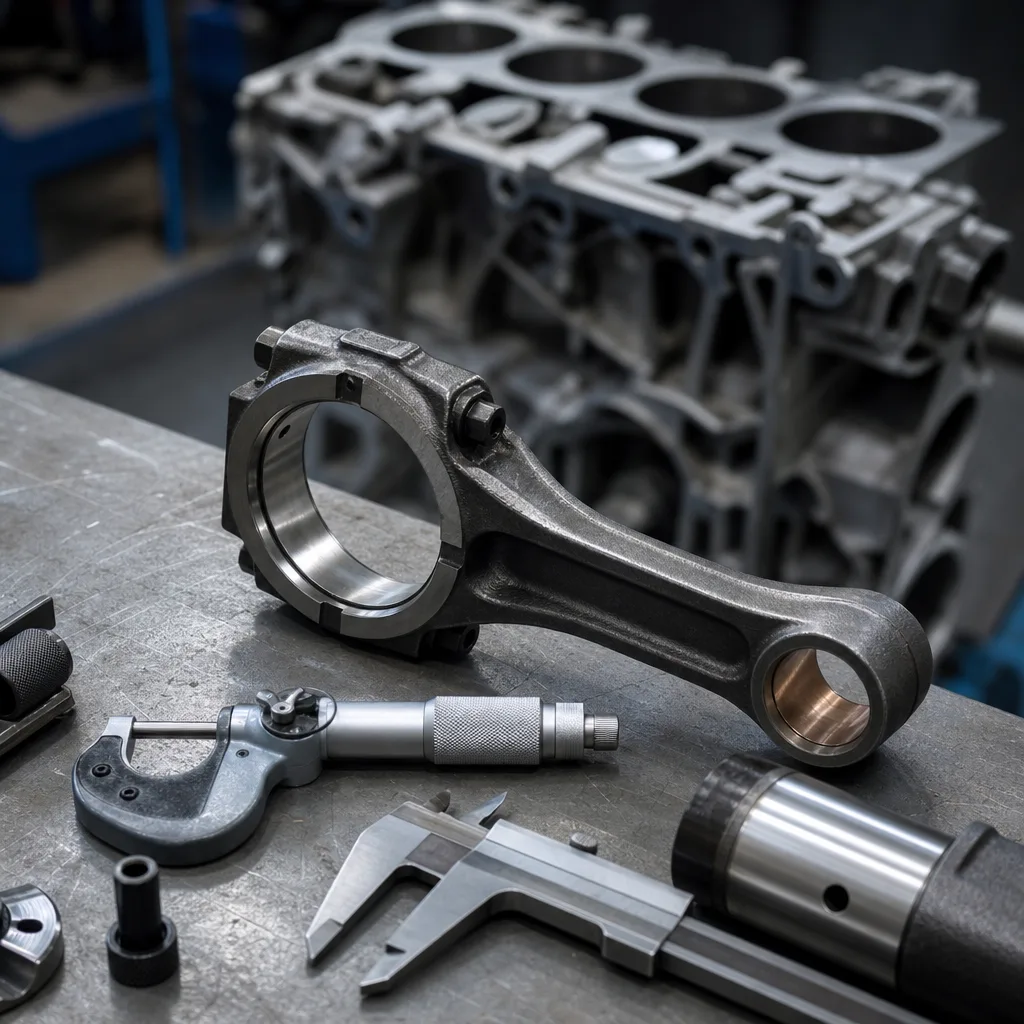
A correct replacement starts with the engine family, not the model badge. The rod must match the original centre-to-centre length, big-end bore after torquing, small-end fit, beam width, cap geometry, and bolt specification. If any one of those points is off, the engine can suffer piston height variation, bearing distress, or imbalance at speed.

For procurement, the priority is OE-equivalent geometry and controlled mass spread across the set. Many passenger-car programmes target less than 2 g variation across a matched set, but the engine drawing remains the source of truth. If the original part is unavailable, the cross-reference should be built from a sample rod, crank journal size, piston pin diameter, and the actual bolt style used in the engine.

For a wider range of engine hardware, start with our catalog or the engine components section.

Dimensional checks before approval

Do not approve a rod on visual similarity alone. The practical checks below are the ones that prevent avoidable returns:

  • Centre-to-centre length: match the engine drawing and confirm set consistency.
  • Big-end bore: measure after torquing, not only on the loose component.
  • Small-end bore or bush ID: verify pin fit and concentricity.
  • Beam and cap clearance: check against the piston and crank at full stroke.
  • Weight matching: keep the rods in a narrow mass band and preserve end-to-end balance.
  • Fasteners: confirm grade, stretch method, and torque angle if the engine uses torque-to-yield hardware.

In practical sourcing terms, a verified replacement rod is one where the measured values line up with the sample and the rebuild can proceed without rework. If the buyer wants repeat orders, lock those dimensions into the purchase specification and keep one retained master sample for later audits.

Materials, finish, and validation

For a replacement programme, the question is not whether the rod is new or used; it is whether the material, heat treatment, and validation match the duty cycle.

</tr></thead><tbody> </tbody></table>New forged-steel rods usually give the cleanest path for rebuilds with commercial demand. For higher load applications, check hardness, surface finish, fracture or split-cap geometry where applicable, and proof-test records. Validation should include dimensional inspection, hardness testing, magnetic particle inspection or an equivalent NDT method, and fatigue or cyclic load testing aligned to the customer plan.

A controlled supplier should work under IATF 16949:2016 and ISO 9001:2015, with REACH (EC) No 1907/2006 declarations for materials and coatings. If the programme needs private labelling, packaging control, or a drawing-based special, custom manufacturing is the appropriate route.

How to source a reliable replacement lot

Buyers should treat the rod as a controlled component, not a generic forging. The right supplier will confirm alloy route, heat-treatment window, machining sequence, and final inspection method. For export programmes, ask for lot traceability, dimensional reports, and consistent packaging that prevents beam damage in transit.

A practical source checklist:

  • Engine code and displacement
  • Sample rod or full teardown set
  • OE comparison point for length, bore, and bolt spec
  • Annual volume and call-off pattern
  • Target market compliance needs, including REACH (EC) No 1907/2006
  • Required test records and label format

Compare the supplier's stated controls with the quality system before confirming an order. That is the simplest way to separate a stable replacement source from a short-run trading offer with weak traceability.

What else should be replaced

If one rod has failed, do not stop at the rod itself. Inspect the crankshaft journal, bearing shells, piston pin, oil supply, and cylinder wall before placing the order. A bent rod can be a symptom of hydrolock, overspeed, detonation, or prior bearing failure, and replacement without root-cause review can repeat the damage.

On a rebuild, buyers commonly replace:

  • The full rod set, not one isolated piece
  • Rod bolts or cap hardware, if the design allows separate replacement
  • Big-end and main bearings
  • Piston pins or bushes if wear or scuffing is visible
  • Oil pump and filter after metallic contamination

Driventus is an independent aftermarket manufacturer; brand names are referenced for fitment only. For a matched programme covering rods and adjacent engine hardware, review our catalog and then send the engine details for a controlled quotation through request a quote.

Frequently asked questions

Use the engine code, rod length, big-end bore, small-end bore, bolt spec, and a sample part. If the old rod is damaged, measure the crank journal and piston pin to rebuild the cross-reference.

Yes. For stable demand, we can work from a sample or drawing through [custom manufacturing](/oem-services.html), then validate dimensions, material, and packing before release.

Typical documents include dimensional inspection data, material certificates, REACH declarations, and batch traceability. Additional test records can be added where the buyer requires them.

If you need an OE-equivalent programme for an Alfa Romeo application, send the engine code, sample photos, and target volume through [request a quote](/contact.html).

Request a Quote
Option Fit risk Durability Commercial risk
Used originalHighUnknownNo traceability
ReconditionedMediumDepends on machining and bolt renewalNeeds process control
New OE-equivalentLowestPredictable when validatedBest for repeat sourcing