Connecting Rod Alfa Romeo OEM Supplier: Sourcing Guide
If you are sourcing a connecting rod Alfa Romeo OEM supplier relationship, the first questions are not about price alone. They are about dimensional match, metallurgy, traceability, packaging, and whether the factory can support stable replenishment across model lines and service channels. For procurement teams, the practical goal is to secure parts that fit the OE envelope, pass routine inspection, and move through customs and receiving without avoidable disputes. Driventus is an independent aftermarket manufacturer; brand names are referenced for fitment only. Our connecting rod programmes are produced under IATF 16949:2016 and ISO 9001:2015 systems, with material control, in-process inspection, and final verification aligned to customer requirements. For buyers in the EU, UK, US, Canada, Australia, and Brazil, the sourcing case usually comes down to lead time, MOQ, test documentation, and the supplier’s ability to support OE cross-reference by application, such as OE 06A107065 where applicable.
What procurement teams should verify first
For a connecting rod Alfa Romeo OEM supplier search, the first screen should be technical, not commercial. Ask for the full drawing pack, alloy specification, heat-treatment route, and inspection method before discussing annual volume.
Key checks:
Application match by engine code and OE cross-reference, where available
Forged or powdered-metal route, depending on the part family
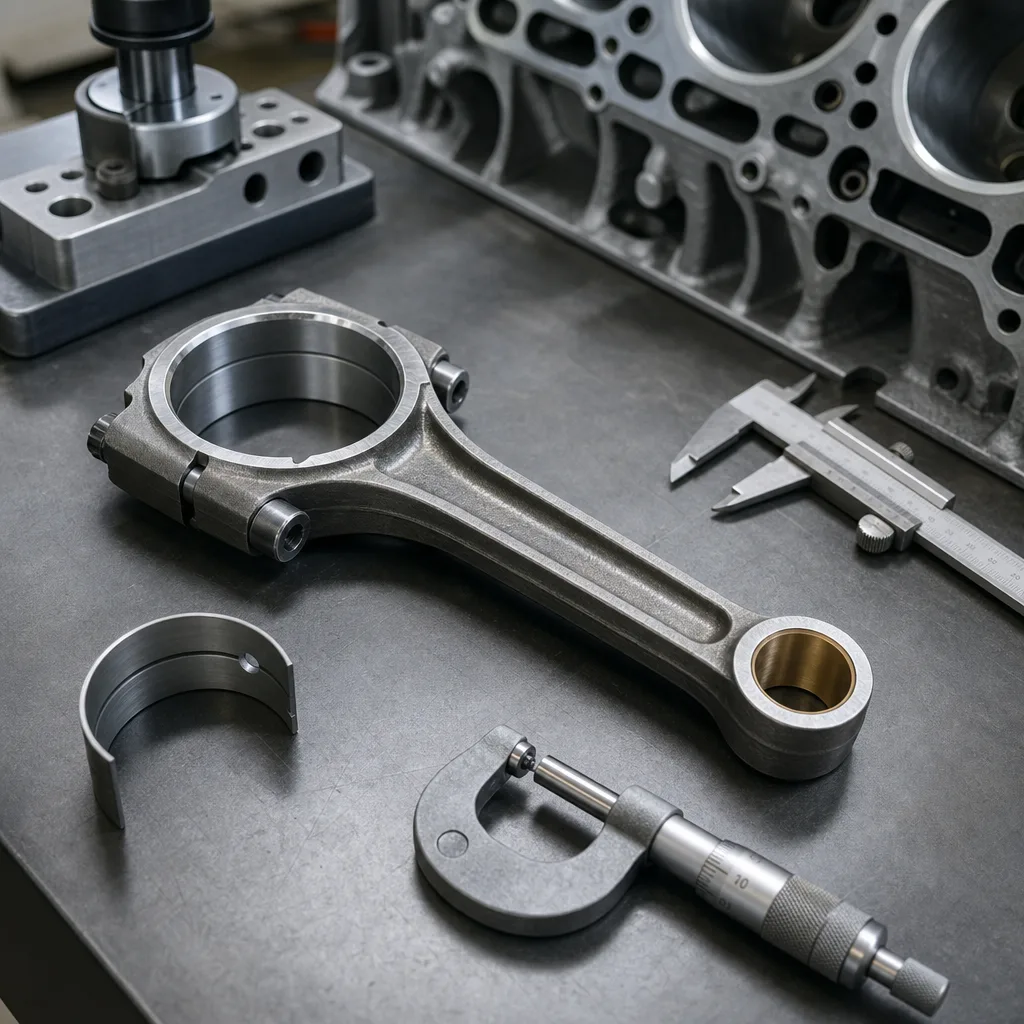
Big-end and small-end bore control
Centre-to-centre length and weight class consistency
Surface finish at the bearing seats and parting faces
Packaging that prevents corrosion and transit damage
A supplier should be able to state whether the rod is supplied as a matched set or as an individual part, and whether it is balanced to a target weight window. For aftermarket programmes, consistent grouping is important when the end user replaces one rod only and needs the remaining set to stay within tolerance.
Dimensions, materials, and tolerances to request
A credible sourcing file should include measurable data, not only a catalogue description. If the supplier cannot provide dimensional and metallurgical control points, the risk sits with the buyer.
Item
Typical procurement request
Why it matters
Material
40Cr, 4340, or customer-specified alloy
Affects fatigue strength and machinability
Heat treatment
Quench and temper with documented hardness range
Supports durability under cyclic load
Centre-to-centre length
Drawing-defined nominal with tolerance
Controls compression ratio and piston travel
Big-end bore
Measured after cap torquing
Bearing fit and oil film stability
Small-end bore
Pin fit and alignment check
Prevents wrist pin wear and noise
Weight
Individual and set weight record
Reduces imbalance between cylinders
Surface protection
Anti-rust oil or VCI pack
Lowers storage and transit corrosion
</tr></thead><tbody> </tbody></table>For reference, many buyers ask for hardness and tensile data, plus CMM or bore-gauge reports tied to batch number. If your programme needs custom weight windows, ask about custom manufacturing before RFQ closure. This avoids later changes to machining fixtures or sorting rules.
Certification, compliance, and audit readiness
Procurement teams often need a supplier that can support both aftermarket distribution and OEM/Tier-1 documentation. That means the factory should be able to present an auditable quality system and conforming records.
Relevant references include IATF 16949:2016, ISO 9001:2015, REACH (EC) No 1907/2006 for restricted substances, and where the application requires emissions-related validation, ECE R-83 may be relevant at vehicle-system level. For durability screening, many programmes use SAE J2527 as a reference point for corrosion or environmental exposure testing when agreed with the customer.
Driventus maintains an internal quality system built around incoming material checks, process control, and final inspection. For buyers, the practical audit questions are simple:
Can the supplier provide batch traceability?
Are critical dimensions recorded by lot?
Is there a corrective-action process with response timing?
Can PPAP-style documentation be prepared when required by the customer?
A supplier that answers these questions clearly is easier to manage across multi-country distribution networks.
MOQ, lead time, and supply continuity
The sourcing model for connecting rods depends on whether you are buying a stock replacement range or a customer-specific programme. MOQ is usually driven by forging die cost, machining setup, and balance-group sorting.
Typical sourcing questions:
What is the minimum order quantity per part number?
What is the standard lead time for repeat orders?
Are raw forgings held in buffer stock?
Can the factory support split shipments?
Is barcode labelling available for warehouse receiving?
For stable aftermarket supply, buyers should ask for a replenishment plan that covers seasonal demand and freight variability. A supplier with in-house machining and inspection can usually reduce handoffs, which helps control lead time. If your current programme includes multiple engine families, review our catalog and the broader engine components range to consolidate sourcing where the application allows it.
When comparing offers, do not focus on unit price alone. A lower quote can become expensive if the supplier cannot hold weight class, misses packaging requirements, or ships mixed batches.
Validation for fitment and field use
Before a new rod is released into procurement or warehouse stock, validate the part against the target engine family. The checks should be mechanical and traceable.
Recommended validation steps:
1. Confirm OE cross-reference by engine code and application. 2. Verify assembled bore sizes after cap torque. 3. Check rod length, side clearance, and weight class. 4. Inspect pin fit, bearing-seat finish, and cap alignment. 5. Review corrosion protection and carton labelling. 6. Record batch number and retain inspection data for claims handling.
If a customer asks whether a listed Alfa Romeo application is approved by the vehicle manufacturer, do not state that it is. The correct position is that the part is supplied for fitment to the referenced application only. Driventus is an independent aftermarket manufacturer; brand names are referenced for fitment only.
For recurring programmes, keep a field-feedback loop between sales, quality, and receiving. That helps identify assembly issues early, especially where one engine family uses multiple rod revisions across production years.
How Driventus supports procurement teams
Driventus manufactures engine and powertrain components in Taizhou, Zhejiang, with export experience in more than 60 countries. For procurement teams, the key value is not only production capacity, but the ability to support consistent reorders, technical documents, and practical communication during source approval.
What buyers can request:
Batch traceability and inspection records
Dimensional and material data for sample approval
Private-label or neutral packaging
Consolidated exports for multi-SKU orders
Programme support for aftermarket, OEM, and Tier-1 channels
If you are building a supplier shortlist for a connecting rod Alfa Romeo OEM supplier programme, use the same scorecard across all candidates: certification, audit response, traceability, lead time, and willingness to support technical review. When the technical file is complete, commercial negotiation is faster and risk is lower.
To discuss a new sourcing programme or compare part numbers, please request a quote.
Frequently asked questions
Yes, where an OE cross-reference is provided by the buyer or applicable catalogue data, we can support fitment matching and technical review. Brand names are referenced for fitment only.
Typical documents include material specification, dimensional inspection records, batch traceability, and quality system certificates such as IATF 16949:2016 and ISO 9001:2015 when applicable.
Yes. We can discuss custom packaging, barcode labelling, and weight-group requirements during RFQ. These details should be confirmed before production release.
If you are building a sourcing list for engine components, send your application data and target volumes. Our team can review fitment, documentation, and supply options at /contact.html.