Connecting Rod for Acura RDX Replacement Sourcing
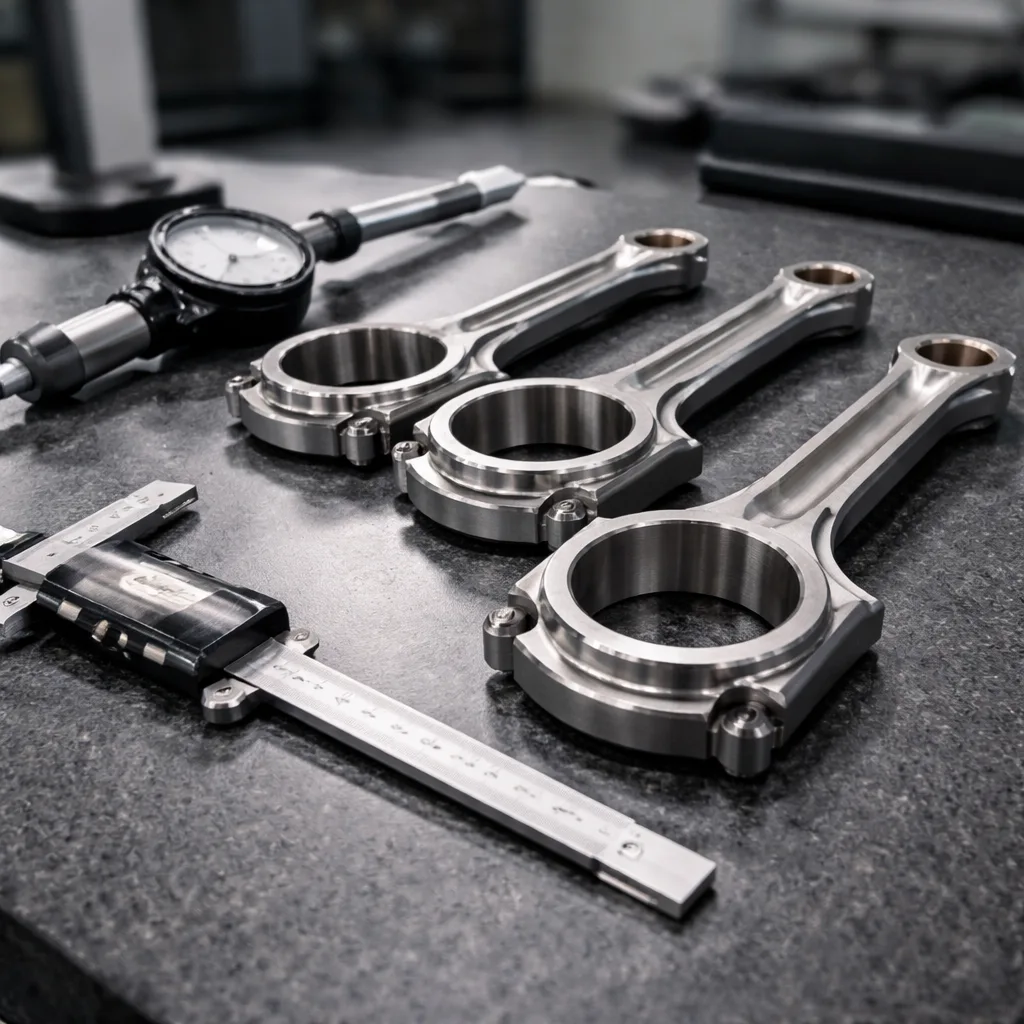
A connecting rod for Acura RDX replacement is rarely a routine buy. It is usually sourced after bearing knock, oil starvation, hydrolock, or a rebuild decision, and the first risk is fitment. The rod has to match the engine application, crank pin geometry, piston pin size, big-end width, bolt specification, balance range, and bearing-shell interface. A small dimensional error can trigger bearing distress, piston noise, or early fatigue failure.
Driventus manufactures connecting rods and related engine components for aftermarket distributors, engine rebuilders, and programme buyers. Replacement rods are controlled through material selection, forging or machining process control, bore finishing, bolt preload verification, and batch inspection. This article focuses on what procurement teams should verify before adding an Acura RDX connecting rod programme to stock. Driventus is an independent aftermarket manufacturer; brand names are referenced for fitment only.
Decision points before you buy
A connecting rod for Acura RDX replacement should not be sourced by vehicle name alone. Acura RDX applications vary by model year, market, and engine family, so procurement teams need to confirm the engine code, production year range, piston pin arrangement, crankshaft journal specification, and whether the repair channel expects single rods, matched sets, or full engine kits.
Use this checklist before you issue a purchase order:
- Vehicle application by year range and market
- Engine family and displacement
- Rod centre-to-centre length
- Big-end bore diameter after cap assembly
- Small-end bore or bushing diameter
- Big-end width and side-clearance target
- Piston pin type: press-fit or floating pin, if applicable
- Rod bolt thread, length, grade, and torque-angle procedure
- Bearing-shell interface and locating tang position
- Weight category or acceptable balance range
Where OE part-number references are used, they should stay in the buyer database as cross-references only, such as OE 06A… or OE 11251… style references when applicable. They must not be presented as vehicle manufacturer approval. Driventus is an independent aftermarket manufacturer; brand names are referenced for fitment only.
Programme buyers can review related engine categories in our catalog and the engine component range at /products/engine-components.html.
Where replacement rods usually fail
Most field failures do not start with the rod itself. They start with an upstream condition that the replacement part inherits. Bearing knock can point to oil starvation, but the root cause may be blocked oil passages, a weak pump, or contaminated lubricant. Hydrolock can bend a rod instantly. Over-revving can stretch the bolt joint or distort the big end. A poor rebuild can create the kind of side loading that looks like a rod defect but is really an assembly problem.
That is why a supplier evaluation should separate part quality from failure mode. The rod must still be manufactured to a stable specification, but the buyer should also document the engine condition that led to replacement. If the programme sees repeated returns, the useful question is not only whether the rod met drawing dimensions. It is whether the installation, lubrication, and rebuild process were controlled.
For procurement teams, the practical filter is simple: if the failure mode can change the required geometry, balance, or fatigue margin, the replacement spec needs to be tightened before stock is released.
Spec checks that matter on the bench
For a connecting rod for Acura RDX replacement, OE-equivalence means the rod performs the same mechanical function within the engine assembly. It does not mean the part is supplied by, approved by, or endorsed by the vehicle manufacturer.
The most important checks are dimensional, metallurgical, and assembly-related. The table below summarises typical procurement checkpoints. Final values must be confirmed against the target engine drawing, sample, or validated specification.
| Checkpoint | Why it matters | Procurement requirement | |
|---|---|---|---|
| Centre-to-centre length | Controls compression height and piston position | Match drawing or approved sample within agreed tolerance | |
| Big-end bore roundness | Affects oil film and bearing load distribution | 100% or batch inspection after cap tightening | |
| Small-end bore finish | Controls pin wear and noise | Confirm surface finish and bushing material, where used | |
| Big-end width | Controls crankshaft side clearance | Match engine-specific requirement | |
| Rod and cap pairing | Prevents bore mismatch | Laser, dot, or batch identification for matched pairs | |
| Rod bolt preload | Maintains cap clamping under cyclic load | Bolt specification and tightening method documented | |
| Weight balance | Reduces vibration and bearing load | Weight class or set balancing defined in purchase order | |
| Material traceability | Supports fatigue consistency | Heat number and batch traceability retained |
| Supply format | Typical buyer | Advantages | Trade-offs |
|---|---|---|---|
| Single connecting rod | Wholesaler, repair chain | Lower unit inventory cost; useful for partial repairs | Weight matching must be controlled at installation |
| Matched rod set | Engine rebuilder, performance engine shop | Better balance consistency across cylinders | Higher inventory value per SKU |
| Rod with bolts | Distributor, repair programme | Reduces risk of bolt reuse | Bolt source and tightening data must be documented |
| Rebuild kit with rods and bearings | Repair chain, importer | Simplifies ordering and reduces parts mismatch | Requires stronger fitment data and higher MOQ |