A clutch kit Skoda replacement should be treated as a dimensional and material match, not a generic parts purchase. For distributors and repair networks, the practical questions are straightforward: does the kit match the OE friction diameter, spline count, cover height, clamp load, and release system; does it align with the flywheel type; and can the supplier document validation across part numbers and production lots. Driventus is an independent aftermarket manufacturer; brand names are referenced for fitment only. For procurement teams, that means looking for drawing control, traceable batch records, and test data rather than marketing claims. This article outlines the checks that reduce returns, protect margin, and keep Skoda applications moving through the workshop without avoidable rework. It also shows where IATF 16949:2016, ISO 9001:2015, and REACH documentation fit into the buying decision.
What must match on a Skoda clutch kit
Fitment starts with vehicle identification. For a Skoda clutch kit replacement, the minimum data set is VIN, engine code, gearbox code, flywheel type, and whether the transmission uses a self-adjusting pressure plate or concentric slave cylinder. The disc diameter and spline count must match the gearbox input shaft. The cover height, diaphragm geometry, and release bearing interface must match the bellhousing package. If any one of these is wrong, the kit may bolt on but still fail on pedal feel, disengagement, or noise.
Checkpoint
What to verify
Why it matters
Disc diameter
Matches OE specification
Torque capacity and clearances
Spline count
Matches gearbox input shaft
Fitment and concentricity
Flywheel type
Solid or dual-mass
Release travel and noise control
Release bearing
Correct height and interface
Pedal effort and release point
Pressure plate
Clamp load and cover height
Engagement stability
Pilot / guide parts
Application specific
Input shaft support
Fasteners
One-time-use status
Prevents clamp loss
</tr></thead><tbody> </tbody></table>This is the difference between a catalog match and a reliable replacement.
OE-equivalence is more than a cross-reference
OE-equivalence is not limited to the headline part number. Aftermarket kits can differ in friction facing material, damper spring rate, and diaphragm spring curve while still meeting the same application target. Procurement teams should ask for measured data, not just a vehicle list. A supplier should be able to show facing thickness, rivet depth, runout, balance, and clamp-load verification against the drawing.
Driventus is an independent aftermarket manufacturer; brand names are referenced for fitment only. That matters because the buying decision should be based on dimensional control and validation, not on any assumed manufacturer endorsement.
For high-mileage fleet use, ask whether the kit was tested for repeated heat cycles, stop-start duty, and launch durability. If the replacement is intended for a taxi, delivery, or workshop network, durability in the release bearing and pressure plate matters as much as friction material.
What should be in the kit
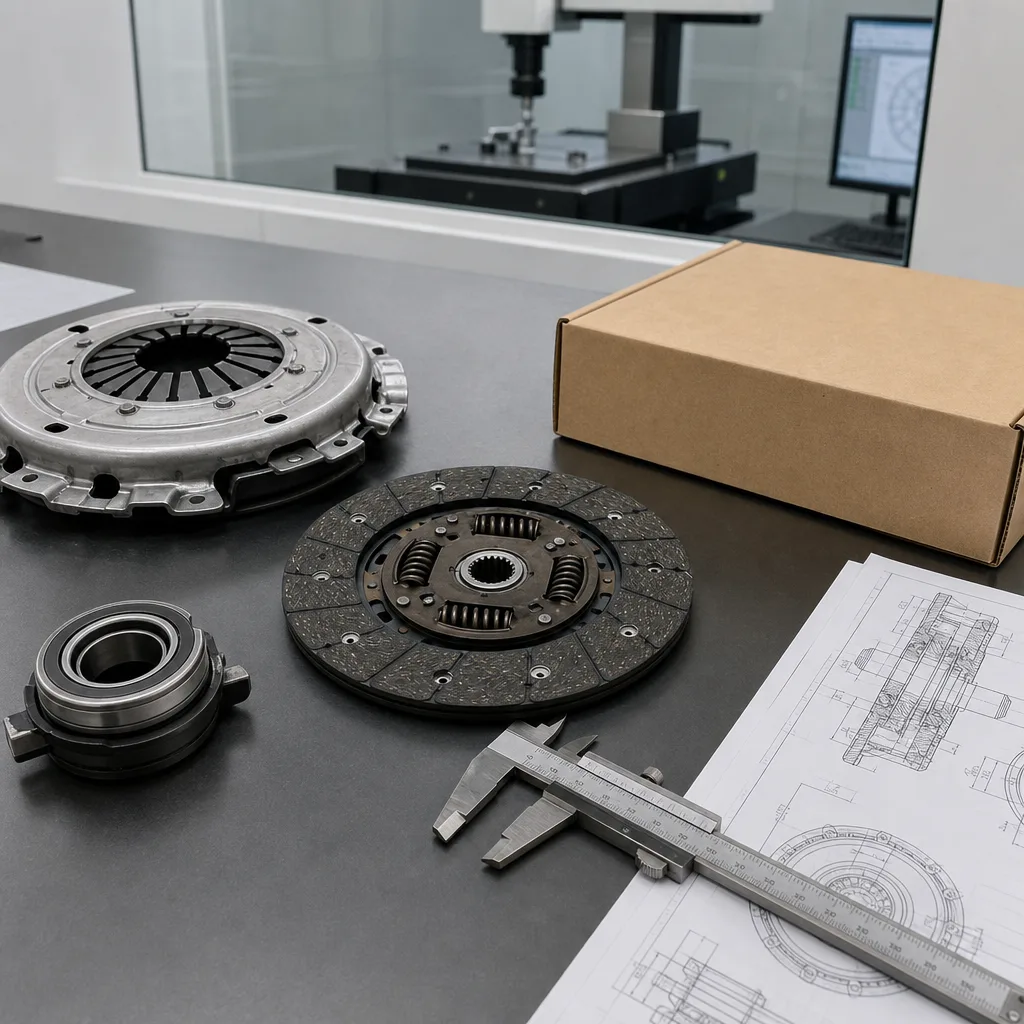
A complete kit should include the friction disc, pressure plate, and release bearing. Many applications also need an alignment tool, and some platforms require guide tube hardware or a pilot bearing. On concentric slave cylinder systems, the hydraulic release unit is often replaced at the same time because labour overlap is high and old seals can contaminate the new kit.
Dual-mass flywheel checks
If the car uses a dual-mass flywheel, inspect rotational free play, angular movement, heat checking, and grease leakage. Replace the flywheel if it is outside the manufacturer's limit. Reusing a worn flywheel can cause judder, shudder, and premature disc wear.
Use these checks as part of the service decision:
Replace the slave cylinder if it shows leaks or uneven release.
Replace one-time-use bolts where specified.
Clean oil contamination at the rear main seal before assembly.
Verify pedal travel after installation.
Road test for judder, slip, and reverse gear engagement.
Quality evidence procurement teams should ask for
Quality evidence should be part of the purchase order, not a follow-up email. For B2B buyers, the baseline pack should include dimensional inspection records, traceability to lot and date code, material certificates for friction lining and spring steel, and REACH (EC) No 1907/2006 declarations where applicable. IATF 16949:2016 and ISO 9001:2015 do not guarantee fitment by themselves, but they show that process control, corrective action, and record retention are in place.
Ask for sample approval data that includes concentricity, runout, balance, and release-force checks. If your network serves EU and UK customers, keep packaging and labelling clear: SKU, vehicle family, language, country of origin, and carton protection for the friction surfaces. Where your programme includes adjacent coated hardware, SAE J2527 may be used as a corrosion reference, but the clutch itself still needs fit-for-purpose validation on the vehicle duty cycle.
How we support distribution and private-label programs
Procurement teams rarely need a single part; they need a controlled supply line. For distributors and repair chains, the useful questions are MOQ, forecast response time, carton quantity, palletisation, barcode format, and private-label capability. We support catalog sourcing through our catalog, document control through the quality system, and platform-specific work through custom manufacturing.
If your application portfolio includes other drivetrain or engine-side items, consolidating those SKUs can reduce inbound freight and simplify claim handling. That is particularly useful when the same warehouse serves multiple Skoda platforms and other European fitment lines. The goal is not a broad claim. It is a repeatable, traceable replacement part that lands in the workshop on time and installs without rework. For a formal check, request a quote with the VIN, gearbox code, and target monthly demand.
Frequently asked questions
Provide the VIN, engine code, gearbox code, flywheel type, disc diameter, and spline count. Those items determine whether the kit will physically fit and release correctly.
Inspect the flywheel first. On a dual-mass unit, replace it if free play, heat damage, or leakage is outside specification. A sound solid flywheel can often stay in service.
Ask for dimensional inspection records, lot traceability, material certificates, REACH declarations where applicable, and a summary of validation checks such as runout and balance.
If you need a verified fitment check, private-label packaging, or batch documentation for this application, [request a quote](/contact.html).