Clutch Kit Hyundai Supplier: Sourcing Guide for B2B Buyers
For buyers searching for a clutch kit Hyundai supplier, the main questions are consistency, fitment, traceability, and supply stability. Driventus supplies clutch kits for Hyundai applications through a controlled aftermarket programme built for distributors, wholesalers, OEM/Tier-1 channels, and multi-site repair networks. We manufacture engine and powertrain components in Taizhou, Zhejiang, and export to more than 60 countries. Our operations are certified to IATF 16949:2016 and ISO 9001:2015. Driventus is an independent aftermarket manufacturer; brand names are referenced for fitment only. This article explains what procurement teams should verify before placing volume orders, including OE cross-references, material consistency, pack control, lead times, and factory audit points. It also covers how to compare suppliers on a like-for-like basis, rather than on catalogue claims alone.
What procurement teams should verify first
A reliable source for Hyundai clutch kits should be assessed on data, not broad claims. For procurement teams, the first checks are application coverage, bill of materials, and the supplier’s ability to hold dimensional consistency across batches.
Minimum sourcing checks
Vehicle application mapping by engine and transmission code
OE cross-reference format where available, for example OE 41421-xxxxx only when the reference is already supplied by the buyer
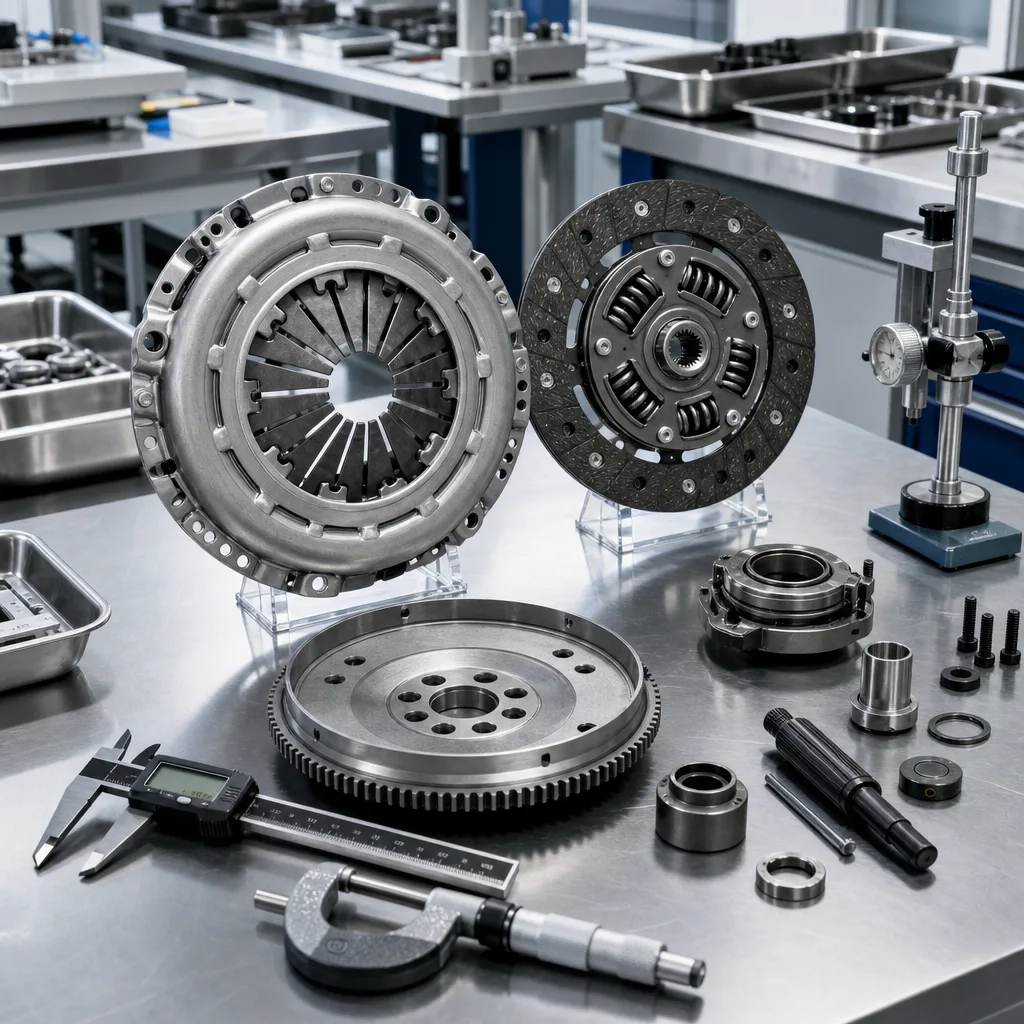
Full kit contents: cover assembly, driven plate, release bearing, pilot bearing if applicable
Packaging control, barcode labelling, and carton drop resistance
Material declarations and compliance support for REACH (EC) No 1907/2006
For B2B purchasing, catalogue breadth matters less than repeatability. If the supplier cannot explain material grade, spline count, hub damping design, and facing composition, the risk of returns rises. Buyers should also confirm whether the supplier supports private label packaging, mixed-SKU consolidation, and export documentation for EU, UK, US, Canada, Australia, and Brazil.
How Driventus structures supply for Hyundai applications
Driventus manufactures clutch kits and related powertrain components with in-house process control. That matters because clutch assemblies depend on machining accuracy, spring load stability, friction material bonding, and runout control.
We supply B2B customers through three common channels:
Channel
Typical buyer
Procurement focus
Aftermarket distributor
Regional wholesalers
Range breadth, carton labelling, fill rate
OEM / Tier-1 supplier
Industrial buyers
Traceability, PPAP-style documentation, process stability
</tr></thead><tbody> </tbody></table>For buyers comparing a clutch kit Hyundai supplier, the relevant manufacturing questions are:
Is the pressure plate diaphragm spring load measured and recorded?
Is driven-plate runout controlled at assembly?
Are release bearings sourced to specification and lot-traceable?
Is final inspection linked to serial or batch identification?
Our operations are aligned to IATF 16949:2016 and ISO 9001:2015, with documented inspection points across incoming materials, in-process checks, and final release.
Fitment, OE cross-references, and validation
Hyundai applications vary by engine family, transmission type, and model year. A supplier should therefore confirm fitment using application data, not only by part name. The buyer should request the exact OE cross-reference, then verify spline count, disc diameter, hub offset, and release system compatibility before purchase order release.
Common validation points
Disc outer diameter and spline specification
Pressure plate bolt pattern and mounting height
Release bearing type and contact face geometry
Pedal effort and clamp load consistency
Thermal cycling and wear behaviour in validation testing
For aftermarket programmes, dimensional match is the baseline. For fleet and repair-chain customers, low variation between cartons is equally important. If a supplier provides validation data, ask whether it was generated under relevant published methods such as SAE J2527 for durability-related exposure testing, where applicable to the programme. For friction and corrosion-related claims, the buyer should request the test method, sample size, and acceptance criteria, not a summary statement.
Commercial terms that matter in volume purchasing
When buyers source from a clutch kit Hyundai supplier, commercial terms need to be aligned with inventory strategy and service level targets. The lowest unit price is not always the lowest landed cost.
Key points to compare:
MOQ by SKU and by mixed container load
Standard lead time and peak-season lead time
Spare parts availability for cover assemblies and bearings
Incoterms, carton dimensions, and palletisation efficiency
Claim handling time and replacement policy
Documentation set: commercial invoice, packing list, certificate of origin where needed
For import managers, stable supply usually depends on forecast discipline. A supplier should be able to work with rolling forecasts, replenishment schedules, and phased release quantities. Buyers supporting several warehouse locations should also confirm whether the supplier can ship consolidated orders without losing batch traceability.
If you need a broader range beyond Hyundai clutch kits, review our catalog or discuss platform-based sourcing under custom manufacturing.
Factory audit points for procurement teams
A factory audit should focus on process control, not only on office certifications. For clutch kit production, the most useful audit questions are practical and measurable.
Audit checklist
1. Incoming inspection: Are friction facings, stampings, bearings, and springs checked against defined standards? 2. Machining control: Are critical dimensions monitored with calibrated gauges? 3. Assembly traceability: Can the factory link each batch to material lots and inspection records? 4. Final inspection: Are runout, clamp load, and visual defects reviewed before packing? 5. Packaging discipline: Are labels, barcodes, and carton counts verified twice?
Buyers should also ask for copies of the supplier’s quality policy and certificate scope. A credible quality system should show how nonconforming material is contained, analysed, and corrected. For international sourcing, this is as important as production capacity.
Driventus supports product development and private-label programmes for customers that need specification alignment across different Hyundai model families. For custom programmes, our engineering and commercial teams can define pack contents, labelling, and test requirements before production starts.
Why aftermarket buyers prefer a controlled supply base
Aftermarket distributors, repair chains, and OEM-linked buyers often move to a smaller number of approved suppliers because the cost of variation is high. A clutch kit returned from one branch can create labour cost, rework, and customer dissatisfaction across the network.
A controlled supply base helps with:
Reduced SKU confusion across vehicle applications
Better stock rotation and forecasting
More consistent pedal feel and engagement point
Lower warranty exposure from mismatched components
Faster reordering for high-turn Hyundai applications
Driventus is an independent aftermarket manufacturer; brand names are referenced for fitment only. That means our role is to supply compatible parts with documented manufacturing control, not to claim vehicle-manufacturer endorsement. If your team is mapping related engine and driveline ranges, you may also want to review our catalog and the wider engine components range for bundle opportunities.
For buyers ready to start a sourcing review, use the same checklist on every quoted line. Ask for OE cross-reference data, packaging spec, lead time, MOQ, and test support before comparing offers.
Frequently asked questions
Yes. We support B2B orders for distributors, repair chains, and OEM-linked buyers. MOQ, lead time, and packaging can be set by SKU and programme size.
Where the buyer provides or confirms the application data, we can map parts to the relevant OE reference format for fitment comparison. We do not claim vehicle-manufacturer approval.
Our operations are certified to IATF 16949:2016 and ISO 9001:2015. We also support material and compliance requests relevant to REACH (EC) No 1907/2006.
If you are evaluating a clutch kit Hyundai supplier for distribution or programme sourcing, send your application list, target volumes, and packaging requirements. Request a quote at /contact.html.