clutch kit · 2026-06-10

Clutch Kit Buick Manufacturer China: Practical Sourcing Guide

When buyers search for a clutch kit Buick manufacturer China partner, the strongest offer is rarely the lowest unit price alone. A dependable sourcing programme depends on application accuracy, stable clamp load, material traceability, controlled dimensions, and packaging that protects the kit through export handling and onward distribution. For passenger-car and light-duty service applications, a clutch kit should be managed as an application-specific assembly rather than a generic collection of parts.

Driventus is an independent aftermarket manufacturer, and all vehicle brand names are used for fitment reference only. That distinction matters in procurement because a change in model year, engine code, gearbox variant, release system, or market specification can alter the disc spline, cover height, bearing size, and kit contents. Before a buyer compares prices, the supplier should be able to explain how the kit is built, checked, packed, and linked to the confirmed bill of materials. The goal is simple: fewer installation surprises, clearer documentation, and a more predictable replenishment programme.

What procurement teams should verify first

A clutch kit quotation is only reliable when the application data behind it is complete. Before releasing an RFQ, confirm the vehicle platform, production year range, transmission code, engine family, and whether the requested set includes a release bearing, pilot bearing or bush, alignment tool, bolts, or other hardware. This early clarification prevents the most common sourcing problem: two kits that look similar in a catalogue but differ at the gearbox interface.

Key points to confirm before price comparison include:

  • Fitment basis: model year, gearbox family, engine output band, and target market
  • Kit scope: cover assembly, driven disc, release bearing, pilot bearing or bush, hardware, and accessories
  • Service expectation: normal retail replacement, taxi duty, stop-start traffic, mixed fleet use, or high-mileage commercial service
  • Packaging need: inner box, master carton count, label format, barcode rules, pallet pattern, and private-label requirements
  • Documentation need: inspection records, traceability data, material declarations, and shipment paperwork

A capable supplier should map the part to the correct assembly without guessing. If your request includes an OE number or competitor cross-reference, it should be treated as a fitment control point, not as a claim of vehicle-manufacturer approval. Driventus does not claim endorsement or approval from Buick or any vehicle maker; brand names are referenced only to identify compatible aftermarket applications.

Kit contents and fitment points

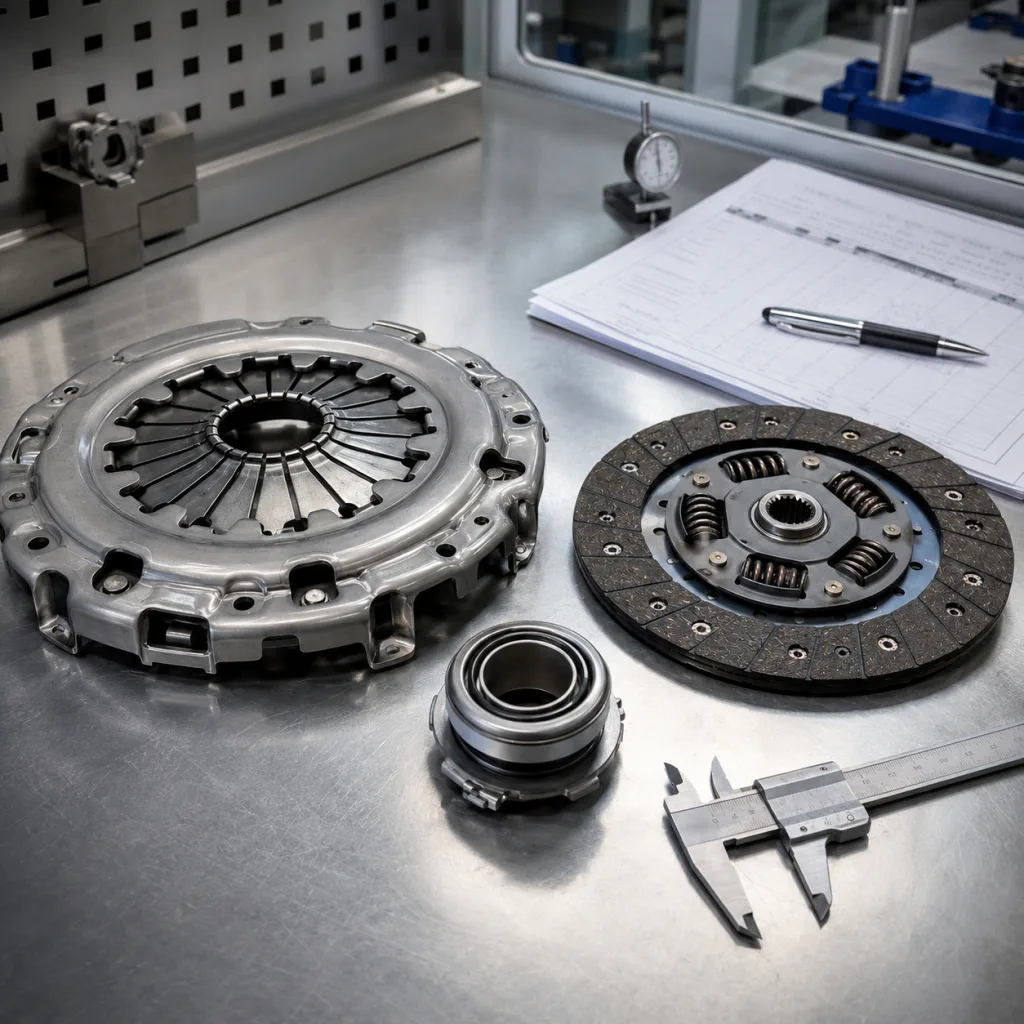
A complete clutch kit should reduce ambiguity for the distributor, installer, and warranty team. The exact parts vary by platform, but the dimensional controls are usually consistent. The pressure plate, driven disc, release bearing, and pilot bearing or bush must work together as a stack. A small error in one component can create noise, poor release, hard shifting, or premature wear after installation.

</tr></thead><tbody> </tbody></table>For buyers supplying several regions, the most frequent failure is often not the friction material itself. It is a minor mismatch in stack height, spline engagement, bearing interface, or release travel that becomes visible only during installation. That is why sample approval should include dimensional inspection against the target gearbox and release system, not only a visual check of the carton and parts. Where possible, the sample review should also verify clutch release feel, bearing fit, and the relationship between the cover assembly and disc thickness.

Materials, tolerances and validation

For a long-term sourcing decision, the material declaration is as important as the product photo. A professional clutch kit Buick manufacturer China programme should define the friction lining, diaphragm spring material, hub steel grade, damper design, rivets, bearing source control, and surface treatments used in the approved bill of materials. Once approved, those inputs should not change without buyer notification and, where required, renewed validation.

Important material and process controls include:

  • Friction lining: stable coefficient of friction, controlled wear rate, bonding strength, and heat resistance for the intended duty cycle
  • Cover and diaphragm spring: heat-treated steel with controlled hardness, fatigue resistance, and release characteristics
  • Pressure surface: machining quality, flatness, roughness, and heat-check resistance
  • Hub and damper: correct spline form, rotational free play, spring retention, and torsional damping performance
  • Rivets and fasteners: proper material grade, setting force, and pull-out resistance
  • Bearing: low-noise operation, seal integrity, grease retention, and dimensional consistency under load

Validation should reflect the actual part configuration and the customer’s market requirement. Driventus works under IATF 16949:2016 and ISO 9001:2015 production controls for process discipline, documentation, and traceability. Where requested, material declarations can support REACH (EC) No 1907/2006 reporting. If a buyer needs additional verification, test plans can be aligned to contract-specific durability, dimensional, noise, packaging, or environmental requirements, including references such as SAE J2527 where relevant to the component set. We state standards only when they are applicable to the contracted part and agreed inspection plan.

Quality system and export documentation

Procurement teams should evaluate both the clutch kit and the supplier system behind it. A reliable quotation is supported by controlled records, defined inspection points, and repeatable packing procedures. Informal assurances are not enough when the shipment will move through export handling, distributor storage, and workshop installation before any issue is discovered.

Driventus can support buyers with:

  • Incoming material inspection and supplier lot traceability
  • In-process controls for cover assembly, disc runout, balance, rivet setting, and assembly torque
  • Dimensional inspection for spline, lining diameter, cover height, bearing height, and interface features
  • Final inspection of kit contents, surface condition, labels, carton strength, and packing layout
  • Photo records and document packs for buyer review or audit files
  • Export documentation aligned with the agreed commercial terms and destination requirements

You can review our quality system to see how production control, inspection, and traceability are managed. For buyers consolidating engine, transmission, and service parts, our catalog helps align clutch sourcing with related replacement components. If your programme includes adjacent categories, the engine components page may also support broader sourcing and cross-category planning.

Lead times, MOQ and custom programs

Lead time and MOQ are not fixed numbers for every order. They depend on the kit configuration, component availability, packaging format, label approval, inspection requirements, and whether the application is a standard build or a customer-specific programme. A clear RFQ helps the manufacturer separate a fast catalogue supply from a more controlled development or private-label project.

Kit element What it controls Typical check
Pressure plateClamp force, cover height, release travel, and pedal feelDiaphragm spring geometry, bolt pattern, cover height, balance, and surface condition
Driven discTorque transfer, torsional damping, and engagement smoothnessHub spline, lining outside diameter, thickness, runout, cushion segment, and damper clearance
Release bearingRelease movement, noise behaviour, and service lifeInner diameter, overall height, guide sleeve interface, bearing rotation, and grease retention
Pilot bearing or bushInput shaft support and alignmentOutside diameter, inside diameter, material, lubrication specification, and seating depth
Hardware and accessoriesCorrect installation and workshop efficiencyBolt grade, thread form, alignment tool fit, instruction sheet, and packing accuracy

</tr></thead><tbody> </tbody></table>For programmes that need tighter application control, our custom manufacturing page explains how we manage private-label and engineered orders. If you are comparing supply options for a long-term tender, send the fitment sheet, expected annual volume, target market, packaging requirements, and any documentation rules. With that information, we can quote on a realistic basis for pricing, sample approval, packing, shipment planning, and replenishment.

Frequently asked questions

Yes. We build according to the buyer’s confirmed fitment data, including transmission type, engine code, production year range, release system, and required kit contents. We do not claim vehicle-maker endorsement; brand names are used for fitment reference only.

Typical documents include commercial invoice, packing list, inspection summary, and agreed traceability or material records. For regulated or contract-specific projects, we can align paperwork to the purchase terms and support REACH (EC) No 1907/2006 reporting needs where applicable.

Yes. We support standard export packing, private-label cartons, buyer-specific labelling, barcode formats, and catalogue-style replenishment. For a faster quotation, send the application data, target annual volume, market destination, and packing requirements through our contact page.

Send your fitment sheet, target market, estimated volume, and packing requirements, and we will review the application and quote the right clutch kit programme for you: [request a quote](/contact.html)

Request a Quote
Sourcing variable What changes Buyer impact
Standard cartonExisting packaging, label set, and approved bill of materialsFaster release to shipment and simpler replenishment
Private labelArtwork, carton structure, barcode format, language requirements, and buyer approvalExtra approval cycle before mass packing
Application-specific kitComponent matching, fixture review, tooling, or sample validationLonger first-order lead time but better fitment control
Audit requirementFactory review, inspection plan, sample retention, and document packMore pre-shipment coordination and clearer compliance records
Mixed-container orderMultiple part numbers, carton sizes, and pallet patternsMore planning for packing efficiency and warehouse receiving