connecting rod · 2026-06-12

Connecting Rod for Chevrolet Cruze Aftermarket Replacement

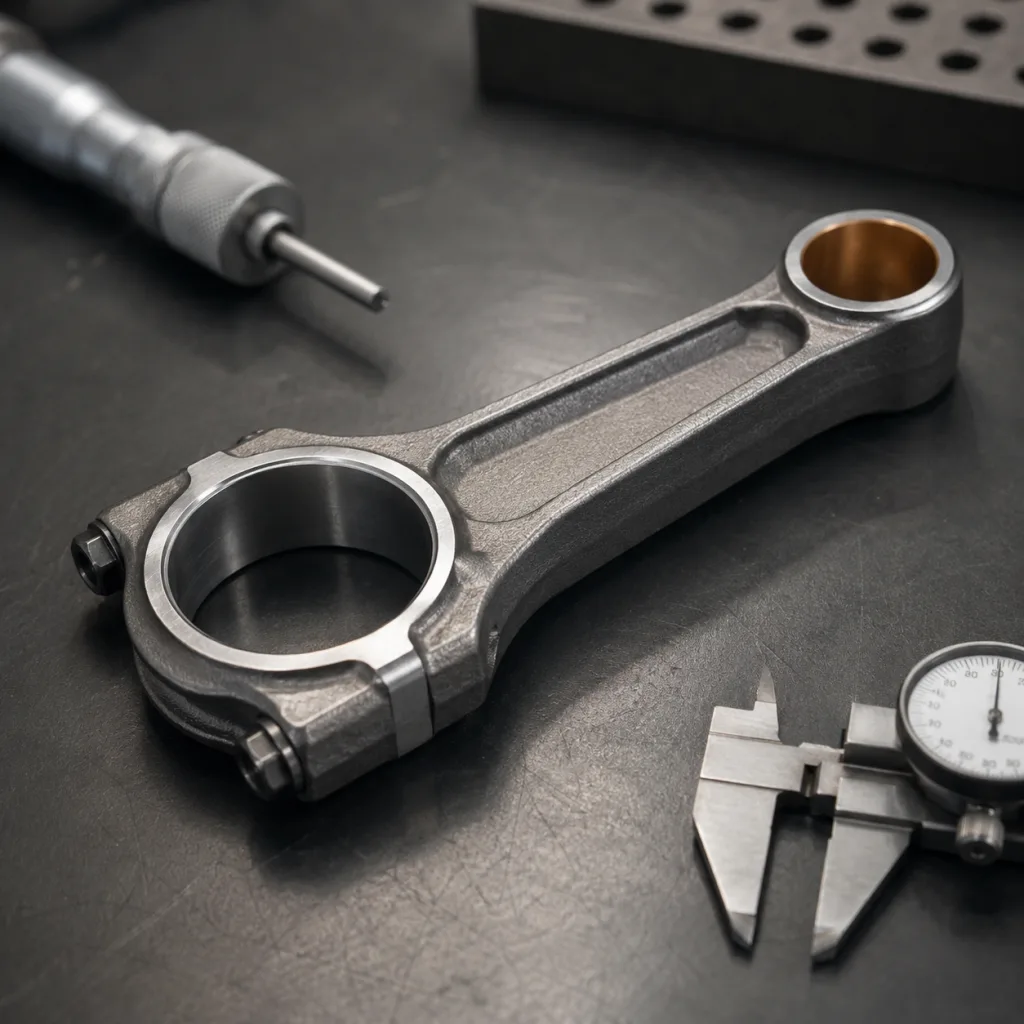
A connecting rod for Chevrolet Cruze aftermarket replacement has to do more than physically fit the engine. It needs to match center-to-center length, big-end and small-end bore dimensions, bolt specification, mass class, and oiling features closely enough to preserve bearing clearance, balance, and service life. For buyers, the real question is not whether a part is listed as compatible, but whether its geometry, material, and validation data align with the exact engine code being sourced. Driventus is an independent aftermarket manufacturer; brand names are referenced for fitment only. We supply replacement rods for procurement teams that need repeatable dimensions, traceable materials, and consistent packaging for repair channels, distributors, and rebuild programs. This guide explains the checks that matter before purchase, the difference between OE-style and forged options, and the evidence that should support any replenishment order.

What the replacement rod must match

A replacement rod is only useful if the critical geometry stays inside the engine builder's tolerance window. For a Cruze application, the main controls are center-to-center length, big-end bore, small-end bore, beam profile, cap design, and bolt grade. If any of those drift, the result can be noise, uneven bearing loading, or shortened fatigue life.

Driventus treats fitment as a dimensional problem first and a catalog problem second. That is why a purchase order should be tied to the engine code, model year, displacement, and piston pin size rather than the vehicle badge alone. Chevrolet Cruze naming can cover multiple engine families across regions, so the part has to be selected from the actual engine build data.

For a proper aftermarket replacement, the rod should also be checked for:

  • Weight match across the set
  • Small-end bush material and interference fit
  • Big-end bore roundness after cap assembly
  • Bolt torque and clamp-load consistency
  • Surface finish on the bearing seats and beam
  • Packaging that protects machined faces in transit

This is the core sourcing decision for the exact application named in the search term: dimensional match, not just visual similarity.

Checks before you place the order

The fastest way to avoid a wrong shipment is to ask for the data before the PO. The minimum order file should include a drawing, measured dimensions, and engine-code traceability. If you are replacing a single rod during overhaul, confirm whether the shop needs one piece, a matched pair, or a balanced set.

</tr></thead><tbody> </tbody></table>If you buy across regions, do not assume one Cruze engine code covers every market. A procurement team should verify the VIN-derived engine family, then compare the sample rod against the approved drawing. That approach is more reliable than relying on year-only catalog matching, which often misses regional variants and running changes.

OE-style and forged options compared

For this platform, buyers usually choose between an OE-style replacement and a forged-steel alternative. The right answer depends on the repair target, the intended service interval, and the load profile.

Check What to confirm Why it matters
Center-to-center lengthMatch the OE drawing or verified sampleAffects deck height, compression clearance, and rod ratio
Big-end boreDiameter, roundness, and finished widthControls bearing crush and oil clearance
Small-end borePin diameter and bush specificationPrevents pin seizure and noise
Bolt specThread pitch, length, and strength gradeGoverns clamp load and fatigue resistance
MassIndividual and set weightSupports balance during rebuild
FinishMachined surfaces, shot-peen coverage, coatingsInfluences durability and corrosion resistance

</tr></thead><tbody> </tbody></table>OE-style parts are useful when the target is factory-like behavior and stable supply. Forged parts can be appropriate when the customer wants additional margin, but they are not automatically superior if the rest of the rotating assembly was designed around the original mass. Extra weight can change balance, and a different beam profile can affect clearance in tight applications.

The sourcing decision should therefore be made on the actual service requirement, not on a generic assumption that forged always means better. For many fleet and repair-channel buyers, OE-equivalent geometry is the safer commercial choice because it reduces the risk of balance changes and fitment surprises.

Validation, traceability, and compliance

A credible replacement rod should come with more than a part number. At minimum, the supplier should be able to show dimensional inspection records, material traceability, and process-control evidence. Driventus runs its production under IATF 16949:2016 and ISO 9001:2015 systems, which matters when a buyer needs repeatability across lots rather than a single acceptable sample.

We also support substance-control expectations tied to REACH (EC) No 1907/2006 for regulated markets. That is important for EU and UK importers who need cleaner documentation at customs intake and supplier qualification.

Typical test pack

  • CMM or gauge-based dimensional inspection on critical features
  • Hardness verification on the finished rod body and cap area
  • Bolt clamp-load or torque checks on the assembled rod
  • Magnetic particle inspection or equivalent crack detection where specified
  • Fatigue sampling on defined production batches
  • Packaging inspection to reduce nicks on machined faces

This is also where buyers should insist on clear wording: Driventus is an independent aftermarket manufacturer; brand names are referenced for fitment only. We do not claim vehicle-maker approval or endorsement. The validation file should stand on its own technical evidence.

How Driventus supports procurement

Procurement teams usually need three things at the same time: a reliable fitment match, stable supply, and a supplier that can support adjacent engine parts. That is where our catalog helps, because it lets buyers review the broader engine line instead of sourcing rods in isolation.

If you are building a multi-SKU engine programme, our quality system page outlines how we handle traceability, inspection, and audit readiness. For buyers who need a non-standard beam profile, coating, or packaging format, our custom manufacturing service can align the rod to your drawing and target market.

For related part families, see our engine components page. It is often more efficient to consolidate pistons, gaskets, pumps, and rods under one supplier review rather than qualify each line separately.

If your team needs a sample check, a drawing review, or a commercial offer for the Cruze application, use the same process we apply to other replacement programmes: confirm the engine code, confirm the dimensions, then request a quote.

Frequently asked questions

Use the engine code, piston pin size, and measured rod dimensions, not the vehicle badge alone. A sample check against the approved drawing is the safest way to avoid a mismatch.

No. OE-style parts are usually the better match for standard rebuilds because they preserve original mass and geometry. Forged steel is useful when extra fatigue margin is required.

Request dimensional data, material traceability, inspection records, and any relevant compliance statements. For EU and UK supply chains, REACH documentation is often part of the file.

If you need a verified replacement for your Cruze program, send the engine code and sample dimensions through our [request a quote](/contact.html).

Request a Quote
Option Material / process Strength profile Cost profile Best use case
OE-style replacementPowdered metal or fracture-cap equivalent, depending on engine familyClosest to original geometry and massLower to midStandard rebuilds, distributor stock, repeatable fitment
Forged replacementForged steel, machined and balancedHigher fatigue margin, usually heavierMid to higherSevere duty, performance rebuilds, extended abuse tolerance