When B2B buyers need to change brake pads across an existing range, the risk is rarely the catalogue listing alone. The real risk is approving a part that installs, but then creates workshop delays, noise complaints, uneven wear, or warranty claims because the pad only loosely matches OE intent.
That is why a good sourcing review should not read like a generic checklist. Buyers need a decision framework: what can go wrong, which checks actually prevent those failures, and where commercial terms must be tied to technical acceptance. OE dimensions, friction behaviour, hardware completeness, bond strength, traceability, and batch discipline all matter—but not equally for every programme.
This article breaks the process into practical buying angles: failure modes, critical approval checks, how to compare validation data, what production controls really affect field results, and how to phase a supplier switch with less return exposure. It also helps define acceptance criteria up front, including nominal new pad thickness, tolerance bands, backing plate flatness, kit BOM completeness, MOQ by SKU tier, ex-works price logic, and realistic lead times for repeat orders versus private-label launches. Driventus is an independent aftermarket manufacturer; any brand names are referenced for fitment purposes only.
Start with the risk map: what usually goes wrong when buyers change brake pads
Brake pads look like a routine service line. In practice, they fail commercially in a few predictable ways.
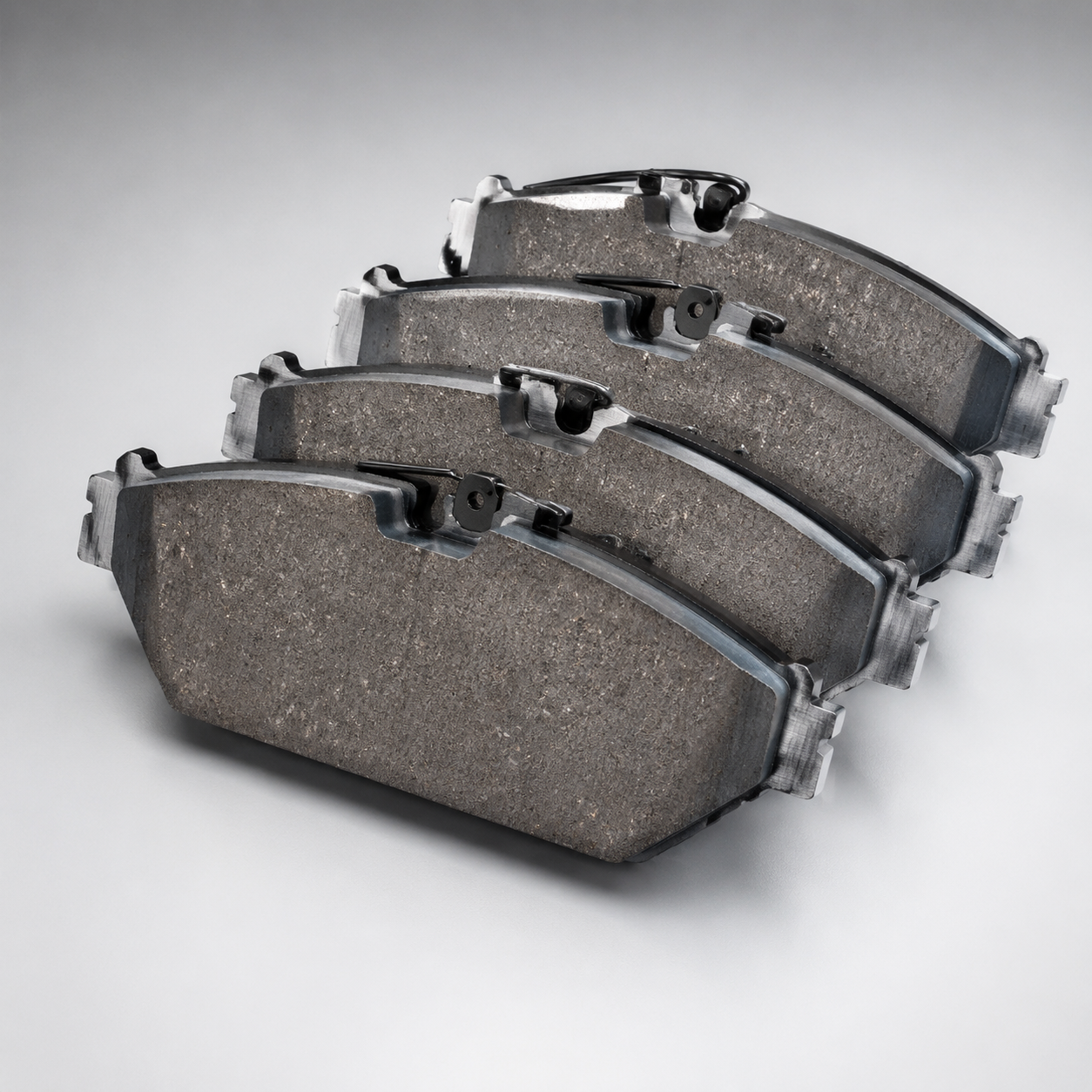
The first is fitment risk. A pad can be listed for the right vehicle and still create trouble if the backing plate outline, ear width, hole position, clip geometry, or sensor provision drifts from the approved design. Small dimensional errors become workshop time, branch returns, and customer frustration.
The second is performance risk. This includes unstable friction across temperature, poor fade recovery, excessive rotor wear, inconsistent pedal feel, or noise behaviour that was not obvious in a simple bench review.
The third is control and compliance risk. Missing material declarations, weak batch traceability, incomplete test records, or inconsistent production documentation may not show up on day one. They matter later, when claims start and the buyer needs to isolate cause quickly.
For multi-branch distributors, fleet networks, and repair chains, these risks scale fast. One wrong sourcing decision can affect dozens of workshops and hundreds of vehicles, not just one branch.
That is why procurement teams should avoid approving a pad range on application coverage alone. Compare against OE drawings, validated samples, or controlled technical data.
A few numbers show why precision matters:
Finished pad thickness variation of ±0.15 mm to ±0.25 mm may be workable on some applications, but tighter calipers can demand narrower control
Backing plate flatness is often reviewed in fractions of a millimetre because excess warpage can cause drag or tapered contact
Hole position, abutment features, and locator geometry should be checked to measurable tolerances, not visual judgement
A supplier supporting serious replacement programmes should also be able to show documented process control under IATF 16949:2016 and ISO 9001:2015, plus material compliance review against REACH (EC) No 1907/2006) where required.
The commercial lesson is simple: low piece price does not protect margin if claims, relabelling labour, expedited freight, or workshop credits follow. If you plan to change brake pads across multiple references, align technical approval with claim-rate targets, MOQ logic, replenishment lead times, and mixed-SKU shipment rules.
If range consolidation is part of the project, it helps to review the supplier's broader coverage through our catalog before finalising a transfer plan.
Use a hard approval gate, not a catalogue match: the OE-equivalence checks that matter most
The approval question is not, "Is this listed for the vehicle?" It is, "Which features must match for the replacement part to behave like the approved design?"
A repeatable approval gate should cover the following:
Check point
What to verify
Typical buyer concern
Overall pad length and height
Match to drawing or approved sample, often within ±0.20 to ±0.30 mm on critical profiles
Caliper fit, edge interference
New pad thickness
Consistent nominal thickness and tolerance, commonly ±0.15 to ±0.25 mm by application
Installation clearance, wear life
Backing plate flatness
Controlled warpage after coating and curing, often reviewed at ≤0.20 mm or project-specific limit
Drag, noise, uneven contact
Backing plate thickness and grade
Material specification and dimensional repeatability, for example 4–6 mm plate depending on design
Strength, thermal stability, fit accuracy
Abutment and clip geometry
Hole, ear, spring, and locator positions measured to drawing
Assembly errors at workshop level
Friction material bond
Shear strength and cure stability with defined minimum acceptance value
Delamination in service
Slot, chamfer, and shim layout
Same functional design intent, including angle, depth, and placement
NVH control, bedding behaviour
Wear sensor provision
Correct mechanical or electronic format and connector orientation
Fitment returns
Hardware completeness
Clips, shims, pins, and accessories supplied as required, packed by kit BOM
Missing components, install delays
Surface coating
Corrosion resistance of backing plate, coating thickness and coverage
Shelf life, appearance, rust claims
</tr></thead><tbody> </tbody></table>For high-volume references, ask for a dimensional report rather than a general statement of conformity. Useful items include:
Pad set thickness range by cavity or tooling station
Backing plate material grade and thickness
Compressibility data where available
Shim stack construction, if fitted
Key dimensions tied to approved drawings or master samples
Adhesive or bonding process summary
Also check whether the pad mirrors the approved design in functional details that often get ignored in sourcing reviews:
Scorched surface treatment
Underlayer use
Slot depth
Chamfer angle
Shim attachment method
These details affect bedding, NVH behaviour, and workshop acceptance more than many buyers expect.
Do not stop at the drawing. Ask how the supplier controls these points in production. Thickness may be measured at 3 to 5 points per pad. Backing plate outline may be checked by fixture or CMM at first-off and then at defined intervals. Shim adhesion may be verified by peel or retention checks. If a supplier claims OE-equivalence, they should be able to show which features are classified as critical, significant, or visual.
Where an application uses a cited OE cross-reference, the format should stay generic, such as OE 11251… when already present in source data. That keeps records usable without creating catalogue confusion.
Compare evidence, not claims: what validation data buyers should ask to see
Two suppliers can both say a pad is stable, quiet, and OE-equivalent. The useful question is: what data exists, and is it comparable?
For professional workshop channels, objective validation matters because repeat claims spread quickly across a range. The exact test package will vary by market, duty cycle, and price segment, but buyers should still ask what was measured, how often it is reviewed, and whether serial production follows the same control logic as development samples.
Useful test items for commercial review
Test area
Why it matters
Common reference
Friction stability
Confirms braking consistency across operating temperatures, often targeting a stable coefficient band rather than sharp hot-cold drift
Internal dyno protocol or market-specific validation
Shear strength
Assesses bond integrity between friction material and backing plate with defined minimum result
Internal lab method
Compressibility
Affects pedal feel and control under load and temperature
Internal lab method
Fade and recovery
Shows behaviour after repeated thermal load
SAE J2522 where relevant
Noise and vibration screening
Reduces workshop complaints
SAE J2521 or internal NVH procedures
Wear rate
Indicates likely service life and rotor interaction, often compared against benchmark pads
Internal dynamometer or vehicle evaluation
Rotor compatibility
Helps assess disc wear and contact behaviour
Internal validation
Corrosion resistance
Supports storage and service appearance, often verified by salt spray hours to internal standard
Salt spray or equivalent internal method
Material compliance
Supports chemical reporting obligations
REACH (EC) No 1907/2006
</tr></thead><tbody> </tbody></table>If the programme targets Europe, buyers may also need to review regional requirements such as ECE R-90 for replacement brake linings where applicable. The obligation depends on vehicle category, market, and product scope, so it should be confirmed per SKU family—not assumed once for the full catalogue.
Beyond the test list, ask four direct questions:
How often is each check repeated in routine production?
What batch retention policy is in place?
Can the supplier trace the product from friction mix through pressing, curing, finishing, and packing?
Are the results generated in-house, by third-party labs, or both?
One common sourcing mistake is mixing up type validation with lot release. Type validation may confirm initial fitment and dynamometer performance for a new reference. Lot release should show routine controls such as thickness checks, appearance review, bond-related screening, hardness or density review, and packaging verification by batch or by statistically defined frequency.
When companies change brake pads suppliers, they often accept old development data without confirming current production discipline. That gap is where returns start.
For easier supplier comparison, request one-page summary sheets with:
Part number
Friction family
Nominal thickness
Tested temperature range
Key pass/fail criteria
Date of validation
Sample size
Revision level
Without a standard format, buyers compare marketing language instead of evidence.
At Driventus, these controls sit within the documented quality system used for serial production. For buyers planning to change brake pads across multiple references, that distinction helps separate broad catalogue coverage from actual programme readiness.
Why good pads still fail in the field: the manufacturing controls behind repeatability
A brake pad can test well once and still perform poorly in the market if manufacturing control is loose. Repeatability, not just development performance, is what buyers are really purchasing.
The process review should cover more than a flowchart. It should show where variation is controlled.
Process points worth reviewing
Raw material verification: incoming inspection of fibres, fillers, resins, lubricants, and metallic content against approved specifications
Mix consistency: controlled batch recipes, measured ingredient handling, and recorded mixing parameters
Pressing and curing: stable moulding pressure, temperature, and cure time to limit density variation and bond inconsistency
Scorching and finishing: controlled post-processing for bedding response, surface condition, and dimensional repeatability
Grinding and flatness control: thickness accuracy and contact surface consistency across the finished pad set
Shim and accessory assembly: adhesive control, attachment integrity, and final fit check
Coating and corrosion protection: backing plate finish control and appearance standard
Marking and traceability: date code, batch identification, and part marking legibility
Ask for operating windows, not just process names. Useful examples include recipe tolerance for weighed materials, mixer time, press tonnage by part family, cure temperature range, post-cure dwell time, grinding target thickness, and the frequency of first-piece versus patrol inspection.
If a supplier cannot explain these controls quantitatively, repeatability is harder to trust.
A practical process sequence often includes backing plate stamping and deburring, plate cleaning, adhesive application, friction mix preparation, hot pressing, curing or post-curing, scorching where specified, grinding to final thickness, slotting and chamfering, shim bonding, coating or painting, hardware assembly, marking, and final packing.
Each step has a failure mode:
Poor plate cleaning can weaken bond integrity
Inconsistent cure can shift friction behaviour and density
Unstable grinding can move finished thickness outside fitment limits
Weak shim attachment can create noise complaints or workshop rejection
Poor pack control can turn a technically acceptable pad into a return because hardware is missing
This matters especially for private-label programmes. Buyers are not just buying stopping performance; they are buying low returns, consistent presentation, and confidence across repeat orders.
Engineering change management is another pressure point. If tooling changes, raw material sources shift, shim construction is updated, or coating systems change, buyers should know whether the supplier issues revised samples, updates inspection plans, and documents the change formally.
A sensible rule is to require notification before any change affecting fit, friction mix family, backing plate source, shim structure, coating system, or kit BOM.
Where branding, kit configuration, or pack format must be localised, custom manufacturing should include controlled change management, approval samples, artwork review, and updated packing specifications. That becomes especially important when you change brake pads under a private-label programme and need stable repeat orders after launch.
Before you switch: 10 procurement questions that expose weak suppliers quickly
A supplier switch should be treated like a controlled transfer, not a price exercise. These questions help buyers find the weak points early.
Can the supplier provide drawing-based fitment validation for top-selling references?
What friction family is used, and is the formulation stable across production lots?
What is the standard tolerance for new pad thickness and backing plate dimensions?
Are shims, clips, and wear sensors included as standard or optional by SKU?
What records support traceability by batch, date code, and raw material lot?
Which tests are performed in-house and which are outsourced?
How are non-conforming batches segregated and dispositioned?
What packaging options are available for distributor, fleet, or private-label channels?
Can the supplier support phased launch by priority SKUs rather than full-range transfer at once?
What is the process for engineering change notification after approval?
For larger projects, buyers may also request pilot orders, PPAP-style documentation where relevant, and retained sample comparison against the incumbent product. Aftermarket brake pads do not always require OEM-style submission packs, but a disciplined approval file still makes supplier comparison much easier.
It also helps to combine technical and commercial criteria in one review:
MOQ and lead time for A, B, and C references
Container mix flexibility for broad aftermarket ranges
Document pack availability including inspection reports and compliance statements
Warranty feedback loop to track field issues by batch
Audit readiness under IATF 16949:2016 and ISO 9001:2015
Range depth and replenishment planning for high-rotation service lines
Support for packaging localisation where multiple markets are supplied from one source
Buyers should ask for actual ranges, not generic reassurance. Typical aftermarket logic may look like this:
Standard MOQ: for established references, often 200–500 sets per SKU; lower MOQs may increase unit cost
Private-label MOQ: printed box, custom shim label, or dedicated hardware pack may push MOQ to 500–1,000 sets per SKU or require a mixed-order value threshold
Trial order quantity: some suppliers will support 50–100 sets for validation on selected references, usually at a higher price and without full packaging customisation
Repeat-order lead time: commonly 30–45 days after deposit or artwork confirmation for standard references, longer if hardware sourcing is constrained
New-tooling or first-order lead time: often 45–90 days depending on backing plate availability, test scheduling, and packaging approval
Price logic: ex-works price is usually driven by backing plate complexity, friction family, shim/hardware content, coating type, packaging specification, and order volume rather than application listing alone
One more point: ask how mixed loads are priced and controlled. A supplier may accept a container with many SKUs, but only if each line meets a minimum batch size or if slow-moving references carry a surcharge. That detail affects both inventory planning and true landed cost.
This is the practical side of deciding to change brake pads from an incumbent source: not just whether a new supplier can quote, but whether they can launch cleanly and replenish without surprises.
A lower-return rollout plan: how to change brake pads across a range without disrupting the business
The safest way to change brake pads across a broad range is rarely a full transfer in one step. A phased model usually reduces return exposure, cash risk, and internal confusion.
Start with the highest-volume references. These SKUs generate the fastest real-world feedback and justify the deepest technical review. Compare against approved samples, confirm dimensions and hardware content, and verify the documentation pack before expanding further.
A practical rollout model is to group the range into A, B, and C tiers:
A-tier: often the top 20–30% of references driving most turnover; these should receive the most detailed fitment review, retained sample storage, and early field monitoring
B-tier: medium-rotation parts transferred once first-launch KPIs are stable
C-tier: long-tail references introduced later, often in mixed batches with tighter inventory planning
This staged approach makes it easier to change brake pads across a large catalogue without putting the whole branch network at risk at once.
Before each phase, define launch gates such as:
Approved dimensional report against drawing or master sample
Confirmed kit BOM and packaging artwork
Agreed MOQ and replenishment lead time
Accepted validation summary for friction, bond, and NVH-related checks
Batch coding format shared with aftersales team
First-order inspection plan and claim reporting route
It also helps to define what success looks like after launch. For example:
Fitment complaint rate below target for first three months
No recurring hardware-missing claims
Stable replenishment lead time on repeat orders
Batch coding clear enough for warranty isolation
No unexplained shift in pad thickness or accessory configuration between orders
This gives procurement, quality, and aftersales teams the same scorecard.
A supplier that can support both standard aftermarket supply and tailored private-label programmes is usually better positioned for long-term range management. If you are assessing new references or consolidating existing supply, review our catalog and use request a quote to discuss project requirements, validation needs, and commercial terms.
Frequently asked questions
Dimensional and fitment accuracy is usually the first priority. Buyers should verify backing plate geometry, pad thickness, hardware configuration, and sensor provision against drawings or approved OE-equivalent samples before moving to broader commercial criteria. As a working rule, ask for nominal dimensions with stated tolerances rather than only a pass/fail statement.
Yes. At minimum, request evidence of friction stability, bond integrity, basic NVH screening, and material compliance documentation. This reduces warranty exposure and gives buyers a clearer basis for comparing suppliers across multiple batches and references. It is also useful to separate initial type-validation data from routine production-release checks.
Yes. Private-label projects should follow the same technical approval path as standard ranges, including fitment review, dimensional inspection, packaging approval, and batch traceability. Branding changes do not remove the need for production control or documented validation, and private-label artwork or custom kit content may increase MOQ and first-order lead time.
If you are reviewing replacement brake pad supply for distribution, OEM service, or repair networks, Driventus can support technical evaluation and programme discussion. Contact our team to discuss your requirements at /contact.html