Car Brake Pads: Buying Guide for B2B Buyers
Buying car brake pads at scale is rarely lost on the quote sheet alone. For distributors, repair chains, fleet service groups, and OE-focused importers, the bigger issue is whether the product arrives, fits, and performs the same way every time.
That means looking past catalogue claims. Friction stability, backing plate accuracy, NVH control, regulatory compliance, and batch consistency usually decide whether a programme stays profitable or turns into returns, installer complaints, and warranty cost.
This guide is built for procurement teams that need decision criteria, not filler. It breaks the topic into supplier-selection logic, material trade-offs, validation data, production failure points, commercial comparison, and a practical approval workflow for car brake pads. Driventus is an independent aftermarket manufacturer; any brand names are referenced for fitment only.
Start with the risk screen, not the lowest quote
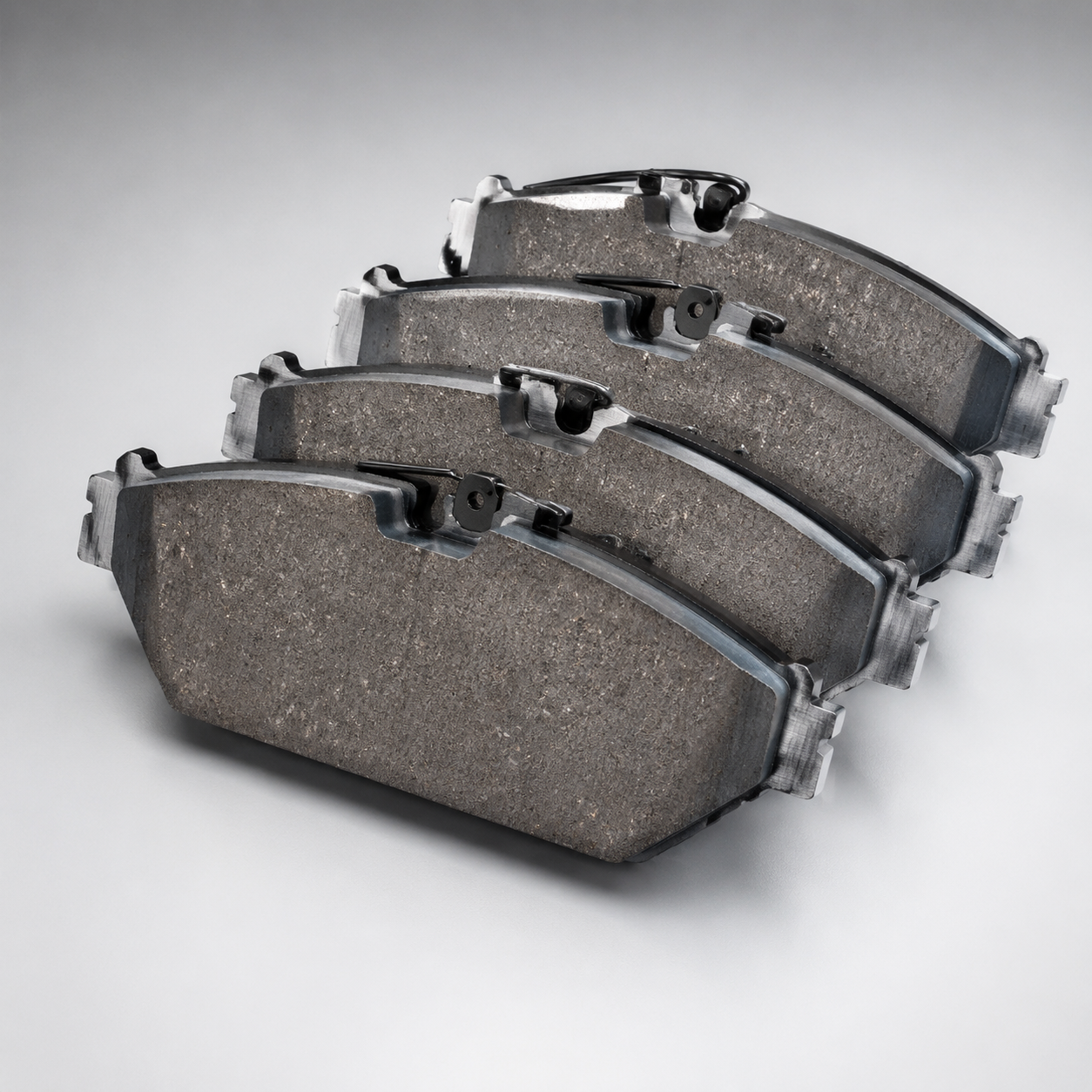
A car brake pad programme should be judged as a controlled assembly, not as a commodity line item. The friction block, shim, adhesive layer, slot and chamfer geometry, scorched surface, and backing plate all affect fitment, noise, and service life.
A useful first-pass screen focuses on six questions:
- Will it fit consistently? Backing plate outline, ear width, hole positions, abutment points, total thickness, and friction height should match approved drawings within agreed tolerances. For many passenger-car references, buyers commonly ask for total pad thickness within ±0.20 mm, backing plate thickness within ±0.05 mm, and critical hole or hook location within ±0.10 to ±0.15 mm.
- Will friction stay stable across temperature? A practical RFQ requirement is a controlled band such as 0.35 to 0.45 μ with no abnormal fade drop and predictable recovery after cooling.
- What is controlling noise? Shim construction, chamfer angle, slot geometry, surface finish, and compressibility all influence NVH. Ask whether the same shim package and noise-control features are maintained across repeat orders.
- What is the wear strategy? Some car brake pads are tuned to extend pad life but increase disc wear; others bias comfort and lower noise. Fleet buyers usually want duty-cycle data, not generic durability language.
- Is compliance documented by part family? Copper-reduction status, heavy-metal restrictions, and destination-market declarations should be tied to the actual references being quoted.
- Can the supplier trace a lot back to production conditions? At minimum, the lot code should link shipment date, press line, shift, and key inspection records.
This early filter eliminates many weak offers before price comparison even starts. In practice, a supplier that can show drawing control, in-process SPC on critical dimensions, and retained lot samples is often lower risk than one that is cheaper but vague.
Choose the compound by channel, not by label
The usual question—"Which material is best?"—is the wrong one. The better question is which compound fits the target vehicle parc, duty cycle, complaint profile, and price band.
| Friction type | Typical characteristics | Main advantages | Main trade-offs | Common applications |
|---|---|---|---|---|
| Low-metallic | Higher metal fibre content, stronger thermal conductivity, typical friction target around 0.38 to 0.45 μ | Good high-temperature response, stable braking under repeated stops, stronger initial bite | More dust, potentially higher noise, increased disc interaction | Performance passenger cars, mixed urban/highway use |
| Ceramic | Fine ceramic fibres and fillers, cleaner visible residue, often tuned around 0.35 to 0.42 μ | Lower visible dust, lower noise tendency, stable day-to-day feel | Higher cost, formulation control is critical for cold bite and fade recovery | Mid-to-premium passenger vehicles |
| Semi-metallic | Broad category with moderate to high metal content, strong thermal robustness | Durable, good heat tolerance, widely accepted in aftermarket and utility applications | Can be noisier, may be harsher on discs in some applications, dust level usually higher | SUVs, pickups, light commercial vehicles, heavier duty cycles |
| NAO / organic | Lower metal content, more fibre/resin-based, smoother engagement | Lower noise potential, lighter pedal feel, good comfort positioning | Faster wear in demanding thermal conditions, not ideal for repeated high-load braking | Small passenger cars, comfort-focused applications |
| Test area | What it measures | Why it matters to buyers |
|---|---|---|
| Shear strength | Bond integrity between friction material and backing plate | Reduces risk of bond failure under thermal load; many buyers ask for values above 3.5 MPa or according to agreed test standard |
| Compressibility | Deformation under applied pressure | Affects pedal feel, taper wear, and NVH; stable values under defined pressure and temperature are more useful than one headline number |
| Scorch / burnish consistency | Bedding behaviour after manufacture | Helps stabilise early service performance and reduces excessive break-in variation between batches |
| Fade and recovery | Braking consistency at elevated temperature and return to normal conditions | Important for warranty control and safety margin; buyers should review both peak fade loss and recovery level |
| Wear testing | Pad mass loss and disc interaction over defined cycles | Supports service interval planning, disc compatibility review, and channel positioning |
| Noise and vibration checks | Squeal tendency across speed/pressure conditions | Critical for installer satisfaction and claims reduction, especially in urban passenger-car applications |