Car Belt Replacement: How Buyers Avoid Fitment Claims and Bad Supply Decisions
Car belt replacement is a high-volume category, but it still generates avoidable claims when sourcing is handled as a catalogue exercise. For distributors, repair networks, and private-label buyers, the real cost shows up later: noise complaints, premature wear, unstable tension, failed installs, and time spent sorting returns that should never have happened.
The root problem is usually not dramatic. It is small dimensional drift, an unsuitable compound, inconsistent cord construction, weak process control, or a supplier that says "OE-equivalent" without showing what is actually controlled. A replacement belt has to match the original belt path, pulley engagement, thermal resistance, and service-life expectation for the job it is meant to do.
In practice, buyers should look for OE-equivalent fit backed by measurable production control. That means verified effective length, rib profile, tensile-member consistency, and traceable lot inspection inside a documented quality system. It also means checking material and regulatory compliance for the target market, then matching the technical file to MOQ, pricing logic, and lead time before the range is launched.
For most import programmes, three evidence layers matter most: first-article dimensional data, routine lot-release records, and validation results for heat, fatigue, and noise. Typical commercial checkpoints include sample lead time of around 7-15 days, repeat production lead time of 30-45 days depending on mix and packaging, and meaningful pricing only after belt type, rib count, packaging specification, and annual volume are fixed. This article lays out how to judge car belt replacement supply using decision points buyers can actually use, rather than generic catalogue language.
Driventus is an independent aftermarket manufacturer; brand names are referenced for fitment only.
Start with the decision that matters: what counts as an OE-equivalent belt?
In aftermarket buying, OE-equivalent does not mean vehicle-maker branding or formal OEM approval. It means the belt fits, runs correctly, and stays inside the operating window the original drive system expects.
For a passenger-vehicle auxiliary-drive car belt replacement, buyers usually need evidence on five points first:
- Effective length and tolerance matched to the tensioner operating range; many buyers want control around ±0.5% or tighter by part family
- Rib count and rib pitch aligned with pulley geometry; a common micro-V pitch is around 3.56 mm, but the supplier should confirm the actual profile standard
- Top width and belt height held within production tolerance, often checked to 0.1 mm resolution during first-article and lot inspection
- Cord stability under cyclic loading, with low permanent elongation after tensile testing
- Compound performance under heat, ozone, and ageing; EPDM is common for modern auxiliary applications
Noise matters too. Many belt claims begin with squeal at cold start or idle long before visible wear appears.
A good sourcing file should also state which application group the belt belongs to:
- Micro-V / poly-V accessory drive applications
- Classical V-belt layouts
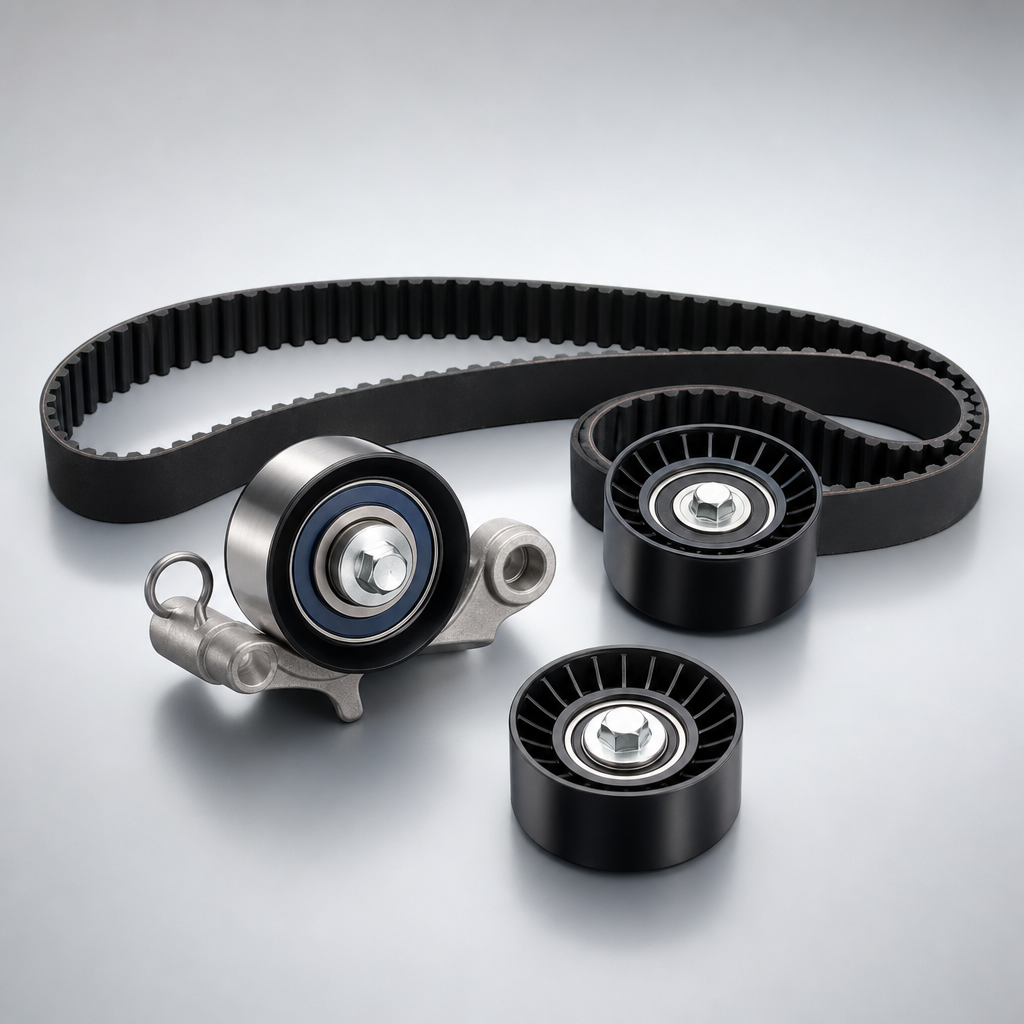
- Timing-belt-related replacement ranges, where applicable and separately controlled
This is where weak suppliers often sound acceptable on paper but fail under review. A dependable source should be able to map each SKU against internal fitment data, identify the drawing basis or reference sample used, explain the measurement method, retain approval samples, and show a lot-coding format that supports claims analysis.
If you are comparing a broader service range, it can also help to review belts together with tensioners, pulleys, gaskets, and related items in our catalog.
Commercial fit matters as much as technical fit. Stock packaging may support MOQs around 300-500 pcs per SKU, while custom sleeves, barcodes, cartons, or private-label packs may push MOQ to 1,000-2,000 pcs per SKU or require mixed-carton minimums. A belt can be technically acceptable and still be the wrong programme choice if the MOQ and replenishment cycle do not match your turnover.
Where car belt replacement programmes usually fail: dimensions, compound, and hidden process drift
Most sourcing failures are not caused by one obvious defect. They come from small mismatches that stack up.
A slight length deviation can shift the tensioner out of range. A rib-profile mismatch can create noise. Poor cord placement may shorten fatigue life. A harder-than-expected compound can change flex behaviour and ageing performance. None of that is visible from a catalogue image.
| Check point | Typical buyer concern | Why it matters |
|---|---|---|
| Effective length | Installation difficulty or low tension | Affects tensioner position and belt slip risk |
| Rib count | Wrong pulley engagement | Causes tracking issues and rapid wear |
| Rib pitch/profile | Noise and poor seating | Must match pulley groove geometry |
| Belt height/thickness | Heat build-up and misalignment | Changes contact behaviour across pulleys |
| Tensile cord construction | Stretch over service life | Directly affects tension retention |
| Rubber compound | Cracking, glazing, hardening | Determines heat and ozone resistance |
| Validation area | Typical method | Procurement value |
|---|---|---|
| Dimensional verification | Length, profile, and rib inspection | Confirms fitment consistency |
| Tensile performance | Load and elongation testing | Screens for stretch-related claims |
| Flex fatigue | Repeated bend cycle testing | Indicates service-life durability |
| Heat ageing | Elevated temperature exposure | Checks hardening and crack resistance |
| Ozone resistance | Controlled ozone exposure | Assesses surface ageing behaviour |
| Noise evaluation | Bench or vehicle-condition assessment | Reduces squeal-related returns |