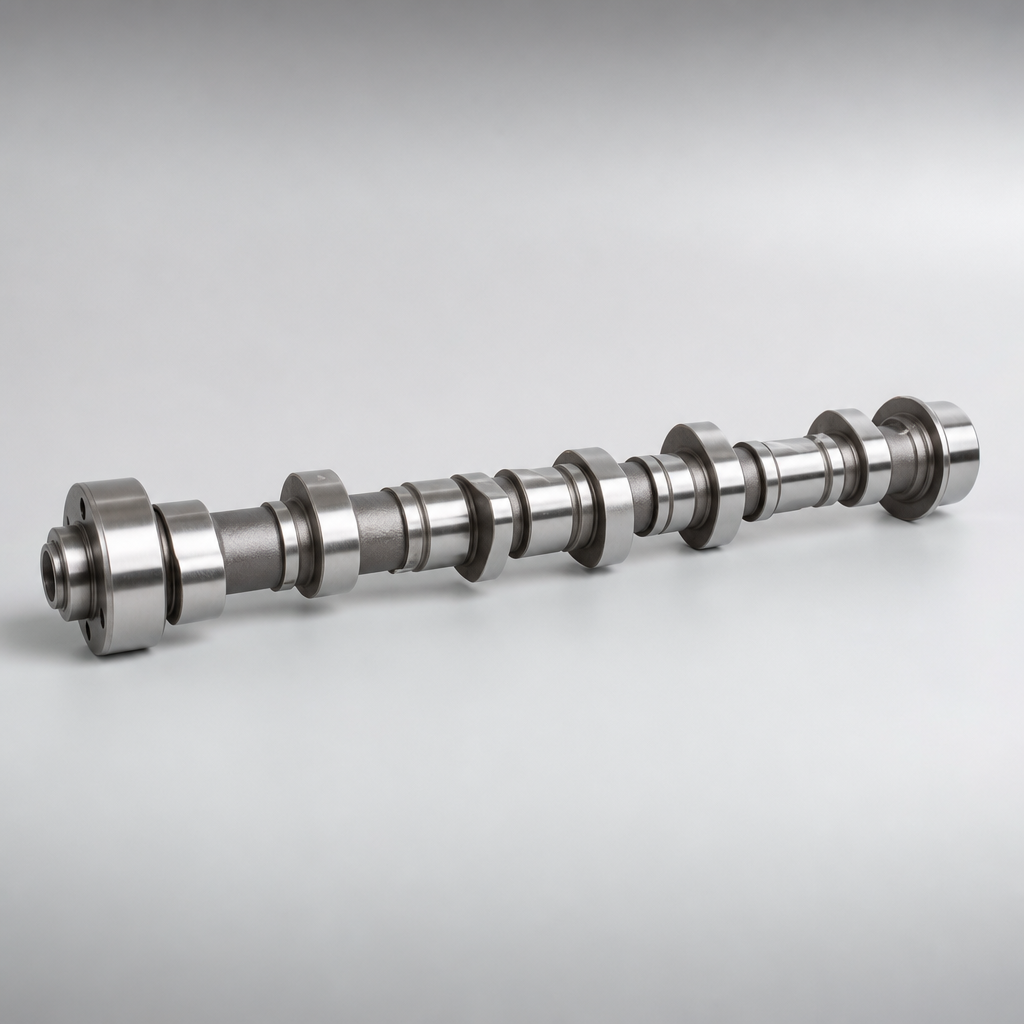
Camshaft for Volkswagen Touareg Aftermarket Replacement
A **camshaft for Volkswagen Touareg aftermarket replacement** should be screened as a risk-control item, not a simple catalog match. For distributors, workshop groups, and import buyers, the real issue is whether the part reproduces OE valve timing, lubrication behavior, and wear life closely enough to avoid noise, repeat labor, or warranty claims. That means checking measured features such as journal diameter, lobe profile, surface hardness, runout, and batch traceability before discussing price breaks.
Touareg applications also need tighter fitment discipline than many buyers expect. Petrol and diesel versions use different engine families, cam profiles, trigger arrangements, and valve timing layouts, so the right part should be confirmed by engine code and OE cross-reference, not by vehicle name alone. In this category, buyers commonly review control points such as +/-0.010 to +/-0.020 mm journal tolerance depending on design, total runout typically held within 0.03-0.05 mm, lobe profile or lift deviation to drawing, journal surface roughness often around Ra 0.2-0.4 um, and lobe hardness frequently verified in ranges such as HRC 55-62 where the material route requires it. Quality-system review should also include IATF 16949:2016, ISO 9001:2015, and material or substance compliance such as REACH (EC) No 1907/2006. Driventus is an independent aftermarket manufacturer; brand names are referenced for fitment only.
Start with the failure modes, not the listing
Most bad purchases in this category come from hidden mismatch, not obvious defects. A shaft can look correct in photos and still be wrong in lift profile, journal sizing, oil feed geometry, trigger features, or hardness depth. The result is familiar: cold-start noise, timing deviation, accelerated follower wear, oiling issues, or immediate installer complaints.
Before approving any supplier, procurement teams should clear these questions first:
Engine-code fitment: Touareg platforms cover multiple V6 and V8 petrol and diesel variants. Match by engine code and production range, not by model name only.
OE cross-reference basis: use documented references only when the supplier can tie them to the exact engine family and build range, such as a number in the format OE 06A107065 where applicable.
Lobe geometry control: profile tolerance should be checked against a drawing, CAD file, or approved master. Many buyers work within 0.01-0.03 mm windows at critical profile points.
Journal diameter tolerance: this affects oil film stability and bearing clearance directly. Buyer review often starts around +/-0.010 mm or the OE-equivalent limit.
Runout: poor straightness increases load and noise. Many importers treat <=0.05 mm total runout after finish grinding as a baseline requirement.
Surface hardness and case depth: these drive lobe durability under cold-start and boundary-lubrication conditions. Batch records matter more than generic statements.
Trigger or sensor compatibility: where timing or position sensing is involved, window shape, phasing angle, and attachment details must match.
Oil passage and drilling accuracy: lubrication routes must follow the intended design or wear will show up quickly.
Commercial review should run in parallel with technical review. For standard aftermarket supply, buyers often see MOQs from 30-100 pcs per item when tooling already exists. Private-label packaging or special marking can shift economical order size toward 100-300 pcs. Unit pricing usually steps down with volume because setup, fixture changeover, inspection, and export packing are spread across more pieces.
If you source across several VAG-related engine lines, it also helps to review adjacent engine parts in our catalog and the broader engine components range so one supplier can support bundled purchasing more efficiently.
Use a comparison sheet when suppliers sound similar
Many quotations use the same language: OE quality, precise grinding, tested hardness, stable supply. Those claims are only useful if the inspection method behind them is clear. A better comparison is to line up the technical checkpoints and ask each factory for the same evidence.
Typical checkpoints
Parameter
Why it matters
Common buyer check
Base material
Determines core strength, fatigue resistance, and machinability
Confirm alloy grade, such as chilled cast iron or alloy steel, plus documented heat-treatment route
Lobe surface hardness
Controls wear resistance at the contact area
Request hardness test records by batch, often in ranges such as HRC 55-62 where specified
Journal finish
Affects lubrication performance and bearing life
Review roughness values such as Ra 0.2-0.4 um and inspection method
Total runout
Limits vibration and uneven loading
Ask for 100% or statistical runout inspection, commonly controlled to <=0.03-0.05 mm
Lobe timing angle
Maintains valve event accuracy
Verify CMM or dedicated fixture report with angular tolerance to drawing
Oil passage cleanliness
Prevents start-up damage from contamination
Check washing standard, residual contamination controls, and blocked-hole inspection
Lobe taper and profile form
Influences follower contact pattern and wear
Review profile inspection data and point-to-point deviation records
Concentricity between features
Supports stable rotation and oil control
Confirm process capability or final inspection records
</tr></thead><tbody> </tbody></table>For many aftermarket programs, buyers should expect hardness verification in HRC, dimensional inspection by micrometer and CMM, and traceability from raw casting or forging through finish grinding. If chilled cast iron or alloy steel is used, the supplier should state the route clearly and support it with metallurgical records.
A credible process description usually includes rough machining, heat treatment, semi-finish grinding, straightness correction where needed, finish grinding, washing, rust prevention, and final audit. Ask one more question that often exposes weak suppliers: how is distortion controlled after heat treatment? On camshafts, even a small shift can move journals or lobe phasing outside tolerance.
Serious manufacturers usually define checkpoints after hardening and again after final grinding. Buyers comparing offers should ask whether runout is checked piece by piece, by batch sampling, or only during first article approval. That answer changes risk far more than a small unit-price difference.
Validation steps that actually lower warranty exposure
Validation is where low-cost offers and low-risk offers separate. If the part is meant for replacement demand rather than experimental use, procurement teams should ask what was tested before the item was released for production or export.
Useful validation methods include:
Dimensional layout inspection against approved drawings or master samples
Material composition verification by spectrometer or equivalent method
Hardness testing at lobe and journal-critical zones
Metallographic review for microstructure and case depth where applicable
Runout and straightness testing after final grinding
Surface roughness measurement on journals and lobes
Bench durability testing under lubricated cycling conditions
Cleanliness inspection after washing and packing
Fitment confirmation on the intended engine family or equivalent fixture where available
The next step is to check the release logic. For example, a supplier may approve production only after first article inspection, material report, hardness report, and runout report all pass against the control plan. Some programs also require a pilot lot of 20-50 pcs for installer feedback before full release. That is especially useful in Touareg applications, where engine-code confusion can turn into expensive returns.
Although camshafts are not regulated like exhaust components, dimensional stability and valve event accuracy still affect combustion behavior and overall engine performance. For buyers serving regulated markets, consistent replacement quality supports downstream service conformity with vehicle systems governed by standards and regulations such as ECE R-83 where applicable.
A documented PPAP-style submission is also practical for private-label or controlled aftermarket projects, even when not formally required. Buyers trying to reduce claim exposure often ask for Level 3-style content: control plan, PFMEA summary, process flow, ballooned drawing, material certificate, hardness report, dimensional report, and retained sample photos.
Validation also affects lead time. If an item is already in the supplier's running program, export lead time may be around 20-35 days after deposit or order confirmation. If re-validation, dedicated packaging approval, or custom marking is required, lead time often moves to 35-50 days.
Questions that reveal whether supplier quality control is real
When assessing a Chinese manufacturer for Touareg camshaft supply, quality governance matters as much as the drawing. Buyers should expect controls aligned with IATF 16949:2016 and ISO 9001:2015, backed by records that can be reviewed during qualification.
Ask for evidence covering:
Incoming raw material verification
Heat-treatment parameter records
In-process SPC on grinding dimensions
Final inspection plan and sampling level
Traceability by batch or production date
Non-conformance handling and containment process
Packaging validation for corrosion protection in sea freight
Substance compliance declarations under REACH (EC) No 1907/2006
Calibration control for gauges and measuring equipment
Corrective action response for field claims or returned parts
The stronger suppliers can explain control frequency in practical terms, not just policy language. Typical examples include:
Incoming material checked by heat number and certificate for each lot
Critical grinding dimensions monitored every 30-60 pcs or per machine setup change
Hardness checked per batch and after any heat-treatment parameter adjustment
Runout checked 100% on critical variants or by tightened sampling on stable programs
Rust-prevention packing verified by packing audit before carton sealing and pallet wrap
At Driventus, these discussions usually connect to the wider quality system, especially for customers managing private label, importer warranty exposure, or multi-market distribution.
For higher-volume programs, buyers may also need special packaging, branded labels, laser marking rules, or kit-level supply with related valvetrain parts. Those requirements should be defined early in the RFQ stage so inspection, labeling, and packing standards are built into the process from the start. If shipment is by sea, ask how long the corrosion-prevention pack is designed to protect the shaft in storage; buyers commonly request 6-12 months of warehouse protection with VCI paper, anti-rust oil, sealed polybag, divider protection, and outer-carton moisture control.
When a standard aftermarket part stops being the right answer
Not every replacement program should stay with a standard catalog part. Custom manufacturing becomes justified when the buyer needs tighter control over branding, packaging, fitment mix, or supply format than a generic listing can deliver.
Typical cases include:
The buyer needs controlled branding and packaging for a private-label line
The target market requires a modified corrosion-prevention specification
Existing demand justifies dedicated tooling or fixtures
The application mix includes low-run variants that need grouped production planning
The customer wants bundled supply with cam followers, seals, or gaskets
The project requires dedicated marking, barcode, or traceability rules by market
In those cases, custom manufacturing can reduce total program cost even when the quoted unit price is not the lowest. The advantage is operational clarity: one drawing set, one inspection standard, one packaging specification, and one traceability route.
The commercial threshold depends on volume and how much is being customized. In practice, custom labeling alone may be justified from roughly 100-200 pcs per SKU, while dedicated inner-box artwork, laser-marking rules, and fixed pallet configuration often become more efficient around 300-500 pcs. If new fixtures, gauges, or validation work are needed, buyers should ask whether tooling is amortized into unit price, charged once, or refunded after cumulative volume.
A practical RFQ package should include engine code, reference part numbers, annual volume, target market, packaging requirement, and any warranty-return history. It should also state whether the program is for stock replenishment, tender business, or service-network supply. That gives the supplier enough context to decide whether a standard aftermarket design is suitable or whether a controlled adaptation is the better commercial and technical fit.
A step-by-step buying workflow for Touareg camshaft replacement
The easiest way to compare offers is to force every quotation through the same review sequence. That keeps the decision from drifting toward price before fitment and process capability are clear.
1. Confirm the exact Touareg engine code and production range. 2. Match all available OE and aftermarket references. 3. Request drawing-based dimensions for journals, lobes, overall length, and key interface features. 4. Verify base material, hardness range, and heat-treatment method. 5. Ask for runout, roughness, and profile inspection records. 6. Confirm compliance documents, including REACH declarations if required. 7. Review corrosion-protective packaging for ocean shipment and warehouse storage. 8. Check lead time, batch traceability, and warranty claim process. 9. Verify whether the supplier has validation data beyond first article inspection. 10. Confirm labeling, palletization, and private-label requirements before order release.
To make quotes directly comparable, ask every supplier for the same commercial fields:
MOQ by SKU for sample order, standard order, and private-label order
EXW or FOB unit price breaks such as sample quantity, 50 pcs, 100 pcs, and 300 pcs
Tooling or packaging charges listed separately
Sample lead time versus mass-order lead time
Warranty handling rule, including photo claim, return analysis, or credit timing
Incoterm and port used for the quotation
This approach separates visually similar parts from validated replacements. It also helps when you source multiple engine components from one supplier and need consistency across shipments. In many cases, a slightly higher unit price is the better decision if it comes with tighter inspection, lower claim risk, and stable export packing. One warranty return can erase the savings from several low-cost orders.
Driventus is an independent aftermarket manufacturer; brand names are referenced for fitment only. Buyers reviewing a camshaft for Volkswagen Touareg aftermarket replacement can use this workflow to qualify offers before sample approval or first shipment.
Frequently asked questions
The main risk is application mismatch hidden behind a similar external shape. Lobe profile, journal size, runout, trigger details, oiling features, and hardness can vary by engine code, which can lead to timing errors, noise, or early wear. Buyers should treat engine-code confirmation and measured inspection data as mandatory, especially where several Touareg engine families are covered by one product line.
At minimum, ask for fitment data, material specification, hardness range, key dimensional records, traceability method, and certification status under IATF 16949:2016 and ISO 9001:2015. REACH declarations may also be required for EU-bound shipments, and validation or inspection summaries are useful for comparing suppliers. A stronger quotation package will also state MOQ, price-break logic, lead time, packing specification, and whether tooling or special-label costs are included.
Yes, if annual volume is stable and the program is defined clearly. Private label, barcode rules, corrosion-protective packing, laser marking, and grouped kits can usually be managed within a controlled supply program, provided the RFQ includes market, volume, and warranty requirements. In practical terms, simple label customization is often workable at lower MOQ than fully custom boxes or kit programs, so buyers should ask for separate MOQ and lead-time conditions for each packaging level.
If you are comparing supply options for Touareg camshafts or related valvetrain parts, you can review fitment and production options in our range and [request a quote](/contact.html).