Camshaft for Volkswagen Polo Replacement: Procurement Guide
A camshaft for Volkswagen Polo replacement has to do more than sit correctly in the cylinder head. For procurement teams, the real release question is whether the part closely matches the OE valve-lift curve, base-circle diameter, journal sizes, timing datum, oil-feed features, sensor trigger geometry, and surface finish. Those details protect idle stability, emissions performance, oil control, and valve-train life.
That level of control is especially important across distributor, repair-chain, and private-label channels. The Polo platform spans multiple engine codes, regional emissions calibrations, SOHC and DOHC layouts, belt and chain timing systems, and production changes within the same model range. Driventus is an independent aftermarket manufacturer; Volkswagen and Polo names are referenced for fitment identification only.
We supply camshaft programmes built around drawing-controlled dimensions, material traceability, profile inspection, hardness verification, batch validation, and export-ready packaging, with documentation aligned to IATF 16949:2016 and ISO 9001:2015 quality-management practices. If you are comparing replacement options for the Polo platform, the safest sourcing approach is to verify engine code, OE reference, cam profile, journal and thrust dimensions, hardness specification, lubrication features, and packaging protection before releasing stock to the sales channel.
What a replacement camshaft must match
For a replacement part, the target is OE-equivalent function, not a generic shaft that simply rotates in the bearing saddles. The correct camshaft has to match the engine family, cylinder-head architecture, valve-train arrangement, timing drive interface, oil-feed design, and sensor features used on the specific application. On Volkswagen Polo applications, that means confirming whether the engine uses SOHC or DOHC architecture, whether the shaft is for the intake or exhaust side on a twin-cam engine, and whether the valve train uses hydraulic tappets, roller followers, or finger followers.
The camshaft controls valve opening point, closing point, lift, duration, and overlap. Even small changes in base circle, lobe height, ramp acceleration, lobe centreline, or phasing datum can affect cylinder filling and exhaust residuals. In the workshop, those differences may show up as unstable idle, extended cranking, cam/crank correlation fault codes, abnormal emissions readings, weak low-end torque, valve-train noise, or hydraulic lifter sensitivity. In distribution, they become warranty and returns issues because the wrong shaft, or a poorly controlled one, may look right until the engine is assembled and run.
A procurement specification should include, at minimum:
Overall length, end geometry, and axial datum
Journal diameters, bearing spacing, journal width, and thrust-face position
Base-circle diameter, lobe height, net lift, flank/ramp geometry, and lobe centreline angle
Intake/exhaust lobe sequence and firing-order orientation
Timing sprocket, belt pulley, chain wheel, gear, or cam phaser interface
Dowel, keyway, locating slot, threaded end, or bolt-hole details
Camshaft position sensor trigger wheel, slot, notch, or reluctor features, where fitted
Oil grooves, oil holes, cross-drilling, and lubrication-channel alignment
Surface hardness, effective case depth where applicable, runout, straightness, and concentricity limits
Journal, lobe, and thrust-face surface finish requirements
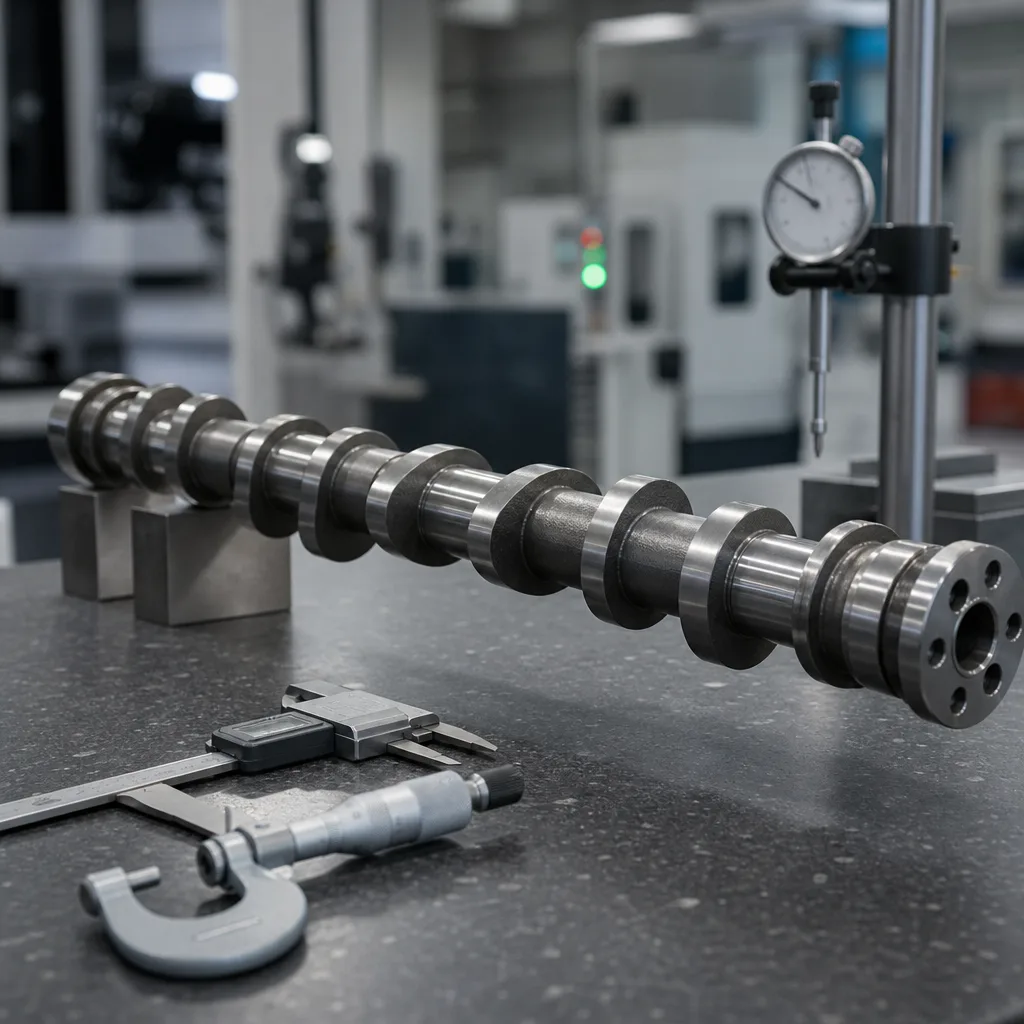
Practical inspection limits should be agreed from the OE sample or approved drawing. Typical control points for aftermarket engine components include journal diameter checks in the micron range with a calibrated micrometer or air gauge, total indicated runout measured on V-blocks or centres, and surface roughness checks on lobes and journals. Exact acceptance limits should remain application-specific; applying one generic tolerance across different Polo engine families increases the risk of oil-clearance, noise, or wear problems.
When any of these values drift, the result can be noisy operation, misfire or cam-position codes, poor starting, oil-pressure sensitivity, accelerated follower wear, or premature lobe polishing. For buyers, the release standard should be dimensional match plus validated durability, not visual similarity alone. A strong camshaft for Volkswagen Polo replacement programme should therefore be managed as a precision engine-component programme, with drawings, master samples, inspection points, and controlled samples agreed before volume release.
Polo fitment: what to verify before ordering
The Polo name covers several engine generations and market-specific variants, so ordering should start with engine identification rather than the badge on the vehicle. The same body style may carry different cam profiles, emissions hardware, timing systems, cylinder-head castings, cam sensors, and phaser arrangements depending on engine code, production year, and sales region.
The most common ordering risk is assuming that one Polo listing covers every vehicle in a model-year range. In practice, catalogue data should be checked against the engine code and, where available, VIN-level build data. This becomes even more important when a market includes naturally aspirated petrol engines, turbocharged petrol engines, diesel variants, flex-fuel calibrations, or locally assembled vehicles with different parts histories.
Minimum fitment checks
Check item
Why it matters
Procurement note
Engine code
Confirms cam profile family, cylinder-head type, and valve-train layout
Match against workshop catalogue, EPC data, and VIN/build data where available
Production date
Captures mid-cycle cam, sensor, phaser, or cylinder-head changes
Check before committing to annual volume forecasts
Valve-train type
Determines lobe count, follower interface, ramp design, and lubrication demand
Do not mix SOHC, DOHC, roller-follower, and flat-tappet applications
Intake or exhaust position
Twin-cam engines may use different profiles and end features
Confirm shaft position before ordering or kitting
Drive method
Changes pulley, sprocket, chain wheel, gear, bolt, dowel, and end geometry
Verify belt, chain, or gear interface and timing datum
Variable valve timing
Affects phaser connection, oil-control route, and locking features
Confirm phaser mating face, oil ports, and locating features where applicable
Sensor trigger
Incorrect slots or reluctor features can create cam/crank correlation faults
Compare trigger geometry with OE sample or drawing
Emissions setup
Calibration sensitivity can differ by region and emissions standard
Check application notes for market-specific exclusions
OE cross-reference
Reduces order errors but does not replace dimensional confirmation
Use the OE number only as a fitment reference
Physical sample
Confirms real-world application details on older or mixed fleets
Use for rebuilders, uncertain catalogue data, and engine-swap markets
</tr></thead><tbody> </tbody></table>For multi-market sourcing, the safest workflow is to validate fitment against the vehicle build data, then confirm the camshaft against a physical sample, OE drawing reference, or supplier dimensional report. This is particularly useful for older stock, remanufactured engines, and vehicles that have undergone prior engine swaps. When a distributor serves several countries from one warehouse, a controlled application matrix should list engine code, OE reference, Driventus reference, intake/exhaust position, production range, timing system, and exclusions so that sales teams do not substitute a visually similar but technically different camshaft.
Material and validation requirements
A dependable replacement camshaft is defined by metallurgy and process control as much as by dimensions. Depending on the application and approved specification, camshafts may be produced from chilled cast iron, ductile iron, forged steel, or machined billet/steel bar. The right route depends on OE design, follower material, contact stress, lubrication regime, and cost target. The key questions are core integrity, lobe wear resistance, journal finish, hardness consistency, straightness after heat treatment, and repeatability across the full shaft length.
Driventus programmes are typically controlled with:
Material traceability by heat, melt, or batch
Incoming material review against the agreed material grade and chemical specification
Casting or forging defect checks where applicable, including visual and process controls for cracks, shrinkage, and porosity risk
CNC machining control for journals, lobes, thrust faces, threads, keyways, dowel holes, and sensor features
Profile inspection against master samples, cam-profile data, or approved drawings
Hardness verification at critical wear zones, especially lobe noses, flanks, journals, and thrust faces
Case-depth or hardened-layer verification where induction hardening, nitriding, or chill-hardening is specified
Runout, straightness, concentricity, and end-face perpendicularity checks
Surface finish inspection on journals, lobes, and thrust faces
Oil-hole, groove, and cross-drilling inspection where lubrication features are present
Cleaning and residual-debris controls before oiling and packing
Final packaging controls to avoid corrosion and impact damage during export transit
Hardness and surface finish deserve close attention because many failures develop gradually. A shaft can install correctly and run quietly at first, then develop lobe wear, follower marking, metal debris, or valve-train noise after service exposure. For a repair chain, that can lead to labour-claim disputes. For a distributor, it creates warranty cost that is difficult to recover if batch records are weak.
Credible inspection plans should state the measurement method, gauge calibration status, sampling level, and acceptance criteria. For example, a buyer can request a first-article inspection report covering journal diameters, lobe lift, base-circle dimensions, timing-interface geometry, runout, hardness readings, and surface-roughness values. Production lots should then be released against a control plan, not informal visual checks.
Where the application is sensitive to emissions or fuel economy, validation should include cold-start stability, idle quality, cam/crank synchronization, oil-feed confirmation, wear pattern review, and endurance cycling on representative duty cycles. For corrosion and handling durability, neutral salt-spray or humidity exposure may be specified for packaged parts depending on the route and storage conditions. For EU supply chains, REACH (EC) No 1907/2006 remains relevant for material and chemical compliance, including coatings, oils, and packaging substances.
The point for buyers is straightforward: a camshaft that passes only visual inspection is not enough. The shaft must be validated against the agreed technical file before it enters channel stock, and the inspection record should be connected to the batch that is actually shipped.
Comparison of supply options
When sourcing a camshaft for Volkswagen Polo replacement, buyers usually choose between three supply paths. The best choice depends on warranty exposure, annual volume, fitment complexity, documentation requirements, and whether the programme will be sold under a distributor brand or installed through a repair network.
Higher setup effort, tooling or fixture review, and sample approval process
Private label, platform programmes, long-term contracts, and fleet-specific coverage
</tr></thead><tbody> </tbody></table>The lowest quoted unit price is rarely the full procurement cost. A camshaft return can include diagnostic time, cylinder-head rework, replacement labour, oil and filter replacement, freight, customer credit, and damage to channel reputation. If a cam profile or sensor trigger is wrong, the part may also generate electronic fault codes that add workshop time before the root cause is found.
A buyer should compare suppliers on:
Application data quality by engine code, production range, and OE reference
First-article approval process and dimensional reporting
Cam-profile inspection capability, not only outside-diameter checks
Heat-treatment or hardening controls and hardness documentation
Lot traceability from raw material to finished carton
Rust-prevention method, oiling, VCI protection, or sealed bag specification
Carton strength, internal supports, and protection for lobes, journals, and machined ends
Response time for fitment questions and non-conformance investigations
For stable repeat demand, OE-equivalent aftermarket or custom manufacturing is normally the stronger commercial choice. It gives procurement teams better control over dimensional consistency, batch traceability, and packaging. If the programme requires a special finish, revised packing, local-language labelling, kitting with seals or followers, or a market-specific variant, custom manufacturing can reduce sourcing exceptions after the initial validation phase.
How Driventus supports procurement teams
Driventus supplies camshaft programmes for export markets through controlled production and documented inspection. The focus is not branding; it is repeatable fitment, predictable lead times, and a quality file that can be reviewed during supplier approval. For a camshaft for Volkswagen Polo replacement, this means supporting the buyer before the purchase order is placed, not only after goods are ready to ship.
The procurement process can include application confirmation, OE-reference review, physical sample comparison, drawing review, material selection, inspection planning, packaging definition, and shipment documentation. For distributors managing several Polo variants, Driventus can help organise the programme around engine-code coverage and practical market demand so that stock decisions are easier to control.
If you are building a broader engine-component basket, start with our catalog and the wider engine components range. For supply-chain due diligence, review our quality system to see how batch control, inspection records, and traceability are managed.
From a purchasing perspective, the useful outputs are:
Dimensional drawings, master-sample reports, or sample-based verification
Application notes tied to engine code, production range, cam position, and OE reference
First-article inspection report where required
Production-lot inspection records tied to shipped cartons
Material, heat-treatment, and process traceability where required
Hardness, runout, profile, and surface-finish checks according to the agreed control plan
Rust-prevention and export-packing specification
Inner box, master carton, pallet, label, and barcode details for warehouse handling
Support for private label, kitting, and platform consolidation
This is where sourcing moves from part selection to programme control. A properly specified camshaft reduces catalogue errors, protects labour margins for repair customers, and lowers the risk of channel complaints tied to premature wear, incorrect fitment, sensor mismatch, or transit-damaged precision surfaces.
Buying checklist before release
Before you place volume orders, confirm the following items with the supplier:
1. Vehicle, market, and engine-code coverage 2. Production date range and any application exclusions 3. SOHC/DOHC layout and intake or exhaust camshaft position where applicable 4. Matching journal diameters, journal spacing, thrust dimensions, base circle, and lobe lift against the OE reference part or approved sample 5. Timing interface, phaser interface, sensor trigger, keyway/dowel, threaded end, and lubrication-feature compatibility 6. Follower type and contact-surface compatibility 7. Material grade, hardening process, hardness range, and case-depth requirement where applicable 8. Runout, straightness, concentricity, and surface-finish limits 9. Sample approval or first-article inspection process before mass production 10. Packaging specification to protect lobes, journals, thrust faces, sensor features, threads, and machined ends 11. Corrosion-protection method for sea freight and warehouse storage 12. Traceability documents and production-lot inspection records 13. Labelling, barcode, and carton-marking requirements for warehouse and repair-chain identification 14. Replacement policy for transit damage, fitment error, or dimensional non-conformance
A final pre-release review should also cover forecast volume, minimum order quantity, lead time, carton quantity, pallet configuration, Incoterms, spare-label requirements, and any private-label artwork or barcode rules. These operational details matter because a technically correct camshaft can still create receiving delays or picking errors if packaging and labelling are not aligned with the buyer's warehouse process.
If a supplier cannot show these details, the offer is incomplete for professional procurement. For replacement parts, the cost of a return is usually higher than the cost of a better-controlled source. A complete buying file should make it clear which Polo engine codes are covered, which OE references are used for fitment only, what inspection limits apply, how the part is packed, and how any non-conformance will be handled before stock reaches the sales channel.
Frequently asked questions
Start with the engine code, production range, valve-train layout, timing drive, intake/exhaust position, sensor features, and OE reference. For uncertain applications, verify against a physical sample, VIN/build data, or a dimensional drawing before ordering.
Yes, if it is OE-equivalent, batch-traceable, and validated for profile accuracy, hardness, runout, surface finish, lubrication features, and fitment. For repair chains, documentation and lot control are as important as the part itself.
Yes. Driventus supports custom manufacturing, private-label supply, application consolidation, export packaging, barcode labels, and inspection records for distributor and repair-network programmes.
For fitment confirmation, sampling, or programme pricing, send your engine code, OE reference, target annual volume, and packaging requirements, then [request a quote](/contact.html).