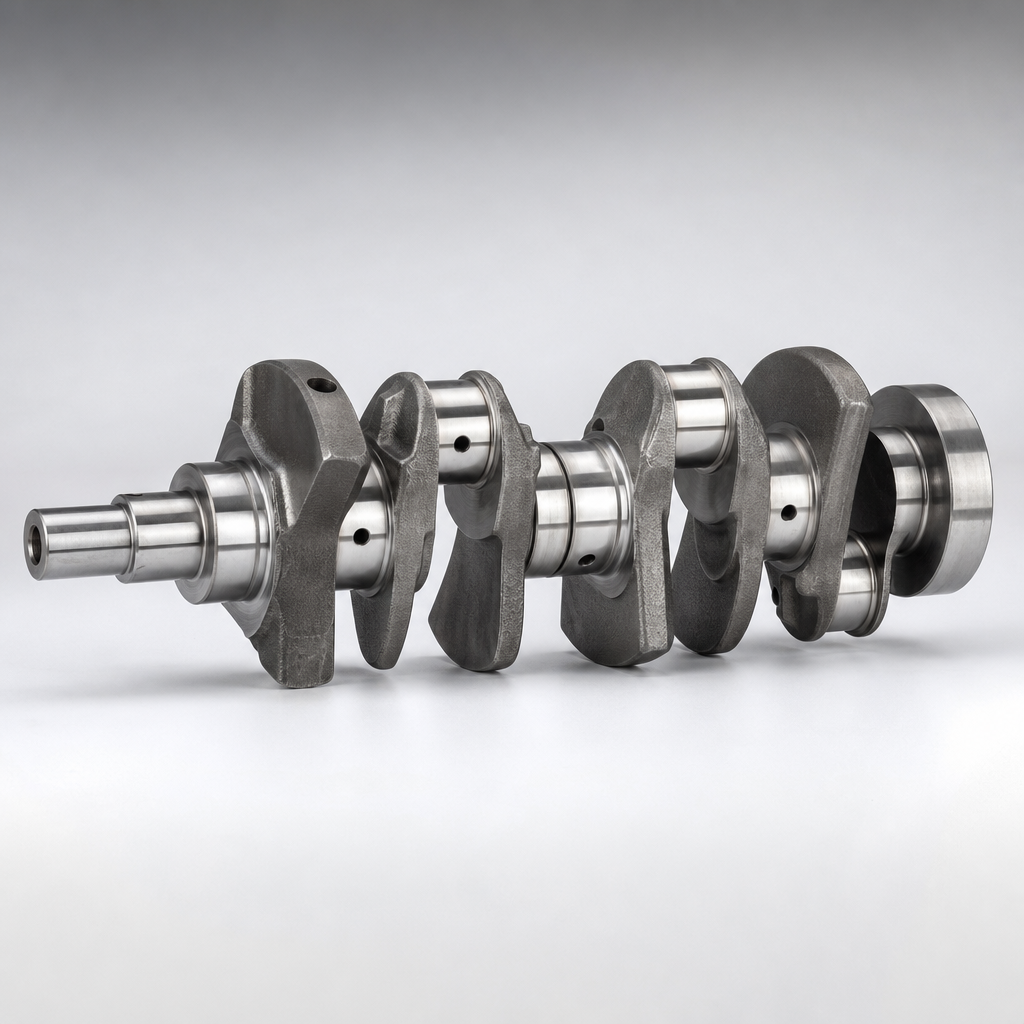
Camshaft for Toyota Hiace OE Equivalent Sourcing
A camshaft for Toyota Hiace OE equivalent replacement has to do more than fit into the cylinder head. It has to reproduce the original valve timing, journal geometry, lobe profile, hardness pattern, oil-feed layout, and drive interface for the exact engine involved. For importers, distributors, and repair-chain buyers, the commercial risk starts where visual similarity ends: wrong timing, unstable idle, valve train noise, oil-clearance problems, emissions issues, and repeat labour claims. Driventus manufactures camshafts and related engine components in Taizhou, Zhejiang, with process controls aligned to IATF 16949:2016 and ISO 9001:2015. This article breaks the sourcing decision into practical checkpoints so buyers can assess a camshaft for Toyota Hiace OE equivalent supply by engineering evidence, not catalogue wording. It also highlights the records, tolerance controls, MOQ assumptions, and lead-time variables that should be settled before volume orders are approved. Driventus is an independent aftermarket manufacturer; brand names are referenced for fitment only.
Start With the Right Question: What Counts as OE-Equivalent?
OE-equivalent does not mean approved by the vehicle manufacturer. It means the replacement part is engineered to match the original component's functional geometry, material behaviour, timing characteristics, and installation interface for a defined application.
That distinction matters because Toyota Hiace platforms cover multiple engine families, fuels, head designs, emissions generations, and valve train layouts. A buyer who approves a part based only on "Hiace camshaft" is taking avoidable risk.
For a camshaft for Toyota Hiace OE equivalent programme, buyers should build the sourcing file around three control layers:
1. Geometry that drives engine behaviour: lobe lift, base circle, phasing, journal dimensions, thrust control, and drive-end features. 2. Material and surface behaviour: core material, hardness distribution, hardened depth or chilled layer, and finish after grinding. 3. Interface compatibility: oil-feed alignment, sprocket or gear fit, dowel/key features, trigger geometry, and protected delivery condition.
The practical checks usually include:
- Lobe lift, base circle, flank form, and opening/closing timing
- Journal diameter, spacing, oil-hole position, and thrust-face width
- Gear, sprocket, or chain-drive interface geometry
- Sensor trigger features where applicable
- Surface hardness depth and lobe finish after grinding
- Straightness, runout, and balance where specified
- Packaging protection against rust and handling damage
Those points should be translated into measurable acceptance limits. Typical aftermarket control plans may use lobe lift tolerance of about +/-0.02 to +/-0.05 mm from approved drawing, journal diameter tolerance around +/-0.01 to +/-0.02 mm, total indicated runout often within 0.03 to 0.08 mm depending on shaft length, and lobe-to-lobe phase control around +/-0.5 degrees crank-equivalent or to drawing limit. Surface finish targets commonly fall around Ra 0.2-0.4 um on lobes and Ra 0.4-0.8 um on journals after final grinding, depending on the original design and follower type.
The failure mode here is simple: a camshaft can look correct, install cleanly, and still be wrong in timing or lubrication. That is why Driventus treats OE equivalence as an engineering comparison backed by drawings, master samples, and inspection records. Buyers should ask how equivalence was established: approved drawing, master sample, reverse-engineered profile data, or only catalogue cross-reference. Those routes do not carry the same risk.
Where Camshaft Programmes Usually Fail
Most sourcing problems do not start with catastrophic metallurgy. They start with ordinary shortcuts.
Common failure modes for aftermarket camshaft programmes include:
- Cross-referencing one SKU across too many engine variants
- Using a worn field sample as the only dimensional master
- Accepting pass/fail language with no nominal values or tolerance bands
- Approving hardness values without checking effective depth or hardness pattern
- Missing oil-hole alignment or deburring issues
- Ignoring runout and straightness until installation complaints appear
- Outsourcing critical processes without clear batch traceability
- Treating packaging as secondary even though journals and lobes are damage-sensitive
For distributors, catalogue overlap is often the most expensive mistake. The shaft may be machined correctly and still be the wrong application because the trigger feature, thrust arrangement, or phasing family does not match the target engine.
For importers, another recurring issue is incomplete approval logic. A supplier may say the part is "same as original," but if there is no profile scan, no hardness map, and no critical-dimension report, the statement has little value when a warranty claim arrives.
A better buying posture is to ask what would cause rejection before the order is placed. If the answer is vague, the sourcing file is still weak.
Compare the Manufacturing Route Before You Compare Price
Material route and process control drive service life. Unit price does not explain enough on its own.
Camshafts operate under repeated sliding contact, marginal lubrication during start-up, and constant cyclic load. A replacement part has to resist scuffing, pitting, scoring, and distortion after heat treatment. Common routes include chilled cast iron, alloy cast iron, forged steel, and induction-hardened steel, depending on design and customer specification.
A practical procurement specification should define the control points below:
| Parameter | Typical control point | Why it matters |
|---|---|---|
| Lobe lift deviation | Customer drawing or master sample limit | Maintains valve lift and engine breathing |
| Journal diameter | Micrometre and roundness inspection | Controls oil clearance and bearing life |
| Surface roughness | Ra value on lobes and journals | Reduces wear during break-in |
| Hardness | Lobe and journal hardness mapping | Helps prevent premature pitting and scuffing |
| Runout | Between-centre measurement | Limits valve train noise and bearing load |
| Oil-hole position | Fixture and visual verification | Confirms lubrication reaches the bearing interface |
| Cam profile | Profile scan or coordinate measurement | Protects timing, lift curve, and emissions behaviour |
| Characteristic | Typical buyer target for approval | Common inspection method |
|---|---|---|
| Lobe hardness | 52-62 HRC depending on material route | Rockwell hardness test |
| Effective hardened depth or chilled layer | 1.0-3.0 mm typical, drawing-dependent | Microhardness traverse / section check |
| Journal roundness | <=0.005-0.010 mm | Roundness tester or precision gauge |
| Total runout | <=0.03-0.08 mm | V-block or between-centre indicator |
| Lobe surface roughness | Ra 0.2-0.4 um | Profilometer |
| Journal surface roughness | Ra 0.4-0.8 um | Profilometer |
| Straightness along shaft | Drawing limit, often <=0.03-0.08 mm | Dial indicator / CMM |