camshaft · 2026-05-29

Camshaft Porsche Manufacturer China: Sourcing Guide

If you are evaluating a camshaft Porsche manufacturer China source, the practical question is not marketing claims. It is whether the supplier can hold dimensional control, document traceability, and ship repeatable product for a defined engine family. For procurement teams, that means verifying metallurgy, lobe geometry, runout, surface finish, packaging, and the factory's ability to support samples and steady production. Driventus is an independent aftermarket manufacturer; brand names are referenced for fitment only. We supply B2B programs for distributors, OEM and Tier-1 buyers, and repair networks that need consistent lead times, technical files, and export documentation. The right supplier should be able to work from drawings, OE cross-references, or sample parts, then translate that into a controlled manufacturing plan with inspection records and clear acceptance criteria.

What a Porsche camshaft buyer should verify

Porsche camshafts are not a commodity part. Small errors in lobe phasing, base circle, or journal finish can change idle quality, valve timing, and wear behaviour. Before a purchase order is issued, the buyer should confirm the exact engine code, model year range, and whether the requirement is OE-equivalent replacement or a custom profile.

Key questions for sourcing:

  • Is the part matched to the correct valve train architecture, including VVT or fixed timing variants?
  • Are the drawings or samples enough to verify journal diameter, overall length, lobe lift, and thrust face geometry?
  • Is the supplier able to document traceability by batch, heat, and inspection lot?
  • Can the supplier support packaging that protects lobes and journals during ocean freight?

For catalogue browsing, see our catalog and the broader engine components range. If the project needs profile changes, custom manufacturing is the right path.

The minimum supplier file should include material declaration, process route, inspection plan, and a clear statement of compatibility. If the buyer is working against an OE reference, the listing should show the relevant OE 06A-style or 11251-style cross-reference only when that number is already part of the application data.

Materials, machining, and inspection points

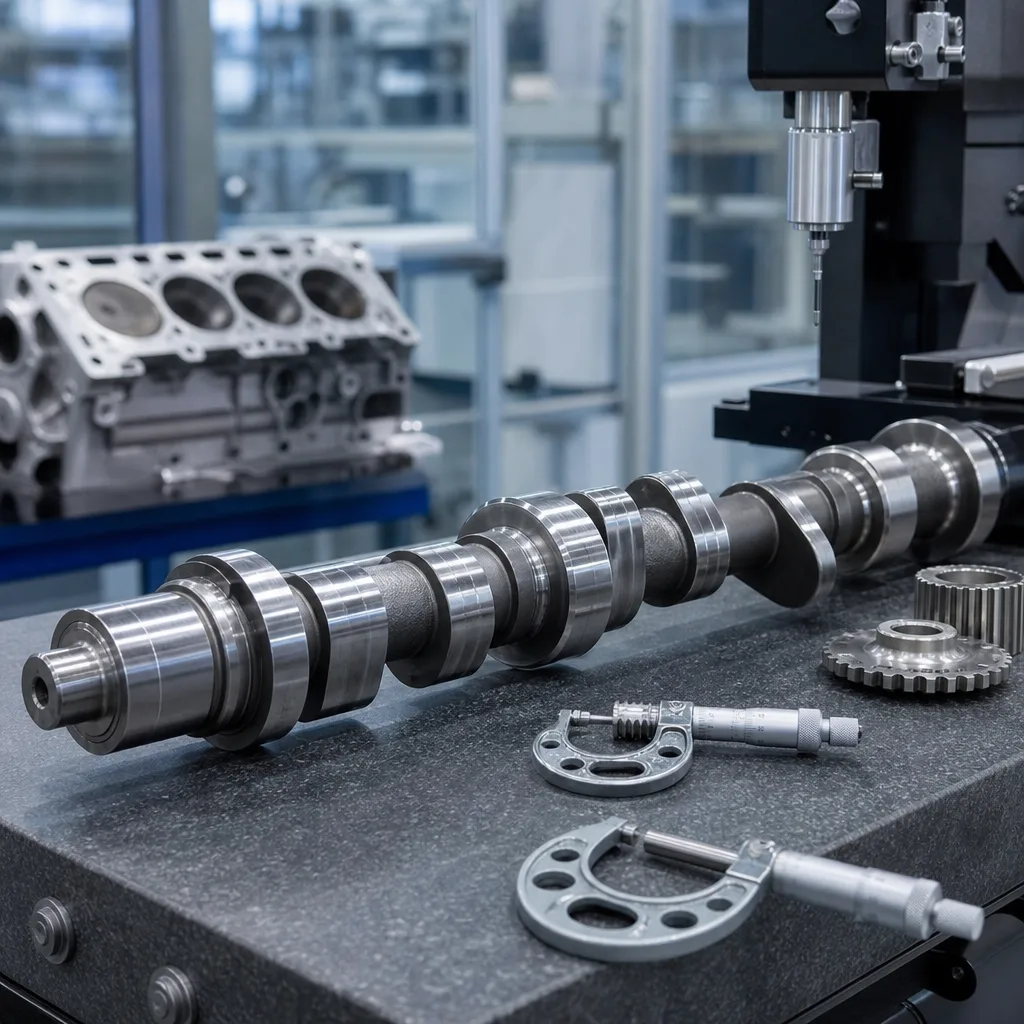
A dependable camshaft is built from controlled material and inspected at several stages, not only at final measurement. For volume programmes, common routes include chilled cast iron or steel billet processes, depending on the duty cycle and the required profile stability. The exact route should be selected against fatigue load, surface wear, and target annual volume.

Typical technical controls

</tr></thead><tbody> </tbody></table>Procurement teams should also ask for the inspection method, gauge list, and sample size used for process approval. A supplier that works to IATF 16949:2016 and ISO 9001:2015 should be able to show calibration records, control plans, and nonconformance handling. For chemical compliance on exported parts and packaging, REACH (EC) No 1907/2006 should be addressed where relevant.

Quality system and validation before release

A camshaft programme should not move to mass shipment until the supplier has passed a document and part-level review. That review should be tied to the product family, not to a generic factory statement.

The practical release pack should include:

  • dimensional report for the first articles
  • material certificate or equivalent heat record
  • hardness and surface checks where specified
  • packaging approval with transit protection method
  • change-control commitment for tooling, steel source, or process sequence

See our quality system for the control structure used across export programmes. For new builds, we normally align sample approval with the buyer's internal requirements and, where needed, PPAP-style documentation. If the target market or end customer asks for a stricter emission-related application check, the buyer should confirm the surrounding engine system as well, because valve timing tolerance can affect downstream calibration.

A competent supplier should also state what happens if a lot is held for discrepancy: rework rules, replacement terms, and escalation contacts. That is more useful than broad promises, because it tells the buyer how the plant behaves under deviation control.

MOQ, lead time, and factory audit criteria

For B2B buyers, the commercial side matters as much as the technical side. A supplier may have a good sample but still fail on repeat supply, packing discipline, or communication speed. The best test is to combine a technical audit with a commercial review before first shipment.

Recommended audit points:

1. production capacity by camshaft family 2. machining centre availability and bottleneck steps 3. in-house versus outsourced heat treatment 4. lot traceability and barcode discipline 5. export packing standard and carton drop resistance 6. sample lead time and production lead time

Buyers should also ask how the plant handles MOQ. Some camshaft programmes justify only modest initial volume, especially for rare engine variants or aftermarket repair demand. In those cases, a supplier that can hold a lower MOQ without losing control is more valuable than one offering a nominally low price on unstable quality.

If the team needs an audited source for multiple engine parts, a single supplier base that covers camshafts, pistons, gaskets, and water pumps can simplify inbound QC and vendor management. Start with request a quote once the part list and annual forecast are defined.

When custom manufacturing is the better route

Not every program should use a stock catalogue item. Custom manufacturing makes sense when the buyer needs a different lobe profile, revised timing event, special coating, or packaging adapted to a specific channel. It also helps when the buyer wants one supplier to hold dimensional control across several related parts.

Custom work is usually justified when:

  • the vehicle application has multiple engine variants under one model name
  • the buyer needs an OE-equivalent replacement with verified dimensional match
  • the target market needs a different durability target than the original part
  • the end customer wants bundled supply for engine rebuild kits

For engineering-led buyers, the fastest route is usually drawing review, sample confirmation, and a pilot lot. From there, the factory can lock the process route and issue a controlled production plan. That approach reduces the risk of later changes that would affect fitment or service life.

If you are comparing a camshaft Porsche manufacturer China option against a regional remanufacturer, the deciding factors are usually not only unit cost. They are process control, documentation, transit protection, and the ability to scale without losing measurement discipline.

Frequently asked questions

Yes, when the buyer provides the engine code, drawing, or validated sample. We use the OE reference for fitment comparison only and do not claim manufacturer endorsement.

Ask for material data, dimensional reports, inspection records, packaging details, and quality-system evidence such as IATF 16949:2016 or ISO 9001:2015 coverage where applicable.

Yes. Trial orders are useful for fitment checks, surface inspection, and packaging validation before a production commitment. Final MOQ depends on the exact camshaft family and process route.

For drawings review, sample planning, and export pricing, [request a quote](/contact.html).

Request a Quote
Control item What to verify Why it matters
Base materialHeat number, chemistry, and certificateConfirms traceability and alloy consistency
Journal diameterMicrometre-level measurement against drawingProtects bearing fit and oil film stability
Lobe profileLift, duration, and flank geometryControls valve event repeatability
RunoutMeasured on a calibrated fixtureReduces vibration and uneven wear
Surface finishJournal and lobe roughnessAffects friction and break-in behaviour
HardnessCase or bulk hardness, as specifiedSupports wear resistance under load