Camshaft Phaser Mercedes-Benz Manufacturer China Sourcing
Sourcing a camshaft phaser for Mercedes-Benz applications is a validation job, not a simple price comparison. Procurement teams need to confirm the engine family, intake or exhaust position, oil-control strategy, camshaft and sprocket interfaces, ECU feedback pattern, and replacement cross-reference before approving a supplier. A unit may look correct in photos and still fail if the vane angle, parking position, lock-pin release pressure, oil-port geometry, rotor clearance, or sensor target index is off. For any B2B buyer searching for a camshaft phaser Mercedes-Benz manufacturer China source, the main priority is controlled matching by form, fit, and function, not a broad replacement claim. Driventus is an independent aftermarket manufacturer; Mercedes-Benz and other brand names are referenced only for fitment identification. We support catalog supply, sample-based development, drawing-based production, and controlled aftermarket alternatives when an OE cross-reference must be matched for regional distribution, private-label programs, or OEM-style purchasing requirements. For procurement teams, the practical questions are straightforward: Can the part number be traced? How is it inspected? What functional tests are covered? What is the lead time? How are packaging, change control, and batch repeatability managed? A good factory should be able to repeat approved batch performance, not only pass a first sample.
What buyers should verify first
Mercedes-Benz phaser sourcing starts with function, not appearance. The same engine family can use different intake and exhaust units, lock-pin strategies, oil-control calibrations, and cam position target patterns depending on displacement, model year, emission standard, and vehicle platform. Before comparing unit prices, confirm the engine code, camshaft position, connector or sensor-side geometry, OE cross-reference from the sample or drawing, and intended market. Use our catalog to screen available references, then decide whether you need a stocked replacement, a private-label catalog item, or a drawing-based build.
A useful first review should answer four technical questions: which engine is being served, which camshaft position is controlled, how pressurized engine oil is routed through the rotor and stator, and how the ECU reads cam position feedback. These checks help prevent a common sourcing error: approving a visually similar phaser that installs but later causes cold-start rattle, slow advance or retard response, incorrect parking position, unstable cam/crank correlation, or diagnostic trouble codes.
A clean RFQ should include:
Engine code and model year range
Vehicle model, chassis code, or platform if known
Intake or exhaust position
OE cross-reference, aftermarket reference, or sample photos
Front, rear, side, bolt-hole, oil-port, and sensor-target photos
Critical dimensions such as mounting depth, bolt circle, center bore, face height, and oil-port position
Target market and annual volume
Required packaging and labeling format
Any private-label, barcode, carton-count, pallet, or traceability requirements
When those details are missing, the first sample round usually takes longer because the supplier has to verify the fitment target before production starts. For distributor programs, this step also protects catalog accuracy. One wrong interchange can create returns across multiple warehouses, e-commerce listings, or repair-chain locations.
Key dimensions and control points
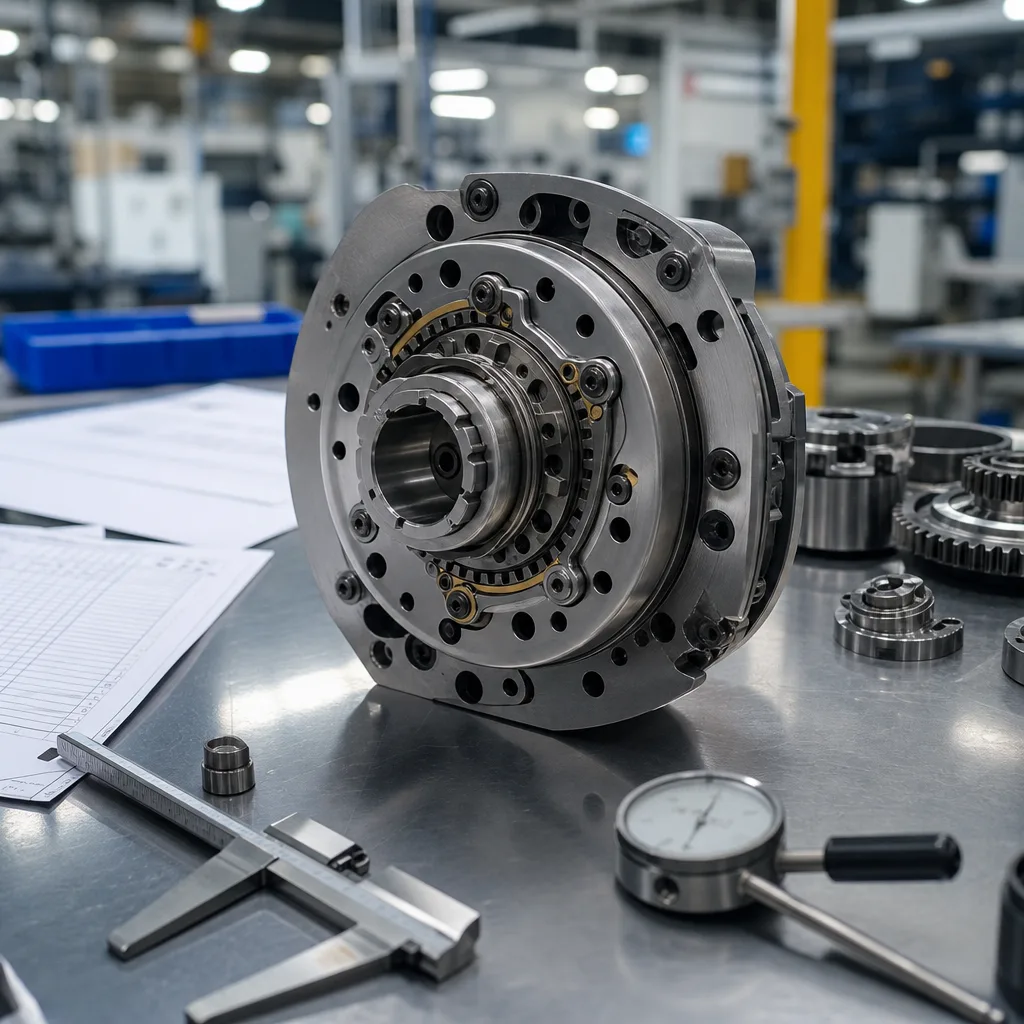
A camshaft phaser is a precision mechanical-hydraulic timing actuator. Small deviations can create engine faults, cold-start noise, delayed phase response, oil-pressure instability, chain load variation, or premature wear. Buyers should treat it as a controlled assembly, not a simple sprocket. Typical review items include vane travel in crankshaft degrees, lock-pin release behavior at defined oil pressure, internal leakage, rotor-to-stator clearance, sensor target indexing, and oil-gallery cleanliness. The table below shows the control points to review during technical evaluation and pre-production approval.
Control point
What to verify
Why it matters
Vane travel
Full advance and retard angle, stop positions, travel consistency, parking position
Incorrect travel changes valve timing and can trigger performance or cam/crank correlation faults
Lock pin
Engagement point, release pressure, return behavior, spring force, pin-seat wear marks
Prevents start-up rattle and cold-start timing faults
Oil feed
Port geometry, passage size, gallery alignment, cleanliness, response time
Affects phase speed, oil pressure stability, and DTC risk
Rotor and stator clearance
Side clearance, concentricity, internal leakage path, vane seal contact
Controls actuation stability and hot-idle performance
Housing interface
Bolt circle, dowel location, center bore, face depth, runout
Must match the timing cover, camshaft, and sprocket interface
Sensor target
Pattern, tooth alignment, index position, magnetic or trigger relationship
Needed for stable cam position signal and ECU synchronization
Sealing surfaces
Flatness, groove condition, contact finish, O-ring or seal land condition
Reduces debris generation, seal damage, and long-term wear
Heat treatment and material
Hardness, case depth where specified, wear resistance, material grade
Supports durability under repeated timing adjustment
</tr></thead><tbody> </tbody></table>During sample approval, procurement teams should ask for dimensional checks and functional confirmation. A part can pass a basic gauge check but still fail in response time, leakage, or lock-pin release behavior. Practical approval data may include CMM or fixture measurements for critical interfaces, runout checks, hardness records, visual cleanliness review, oil-passage inspection, and bench test results for lock/release and actuation response. For a camshaft phaser Mercedes-Benz manufacturer China program, the right question is not only whether the part fits the engine. It is whether the factory can hold the same geometry, oil-flow behavior, and response window across repeated production lots.
Buyers comparing suppliers should also confirm how engineering changes are controlled. A small revision to machining sequence, spring force, rotor clearance, vane seal material, coating, or heat treatment can change performance. For long-term supply, the approved sample should be tied to drawings, control plans, inspection plans, functional test parameters, retained samples, and packaging specifications so later batches stay aligned with the validated version.
Quality system and validation
Our quality system is aligned with quality system requirements built around IATF 16949:2016 and ISO 9001:2015. For procurement teams, this supports controlled traceability, documented inspection, calibration control, nonconforming-material handling, and repeatable process control instead of ad hoc sampling. In practical terms, buyers need confidence that the approved part is not only correct once, but repeatable through material purchasing, machining, deburring, cleaning, assembly, bench testing, packing, and shipment.
Typical control measures for phaser production include:
Incoming material verification by lot and supplier batch
Heat treatment, hardness, and surface condition records where applicable
Supplier and material batch traceability
Dimensional inspection on critical features such as bolt circle, mounting depth, center bore, oil ports, and runout
In-process checks for machined interfaces, oil passages, burrs, and edge breaks
Functional checks on lock engagement and release behavior
Leak and response testing on dedicated hydraulic benches
Cleanliness controls for oil galleries, chips, and loose particles
Surface finish, burr, and visual appearance controls
Final inspection before packing
Traceability records tied to batch, operator, inspection date, and production date
Validation should match the buyer’s risk level. A catalog replenishment order may require fitment confirmation, batch inspection, standard functional testing, and shipment-level traceability. A new private-label or drawing-based item may require sample submission, dimensional report, material and hardness report, bench testing, packaging approval, pilot order review, and then a controlled mass-production release. For customers serving warranty-sensitive markets, inspection records and production traceability are especially important when investigating field claims or separating installation issues from part-related failures.
Where buyers need compliance documentation, material declarations and restricted-substance tracking can be prepared for REACH (EC) No 1907/2006. This is especially relevant for EU and UK import programs that require a clean technical file before stock release. If the buyer has additional requirements for labeling, carton markings, country-of-origin documentation, inspection templates, retained samples, or platform-specific quality records, those details should be stated during RFQ review so they can be included in the quotation and production plan.
Supply model for distributors and OEM buyers
For aftermarket distributors, wholesalers, importers, private-label brands, and multi-location repair chains, the commercial model matters as much as the technical one. Buyers usually need stable packaging, consistent carton count, repeatable label data, predictable replenishment, and a supplier that can handle both repeat orders and special runs. Our custom manufacturing support is designed for these cases, including sample matching, reverse-checking, drawing-based production, and private-label supply when the buyer needs a controlled alternative to an existing OE reference.
Common sourcing scenarios include:
Catalog part with recurring replenishment
New build matched to a supplied OE or aftermarket sample
Drawing-based production for a private-label program
Mixed timing component bundles for a service-line rollout
Regional distributor stock programs with fixed label, barcode, and carton specifications
OEM-style sourcing where documentation, inspection, PPAP-style files, and change control are required
For adjacent engine and timing parts, see our engine components. This is useful when a buyer wants to align phasers with gaskets, water pumps, timing chains, tensioners, guides, sprockets, or related powertrain items under one supply plan. Consolidating related parts can simplify vendor management, shipment planning, carton labeling, replenishment forecasting, and warranty traceability, especially for distributors building a complete engine repair category.
Lead time depends on whether the item is already in the catalog, whether tooling or fixture changes are needed, whether a physical sample must be reverse-checked, and how much validation the buyer requires. For urgent replenishment, a stocked reference is usually faster than a new build. For custom programs, the timeline should include technical review, quotation, sample production, sample testing, buyer approval, packaging confirmation, mass production, final inspection, export packing, and shipment preparation.
Commercial planning should also cover minimum order quantity, forecast schedule, safety stock expectations, packaging configuration, pallet loading, Incoterms, destination requirements, and after-sales claim procedure. A stable supply model reduces emergency purchasing and helps buyers avoid switching suppliers after a product has already been introduced into their catalog, e-commerce data set, or repair network.
How to send a clean RFQ
A complete RFQ shortens the quotation cycle and reduces sampling risk. For this product family, send the technical and commercial details in one package so engineering, quality, and sales teams can review the same requirement set. This matters even more for a camshaft phaser Mercedes-Benz manufacturer China program, where the buyer may be comparing several engine variants, OE references, or intake/exhaust positions at the same time.
Include the following items:
Engine code and vehicle application
Model year range and market region if known
Intake or exhaust side
OE cross-reference, aftermarket reference, or supersession number if available
Clear photos of the front, rear, side, oil ports, bolt pattern, timing mark, and connector or sensor area
Sample dimensions, 2D drawings, 3D files, or inspection points if available
Any known timing angle, lock-pin, oil-control, response-time, or leakage requirements
Target quantity by month or year
Destination country and preferred Incoterms
Packaging requirement, including inner box, master carton, pallet, and label format
Branding, private-label, barcode, carton, or pallet requirements
Required documents, inspection reports, compliance files, or retained-sample requirements
If the engine family has multiple phaser variants, note any differences in sensor wheel pattern, oil gallery alignment, locking position, mounting depth, center bore, sprocket profile, or bolt pattern. Those details often separate a correct match from a near match. If the buyer can provide an original sample, a failed sample, and the intended replacement reference, the comparison process is faster and more accurate.
After the requirement is confirmed, we can move from fitment review to quotation, sample planning, and production scheduling without rework. A typical process is: application review, cross-reference confirmation, technical evaluation, quote, sample or pilot run, dimensional inspection, functional check, buyer approval, production release, final QC, packing, and shipment. Complete starting information keeps that process controlled and avoids repeated sample corrections.
Frequently asked questions
Yes. We can quote from a physical sample, technical drawing, 3D file, or validated OE cross-reference. The review checks mounting geometry, oil interface, vane travel, lock behavior, sensor target alignment, material requirements, and functional test needs before production is released. Brand names are used for fitment reference only.
Typical files include dimensional inspection records, functional test results where required, traceability data, material declarations, batch information, and compliance support for REACH (EC) No 1907/2006 when required by the destination market. Specific report formats should be confirmed during RFQ review.
Yes. Catalog items are suited to faster replenishment, while custom programs are used when buyers need a specific fitment, drawing-based build, sample-matched development, packaging specification, private-label requirement, or controlled distributor program with documented change control.
For fitment review, volume planning, or a drawing-based quotation, [request a quote](/contact.html).