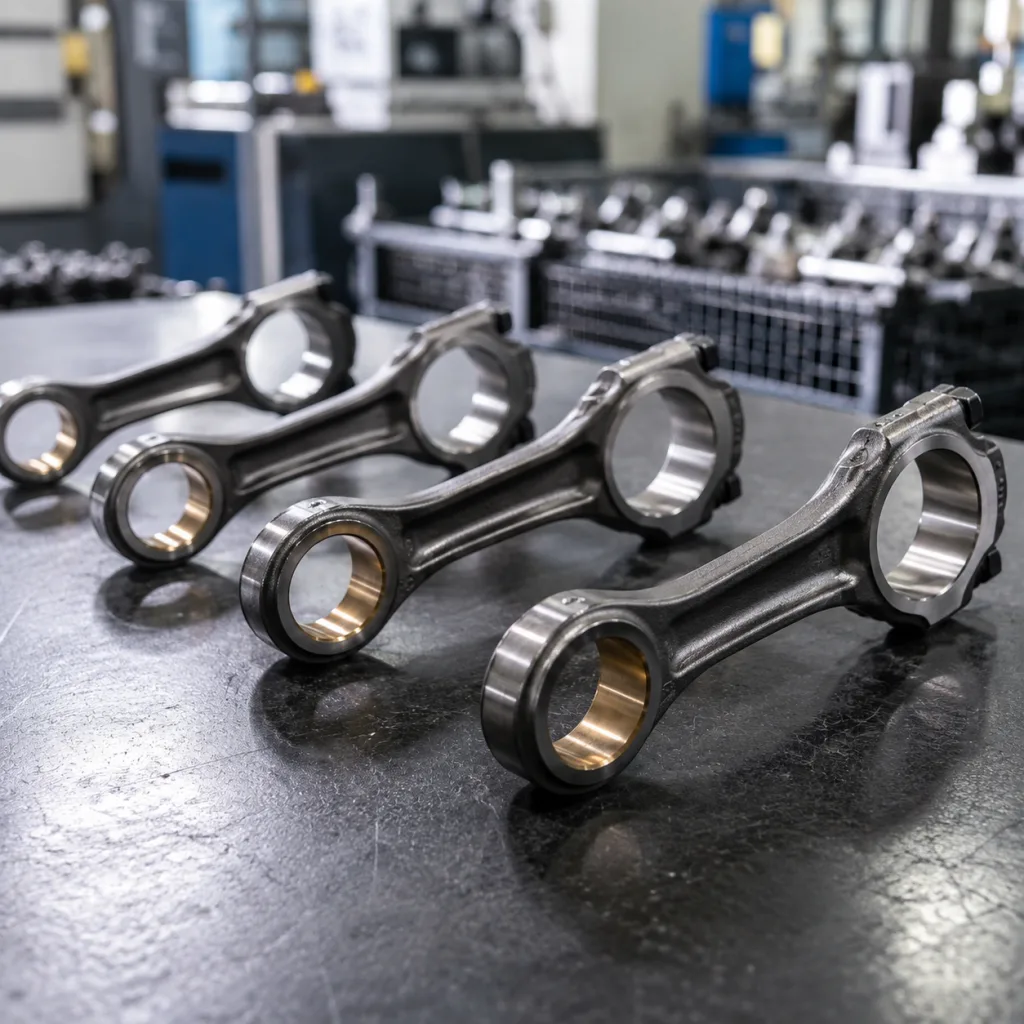
Camshaft Phaser Genesis Aftermarket Replacement Guide for Procurement Teams
Replacing a camshaft phaser on a Genesis application is not a simple bolt-on repair. It affects cold-start NVH, idle stability, torque delivery, emissions calibration, and OBD correlation logic. A hydraulic vane-type phaser has to match the engine family, intake or exhaust position, lock-pin strategy, cam interface, oil-feed clocking, internal leakage profile, and trigger indexing to the cam sensor reference. Small deviations matter: trigger-to-lock angle error near 1 cam degree, stop-angle mismatch, or excess vane side clearance can lead to cold-start rattle, unstable idle, slow cam response, or P0011/P0014/P0016-P0019 style faults after installation. When sourcing a camshaft phaser Genesis aftermarket replacement, procurement teams should qualify the part against OE nominal dimensions and functional behavior across temperature and oil-pressure conditions, rather than stopping at a casting-level fit check. Driventus is an independent aftermarket manufacturer; Genesis and other brand names are referenced for fitment only. We supply replacement engine components to distributors, repair networks, and OEM programs, with process control aligned to IATF 16949:2016 and ISO 9001:2015. This guide explains what an acceptable replacement looks like, which dimensions and hydraulic control points deserve the closest attention, what validation data and documents to request, and how to build a repeatable sourcing program instead of requalifying every lot.
What Defines a Valid Replacement
A valid replacement starts with OE-equivalent hydraulic and angular behavior, not with a casting that only looks right on the bench. On Genesis VVT applications, the phaser needs to lock at the correct park angle during crank, release at the specified oil pressure, move through the approved advance/retard window, and hold commanded position without excessive internal leakage once oil is hot. A part may install cleanly and still fail in service if trigger-to-lock indexing is off by about 1 cam degree, if the lock pin does not seat fully, or if vane clearances let hot oil bleed off too quickly.
Before approving a part for volume supply, buyers should confirm these application-specific items:
Exact application identity: engine code, model year, build-date split, destination market, emissions-calibration family, and whether the part is for the intake or exhaust cam.
Bank and side designation: where bank-specific variants exist, confirm LH/RH or Bank 1/Bank 2 explicitly rather than relying on a generic catalog line.
Phaser architecture: vane count, chamber geometry, lock-pin location, return spring arrangement, and whether the unit parks in the fully advanced, fully retarded, or intermediate position.
Installed angular references: total phase range, mechanical stop angles, and the angular relationship between the locked position and sensor target. These values should be stated in cam degrees or crank degrees, not described only as "OE-style".
Cam and sprocket interface: pilot diameter, spline or bolt interface, thread specification, stack height, and clamp-face geometry.
Oil-control layout: feed-port clocking, annular grooves, internal restrictions, seal-ring design, and bleed paths that determine fill time and leakage.
Wear-critical surfaces: bore finish, thrust-face finish, coating coverage, and hardness of the lock pin and related contact surfaces.
A workable release rule is to compare every candidate part with an approved OE sample or locked customer master, then freeze that baseline for repeat orders. If the supplier cannot state the lock angle, total phase travel, trigger indexing, and the oil-pressure and temperature conditions used for validation, the part is not defined well enough for a procurement decision.
For current ranges, start with our catalog. If the phaser is being replaced as part of a broader timing-system repair, review matching engine components at the same time so the repair package stays consistent.
Critical Dimensions and Control Points
Most sourcing problems come from hidden control mismatches, not obvious casting defects. The review should center on the dimensions and functional datums that decide how the phaser installs, seals, locks, and responds to oil control. Those are the points that determine whether the part behaves like the OE unit after thousands of cycles, not just whether it can be assembled once.
Feature
How to verify
Typical control focus
Why it matters
Mounting face, bolt pattern, and stack height
CMM or dedicated fixture using the same datums as the OE or approved master
Axial stack is usually controlled to print, often within +/-0.05 to +/-0.10 mm depending on the datum scheme
Misalignment can affect clamp load, chain line, and cover fit
Cam pilot, spline, or bolt interface
GO/NO-GO gauges, thread gauge, and runout check
Pilot or spline TIR is commonly kept within about 0.03 to 0.05 mm to the mounting datum
Poor interface fit can create runout, fretting, or timing error
Rotor-to-housing and vane clearances
Bore gauge, air gauge, or equivalent with 0.01 mm resolution
Even a 0.02 to 0.04 mm shift from OE nominal can materially change hot-oil leakage
Excess clearance slows response and weakens position hold
Effective phase travel and hard stops
Index fixture or actuator bench, reported in cam or crank degrees
Stop-angle error should track OE nominal closely; more than 1.0 cam degree deserves containment or engineering review
Wrong travel can reduce performance and trigger correlation faults
Lock-pin system
Measure bore depth, pin protrusion, spring force, and engagement at rest
Release pressure and engagement depth should be recorded, not judged by hand feel
Weak or shallow lock commonly causes cold-start rattle
Oil-port clocking and metering features
Angular fixture, pin gauges, burr inspection, and passage check
Clocking error should be measured in degrees; burr condition can matter as much as passage diameter
Incorrect routing changes fill rate, hysteresis, and stability
Trigger wheel or sensor target phasing
Check from locked datum to target feature on fixture or CMM
About 0.5 to 1.0 cam degree of index error can create correlation complaints on sensitive calibrations
The ECU may misread actual cam position even if the part bolts on
Surface condition and coatings
Hardness report, roughness Ra, coating thickness or coverage, corrosion test as applicable
The supplier should declare measurement method and acceptance values for wear surfaces
Wear rate, sludge sensitivity, and storage life depend on these controls
</tr></thead><tbody> </tbody></table>A sample can look fine and still miss the mark if its internal stop angle is slightly off, the lock pocket is too shallow, or the oil window is clocked differently from the approved design. Problems like that often stay hidden until cold start, hot idle, or low-speed transient conditions. Buyers should therefore ask for the measurement method, datum structure, sample size, and tolerance basis used on the inspection report, not just a pass/fail stamp. For launch lots, it is reasonable to ask whether critical angular features are 100% checked or only sampled.
If your team needs a controlled drawing pack, a private-label variant, or a specification locked to your own master sample, custom manufacturing can define the geometry, validation route, and release criteria before tooling approval.
Validation on Bench and Vehicle
For a camshaft phaser Genesis aftermarket replacement, validation should prove repeatable hydraulic response and signal compatibility across temperature, oil pressure, and lot variation. One room-temperature hand test on a single sample is not enough for a distributor program or repair-network rollout. The plan should demonstrate consistent actuation, locking, leakage control, and target indexing under the same conditions that create field complaints.
Bench checks
Use the specified oil grade or a validated equivalent, and record the viscosity condition. A useful minimum matrix is ambient oil plus hot oil at 90-110 C; any cold-start claim should include a cold-soak or high-viscosity condition.
Sweep the phaser at representative oil pressures such as 100-150 kPa for cranking, 150-250 kPa for hot idle, and 300-500 kPa for normal running, or at the OE-defined pressures for the target engine.
Measure total travel, repeatability, hysteresis, and response time between commanded positions. Results should be reported as angles and time, not only as pass/fail.
Measure internal leakage at fixed angle and pressure before and after cycling. Leak growth after endurance is often more informative than initial leakage alone.
Run endurance cycling sufficient to expose vane wear, pin wear, and spring relaxation. Many buyers use 100,000-300,000 bench cycles as a screening range, then align the final requirement to customer or OE expectations.
Verify cleanliness of oil galleries, lock-pin bore, and ports to ISO 16232 or an equivalent particle-control standard, because residual chips and wash media can mimic field failure.
Confirm preservation oil, corrosion protection, and packaging integrity so the validated part arrives in the same condition in which it was tested.
Vehicle checks
Perform an overnight cold soak, then monitor for start-up rattle duration, idle flare, delayed lock release, and scan-tool cam-angle behavior during the first seconds after crank.
Compare commanded versus actual cam angle at hot idle and during light transients. On sensitive calibrations, steady-state deviation beyond roughly 2-3 crank degrees can already indicate a control or indexing problem even if no code sets.
Evaluate hot restart, tip-in, decel, and low-speed transient operation where slow fill or high leakage becomes visible.
Complete a road test and DTC scan with attention to correlation and performance faults such as P0011, P0014, and P0016-P0019 family codes where applicable.
When possible, run a side-by-side comparison against OE or an approved master sample on the same vehicle or dyno routine to separate product behavior from vehicle-to-vehicle variation.
For customer programs, the validation file should retain sample IDs, lot numbers, test oil, pressure, temperature, fixture revision, and pass/fail limits behind every result. System control can align to IATF 16949:2016 and ISO 9001:2015, while material declarations should support REACH (EC) No 1907/2006 where required. The goal is not to make one sample pass; it is to show that every released lot of the camshaft phaser Genesis aftermarket replacement behaves the same way in service.
Documents Buyers Should Request
Procurement should not buy a cam phaser on appearance alone. Before issuing a purchase order, ask for a controlled technical pack that identifies the application clearly, shows how the part was measured and tested, and explains how future lots will stay equivalent to the approved sample. Strong suppliers treat this as standard release discipline because it reduces disputes over fitment, warranty, and silent design changes.
A practical document set should include:
Application matrix and OE cross-reference: engine code, model-year range, VIN or build-date split, destination market, intake or exhaust position, bank-specific notes, and supersession history where relevant.
Ballooned drawing or master-sample checklist with first article report: measured results on critical characteristics, datum scheme, actual values, and revision status.
Material, heat treatment, and coating declaration: substrate, hardness scale and target, surface finish on wear points, and compliance for REACH or customer-required material reporting.
Functional validation report: oil grade, temperature points, pressure points, travel result, leakage result, response time, sample size, and cycle count used for release.
Control plan and PFMEA summary: in-process and final controls for lock angle, port geometry, clearances, target phasing, cleanliness, and preservation.
Measurement system evidence: gauge description and, for critical angular fixtures, Gage R&R or equivalent repeatability data.
Capability or SPC summary for critical characteristics: after launch, many buyers expect Cpk >=1.33 where statistical control is practical, or a documented containment plan where it is not.
Lot traceability and change management: date-code or batch-code format, raw-material and sub-supplier linkage, and formal PCN timing before tooling, material, coating, machining, or process changes.
Packaging specification: rust preventive or VCI method, inner-pack quantity, barcode label format, transit protection, and any shelf-life controls.
Warranty and 8D response process: response time, required return-part data, teardown method, and the criteria used to separate installation issues from genuine product defects.
A supplier with a documented quality system should be able to show how incoming inspection, in-process control, final release, and field containment connect. If your program needs neutral packaging, private-label marking, barcode format changes, or a drawing revision for a regional platform, the scope should be fixed under custom manufacturing before volume orders begin. For broader sourcing across related product families, use our catalog to review compatible lines.
Fitment Strategy for Repeat Orders
The commercial value of an aftermarket phaser is not the first shipment. It is the confidence that the same approved part can be reordered months later without reopening the engineering debate. For distributors, repair chains, and program buyers, repeatability matters as much as price. That is why a controlled fitment strategy belongs in the sourcing plan for any camshaft phaser Genesis aftermarket replacement.
A practical repeat-order workflow looks like this:
1. Lock the application and supersession data. Collect the engine code, model year, VIN or build-date split, destination market, cam position, bank, OE number, and any superseded OE numbers. This prevents early and late variants from being mixed under one SKU. 2. Approve an engineering baseline. Compare the aftermarket sample against an OE or customer-approved master for stack height, lock angle, stop angle, port clocking, trigger index, runout, and functional bench results. Record the approved revision, sample photos, and actual measurements, then retain a golden sample. 3. Launch with heightened controls. First production lots should receive tighter incoming review than steady-state supply. Many buyers require 100% verification of trigger index or lock position during launch before moving to normal sampling. 4. Freeze change control. Lock the part number, drawing revision, marking, packaging format, MOQ, lead time, and any private-label requirements before mass production. Agree PCN rules in advance; a 90-day notice window for tooling, material, coating, or sub-supplier changes is common. 5. Monitor field performance by lot. Track warranty ppm, return codes, failure mode, installation context, and teardown results. Corrective action should be based on verified evidence, not anecdotal complaints.
This approach keeps technical fitment stable as the program moves from pilot samples to steady supply. It also simplifies forecasting because lead time, approval gates, and release criteria are already defined. If the phaser is part of a wider timing refresh, we can suggest matching items from the broader engine components range so the repair package stays consistent.
For sourcing teams, the objective is not a one-off sale. It is a replacement part that can be reordered with confidence, backed by traceability, controlled change management, and repeatable validation. If you need sample pricing, production lead time, or a program review, request a quote.
Frequently asked questions
Yes. Send the engine code, model year, VIN or build-date split if known, destination market, cam position, bank, and OE part-number cross-reference. We confirm whether the required camshaft phaser Genesis aftermarket replacement matches the correct VVT range, lock angle, trigger index, and oil-control layout before sample release.
Request the application matrix, OE cross-reference, ballooned first article dimensional report, material and process declaration, functional validation report at stated oil pressures and temperatures, lot traceability details, control plan or PFMEA summary, packaging specification, and warranty or 8D process. For program control, also ask how the supplier manages PCNs and how its quality system aligns with IATF 16949:2016 and ISO 9001:2015.
Yes. Private-label marking, neutral cartons, barcode or GTIN label formats, inner-pack changes, and corrosion-protection adjustments can be handled under a defined specification. The right sequence is to lock the drawing revision, tolerance basis, acceptance criteria, date and lot-code format, and packaging standard before production so branding changes do not create traceability or fitment ambiguity.
If you need a validated camshaft phaser Genesis aftermarket replacement plan, send the engine code, model year, VIN or build-date split, intake or exhaust position, bank, OE cross-reference, destination market, and annual volume via [request a quote](/contact.html). We can review fitment, the sample route, validation scope, private-label requirements, and production lead time for your program.