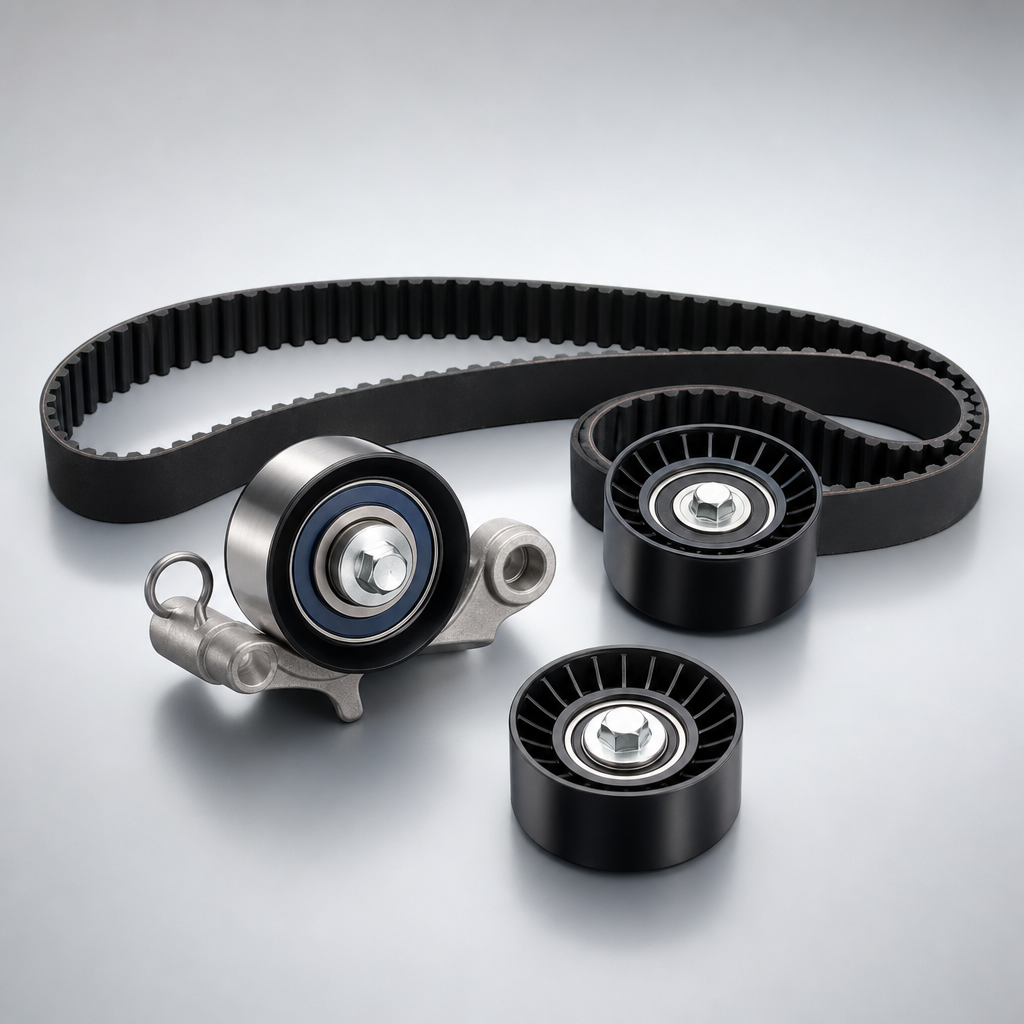
Camshaft Phaser Buick OEM Supplier Guide
Choosing a camshaft phaser Buick OEM supplier is not a simple price exercise. For importers, aftermarket programme managers, and OEM purchasing teams, the real question is whether the source can hold performance over time: stable hydraulic response, repeatable machining, reliable lock-pin function, and traceable production records. A variable valve timing phaser lives in hot engine oil, repeated start-stop cycles, and narrow angular-control windows. Small errors in vane clearance, oil-port geometry, surface finish, or locking behaviour can show up fast as cold-start rattle, timing instability, fault codes, leakage, or short field life.
That is why a credible sourcing review needs more than a catalogue and a quote. Buyers need comparable numbers: clearance range, hardness window, leak-test pressure, functional test limits, MOQ, repeat MOQ, and true production lead time. They also need to know how the supplier reacts when a process drifts. This guide breaks the evaluation into practical decisions, failure points, and document checks so teams can compare a camshaft phaser Buick OEM supplier on evidence rather than marketing claims. Driventus is an independent aftermarket manufacturer; brand names are referenced for fitment only.
Start with the go/no-go questions
The first screen should tell you whether the supplier is even worth a sample order. Do not start with catalogue breadth. Start with control.
A credible camshaft phaser Buick OEM supplier should explain how phaser housings, rotors, vanes, locking mechanisms, springs, bolts, trigger features, and sealing surfaces are managed from incoming material through final inspection.
Ask for these basics first:
- Quality certification: current compliance with IATF 16949:2016 and ISO 9001:2015
- Traceability: lot-level control for raw material, machining, heat treatment, washing, assembly date, and final test records
- Validation: evidence for breakaway torque, hydraulic leakage, lock-pin release, angular response, noise screening, and endurance testing
- Documentation: control plan, PFMEA, inspection standards, gauge list, and PPAP support if required
- Chemical compliance: declaration support for REACH (EC) No 1907/2006 where export markets require it
- Supply terms: opening MOQ, repeat MOQ, sample lead time, production lead time, and packaging standard
Then force the conversation into measurable acceptance criteria. “Tested before shipment” is not an answer.
Examples buyers should request:
- Rotor-to-housing vane side clearance target, commonly controlled in the 0.03–0.08 mm band depending on design
- Axial end play or stack-up tolerance, often reviewed in the 0.05–0.15 mm range
- Critical bore and journal tolerances typically held to ±0.01–0.03 mm on features affecting hydraulic sealing or assembly fit
- Surface hardness on wear areas, often around HRC 58–62 where induction hardening or similar treatment is specified
- Leak-test pressure such as 2–5 bar for screening, with higher-pressure validation depending on design
- Lock-pin release performance at defined oil pressure and temperature, including repeatability after cycling
One more decision point matters early: is the supplier quoting only the phaser assembly, or can it also support related timing components such as sprockets, bolts, seals, oil-control valves, or timing kits? That affects supplier count, freight efficiency, and container utilisation. Buyers reviewing our catalog often prioritise bundled sourcing across valve train and broader /products/engine-components.html programmes to reduce transaction cost.
Read the part through its failure modes
A camshaft phaser is best evaluated by asking how it fails. That gives procurement and engineering a common framework.
The failure-mode lens
- Poor angular control accuracy leads to unstable timing response; suppliers often validate against a target response curve with allowable deviation such as ±1° to ±2° cam angle depending on method
- Excess vane-to-housing clearance increases internal leakage and weakens holding performance, especially after thermal cycling
- Unstable lock-pin engagement or release shows up as cold-start rattle, restart issues, or inconsistent position control
- Low wear resistance on loaded faces, pin bores, or stop areas shortens life under repeated impact and sliding contact
- Residual internal contamination can block oil-control paths and create sticking or leakage
- Seal incompatibility with local oil formulations can affect durability in target markets
Once you look at the phaser this way, the supplier conversation becomes sharper. Ask how each risk is checked, how often, and with what record.
| Check item | Failure it helps prevent | Typical buyer expectation |
|---|---|---|
| Dimensional layout | Fitment error, stack-up drift | First article on 5 pcs and periodic lot recheck |
| Hydraulic leakage test | Weak phase response, unstable holding | Defined pressure range such as 2–5 bar with pass/fail limit in ml/min |
| Lock-pin function test | Start-up noise, release sticking | 100% or control-plan sampling with release/relock criteria |
| Salt spray or corrosion check | Storage damage, coating failure | Typically 48–96 h if coated surfaces are specified |
| Endurance cycling | Wear, fatigue, repeatability loss | Bench validation of 50,000–300,000 cycles before SOP depending on programme level |
| Cleanliness inspection | Oil circuit blockage, internal scoring | Controlled cleanliness standard with documented wash process |
| Sourcing factor | What to confirm during RFQ | Why it affects total cost |
|---|---|---|
| MOQ | Opening quantity, repeat quantity, mixed-model policy | Changes inventory risk and SKU launch speed |
| Lead time | Tooling, samples, pilot batch, mass production | Shapes launch planning and safety stock |
| Capacity | Monthly output by line or cell | Matters during demand spikes |
| Audit readiness | Process flow, PFMEA, control plan, calibration records | Shortens qualification time |
| Packaging | Rust prevention, partitioning, drop protection, carton labels | Reduces transit damage and receiving errors |
| Claims handling | Response time, containment process, 8D discipline | Directly affects warranty control |