Camshaft Phaser Acura OE Equivalent: Sourcing Guide
Procurement teams sourcing a camshaft phaser Acura OE equivalent need more than a part that fits the bolt pattern. The unit must match oil control behaviour, phasing range, timing cover clearance, connector interface, and calibration expectations for the specific engine code. Small differences in vane travel, spring preload, or spool valve response can create fault codes, cold-start rattle, or driveability complaints after installation. For aftermarket buyers, the useful question is whether the replacement is dimensionally and functionally equivalent to the OE part under normal service conditions. Driventus is an independent aftermarket manufacturer; brand names are referenced for fitment only. We supply camshaft phasers for B2B programmes under IATF 16949:2016 and ISO 9001:2015 controls, with material and validation checks aligned to export market requirements. This article explains what to verify before ordering, which specifications matter, and how to compare OE references with an equivalent replacement.
What OE-equivalent means for Acura camshaft phasers
For buyers, OE-equivalent means the replacement matches the original part’s function, installation envelope, and service performance without claiming OEM approval. The key checks are:
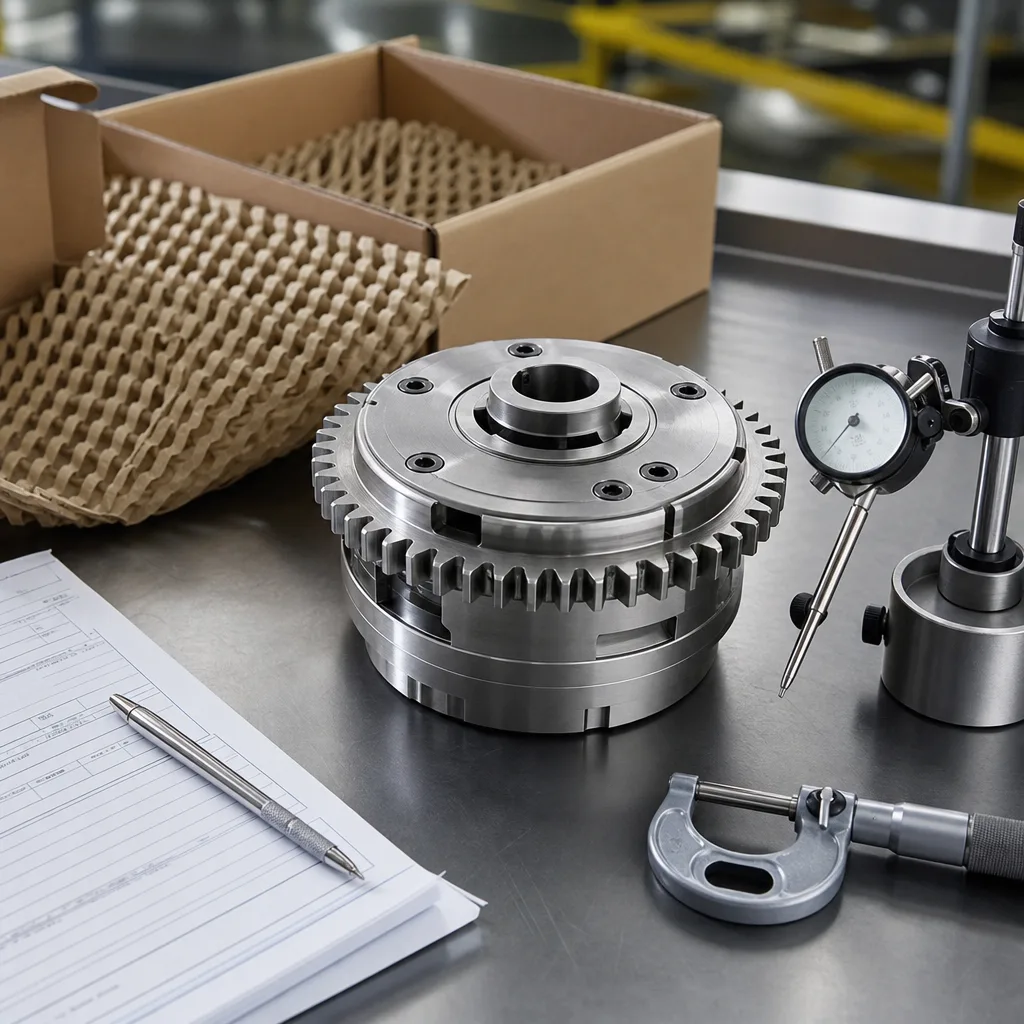
- Mounting pattern, rotor/vanes, and timing sprocket interface
- Phasing range and locking position
- Oil port geometry and response to engine oil pressure
- Sensor or trigger wheel configuration, if integrated
- Overall stack height and clearance to the timing cover
- Compatibility with the target engine family and OE reference
A reliable source should be able to confirm fitment against the OE cross-reference, for example OE 06A107065 when that reference is supplied in the customer request. The goal is repeatable interchange, not a visual match alone.
Specifications buyers should verify before purchase
Use the following checklist during RFQ and sample approval:
| Control point | What to verify | Why it matters |
|---|---|---|
| Material | Housing alloy, rotor steel, locking components | Wear resistance and oil exposure stability |
| Phasing travel | Match to OE range and lock position | Prevents timing errors and DTCs |
| Oil passages | Port size, position, and finish | Affects response time and cold-start behaviour |
| Surface finish | Burr-free edges, clean machining | Protects seals and hydraulic control |
| Dimensional match | OD, ID, height, sprocket offset | Ensures installation without interference |
| Validation | Cycle testing, leakage, functional checks | Confirms service reliability |