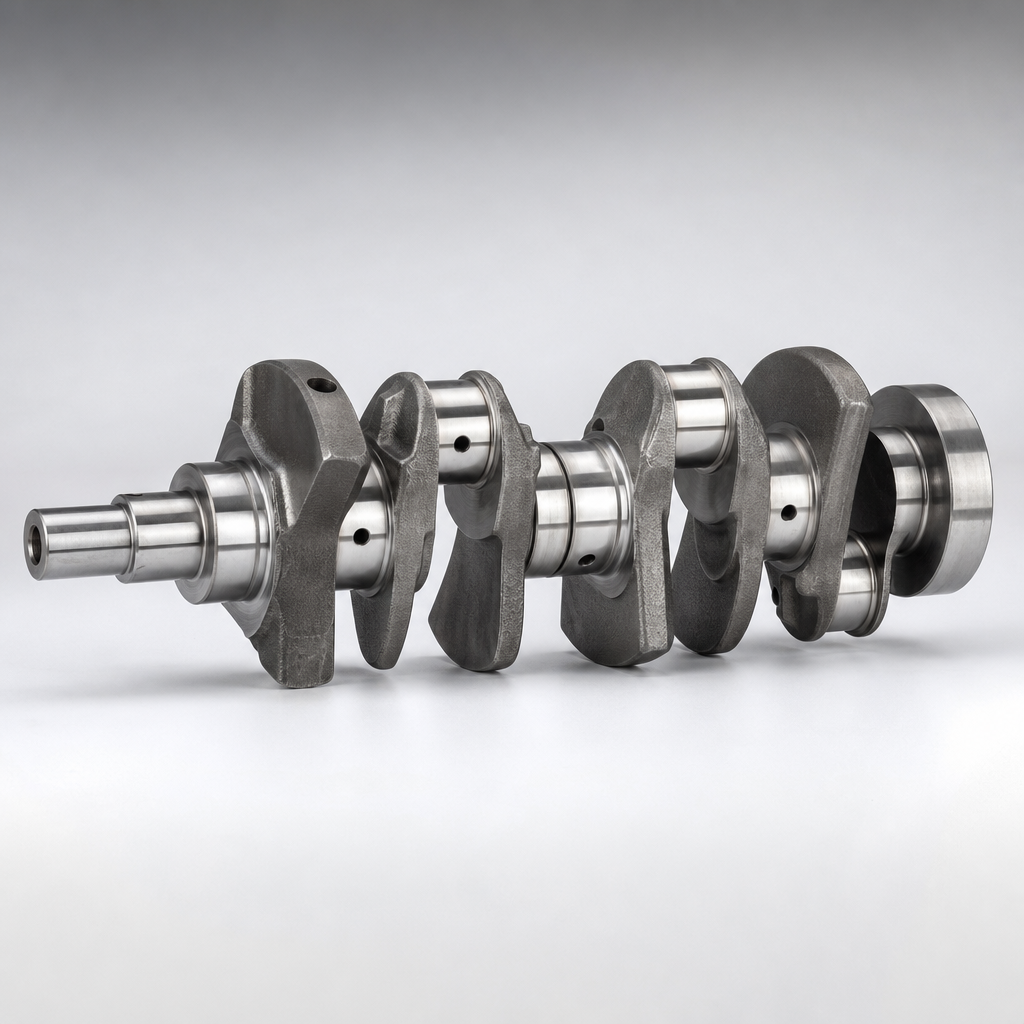
Camshaft for Mitsubishi Pajero Aftermarket Replacement
Buying a **camshaft for Mitsubishi Pajero aftermarket replacement** is usually less about catalog coverage and more about risk control. A supplier can claim fitment, but approval typically turns on a smaller set of facts: dimensional accuracy, metallurgy, lobe profile consistency, heat-treatment control, and traceability by lot.
That matters because Pajero engine families span multiple years, regions, and engine codes. In the field, demand comes from both planned rebuilds and failure-driven repairs after oil starvation, valvetrain wear, or poor previous rebuild quality. Buyers therefore need verification against the exact application, not a broad model reference. Journal diameter, runout, lobe lift, base circle, and hardness should be checked against the relevant drawing or an approved OE sample. As a working benchmark, many procurement teams look for journal diameter control around +/-0.01 to +/-0.02 mm, total indicated runout within 0.03-0.05 mm, and lobe profile consistency within the supplier's approved inspection standard.
For distributors, rebuilders, and repair networks, the commercial question is simple: will the part install without rework and hold stable timing and wear performance in service? That is why sourcing reviews usually extend beyond the part itself to IATF 16949:2016 and ISO 9001:2015 process discipline, plus material compliance requirements such as REACH (EC) No 1907/2006 where applicable. Driventus is an independent aftermarket manufacturer; brand names are referenced for fitment purposes only.
A practical approval framework before you release a Pajero camshaft order
Treat the camshaft as a precision timing component, not a commodity casting. If the approval process is weak, the resulting problems are predictable: noisy running, unstable idle, accelerated follower wear, fitment disputes, and avoidable returns.
A workable decision framework starts with five questions:
1. Is the application mapped correctly? Confirm engine code, model year range, intake or exhaust position where relevant, number of journals, and any trigger or timing features. 2. Does the geometry match the target design? Review journal diameter, spacing, overall length, base circle, lobe lift, and feature locations against the drawing or approved OE sample. 3. Is the wear system credible? Check base material, lobe hardness, journal hardness, and surface finish. 4. Can the supplier repeat the result? Ask how lot traceability, in-process inspection, and setup control are handled. 5. Will the part arrive in usable condition? Review corrosion protection, packaging stability, and carton-level identification.
The underlying checkpoints are straightforward:
- Base material: commonly chilled alloy cast iron for many aftermarket references, or forged/alloy steel where the original design requires it
- Lobe hardness: often controlled around HRC 52-60 after induction hardening or equivalent process, with an actual drawing-based acceptance range
- Journal hardness: typically lower than lobe hardness to balance toughness and wear behavior
- Journal diameter tolerance: must suit housing dimensions and target oil clearance, often reviewed within an assembled clearance window of 0.02-0.06 mm depending on engine design
- Runout: commonly limited to 0.03-0.05 mm TIR across support journals
- Surface roughness: many buyers look for Ra <= 0.4-0.8 um on critical ground surfaces
- Timing feature accuracy: keyway, dowel, reluctor, or trigger features should be verified to controlled angular tolerance
- Packaging protection: anti-corrosion oil, VCI bag or sleeve, end caps, desiccant where required, and lot traceability
For national distributors and multi-site repair groups, one extra point matters: consistency across repeat shipments. The supplier should be able to hold stable labels, batch coding, and stock presentation, not just one acceptable pilot lot.
Where Pajero camshaft programmes usually fail: the common sourcing mistakes
Most aftermarket problems do not start with a dramatic defect. They usually start with one overlooked detail.
The most common failure modes in sourcing are:
- Mixed application data across regional Pajero engine variants
- Number matching without a controlled fitment review
- Incomplete validation of mating parts such as tappets, followers, or rocker contact surfaces
- Hardness variation between lots
- Profile drift caused by weak grinding control
- Cosmetic standards that do not distinguish harmless marks from functional damage
- Inadequate rust prevention for sea freight and warehouse dwell
- No retained samples for claim analysis
One recurring mistake is to accept an OE-style cross-reference as proof of interchangeability. It is not. If a listing references a number such as OE 06A107065, that number should be tied to an approved application list and checked against actual geometry. Cross-reference errors are still one of the easiest ways to create returns.
Another weak point is claim diagnosis. A correctly manufactured camshaft can still fail early if it is installed with worn followers, contaminated lubrication, poor startup priming, or incorrect lash components. Buyers who ignore that interface often end up arguing over warranty without enough evidence to separate manufacturing defects from installation damage.
Documentation can also become a hidden risk. For EU and UK importers, internal sourcing policy may require material declarations or chemical compliance records alongside commercial documents, especially where REACH (EC) No 1907/2006 is referenced.
The cost mistake is familiar: buying on ex-works price alone. A camshaft that is USD 3-8 cheaper can become the more expensive option if return rates rise by 1-2%, if workshops need extra fitting time, or if rust claims appear after 45-60 days of transit and storage. On this product, total claim exposure usually matters more than the headline unit price.
What OE-equivalent should actually mean in a buyer-side comparison
In B2B purchasing, OE-equivalent should be measurable. It should mean the aftermarket part matches the original in function, geometry, and expected service performance within controlled tolerances.
A useful comparison table looks like this:
| Checkpoint | Why it matters | Typical buyer request |
|---|---|---|
| Overall length and journal spacing | Confirms fit in the cylinder head and bearing cap layout | Dimensional inspection report with actual measured values |
| Lobe lift and duration profile | Directly affects valve timing and engine behavior | Profile measurement record or cam analyzer printout |
| Base circle and nose geometry | Influences lash, follower contact pattern, and lift curve stability | Master sample comparison report |
| Journal hardness and case depth | Determines wear resistance under lubrication load | Heat-treatment report with test points and case depth data |
| Runout and straightness | Reduces abnormal contact, noise, and uneven wear | Final QC report with TIR result |
| Material chemistry | Confirms the part was made to the intended design logic | Material certificate or spectrometer report |
| Visual and surface inspection | Catches grinding burns, burrs, nicks, and transit damage | 100% appearance check |