For importers and category buyers, camshaft Mercedes-Benz wholesale sourcing is less about finding a part number and more about controlling risk across fitment, metallurgy, machining repeatability, packaging accuracy, and delivery performance. Camshafts work under high contact stress, changing oil-film conditions, and repeated temperature cycles, so small deviations in lobe geometry, journal alignment, or surface hardness can become warranty claims across a repair chain or distributor network. Driventus manufactures engine and powertrain components in Taizhou, Zhejiang, supplying B2B customers in more than 60 countries. For Mercedes-Benz passenger car and light commercial aftermarket applications, we focus on OE-equivalent dimensional matching, traceable production batches, and supplier-onboarding documentation. Driventus is an independent aftermarket manufacturer; vehicle brand names are used for fitment reference only.
Wholesale sourcing requirements for camshaft programmes
A wholesale camshaft programme should begin with the vehicle parc, engine codes, annual demand, target price band, and expected warranty tolerance. Landed cost matters, but camshafts are highly sensitive to process variation. A low unit price does not protect a distributor if lobe lift, journal diameter, runout, oil-hole location, or surface hardness changes between production lots.
For camshaft Mercedes-Benz wholesale enquiries, Driventus typically confirms the target application list, sample or OE-reference numbers, annual forecast, destination market, packaging format, and inspection level before quotation. When buyers already operate a private-label range, we can align carton labels, barcodes, neutral packing, pallet configuration, and export carton requirements with their existing programme.
Typical B2B sourcing checkpoints include:
Engine family and fitment range confirmation before quotation
Material and casting, forging, billet, or assembled route confirmation by application
Lobe profile inspection against approved drawings, samples, or verified references
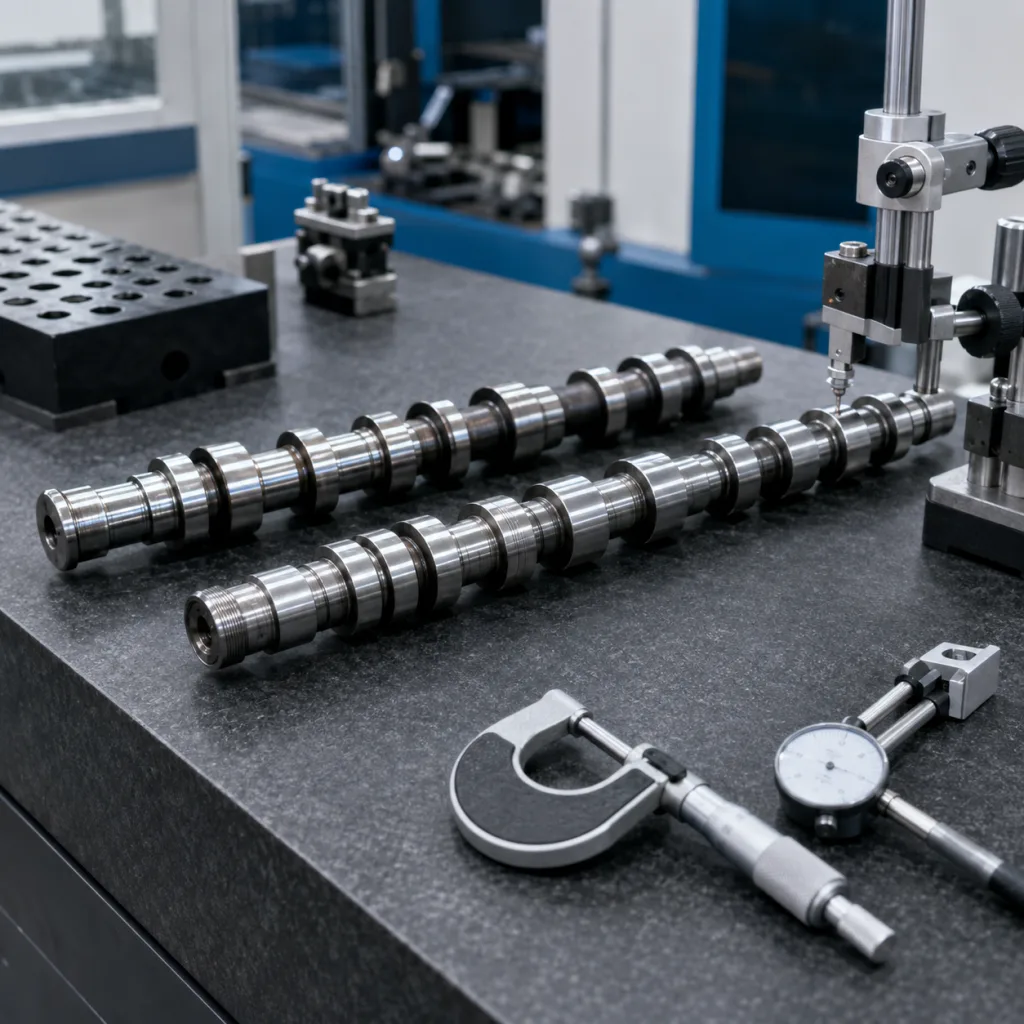
Journal diameter, straightness, and runout measurement records
Surface treatment, hardness, and case-depth verification where applicable
Oil-hole, thrust-face, and timing-interface checks for functional compatibility
Export carton strength, corrosion protection, and part-number label control
Batch traceability from raw material or blank intake through machining and final packing
Buyers can review related engine items in our catalog, including coordinated sourcing for timing components, gaskets, pistons, oil pumps, and water pumps.
Manufacturing route, materials, and tolerances
Camshafts are not single-process parts. Depending on the application, production volume, and original design, the route may involve chilled cast iron, ductile iron, forged steel, steel billet machining, or assembled camshaft construction. The correct choice depends on valvetrain load, lubrication conditions, lobe and journal design, required wear resistance, and commercial target.
Driventus evaluates each camshaft by function rather than appearance. Key control points include lobe profile, bearing journal geometry, oil-hole position, thrust face width, gear or sprocket interface, dowel or keyway location, and sensor trigger features. Where the original design uses a hollow or assembled structure, equivalent mass, interface stability, and assembly alignment are reviewed during development.
Control item
Typical wholesale requirement
Inspection method
Lobe lift deviation
Controlled to drawing or approved sample
Cam profile measuring equipment
Journal diameter
Application-specific tolerance
Micrometer and roundness checks
Total runout
Controlled across bearing journals
V-block or centre support inspection
Surface hardness
Matched to material route
Rockwell or equivalent hardness test
Oil-hole position
Verified against datum scheme
Gauge and visual inspection
Trigger or timing interface
Matched to application reference
Fixture, gauge, and dimensional review
Packing corrosion resistance
Sea-freight suitable protection
Oil film, VCI, or sealed packaging review
</tr></thead><tbody> </tbody></table>For private-label or application-expansion projects, custom manufacturing can include sample reverse engineering, drawing conversion, pilot batch production, and inspection report preparation. This helps distributors expand into long-tail applications without splitting technical control across multiple factories.
Certification, audit documents, and compliance files
Procurement teams usually need more than a product quote. Supplier approval may require certification records, production flow charts, control plans, inspection formats, material declarations, packaging specifications, and corrective-action procedures. Driventus operates under IATF 16949:2016 and ISO 9001:2015 quality-management frameworks. These standards support process discipline, traceability, document control, and continual improvement, while part-specific validation remains necessary for each approved reference.
For EU and UK importers, material compliance may involve declarations related to REACH (EC) No 1907/2006. North American buyers often focus on material traceability, packaging compliance, product-liability documentation, and warranty investigation workflow. For Brazil and other regulated import markets, customers may request additional commercial documents, Portuguese labels, customs-specific packing lists, or country-specific invoice details.
Common supplier audit files include:
Business licence and export registration details
IATF 16949:2016 and ISO 9001:2015 certificates where applicable
Process flow chart and control plan for camshaft production
Incoming material or blank inspection format
In-process machining inspection format
Heat-treatment or surface-treatment record format where applicable
Final inspection report template
Non-conforming product control procedure
Packaging specification and label approval sheet
Corrective-action and warranty feedback procedure
Buyers can review our quality system before requesting a supplier file. Driventus can support remote audits with document packs, video walkthroughs, production-lot traceability examples, and sample inspection records.
MOQ, lead time, and order planning
MOQ depends on camshaft type, tooling status, blank availability, machining fixtures, inspection workload, and packaging configuration. Fast-moving references with existing tooling can usually be quoted at lower MOQ than slow-moving applications requiring new development, special blanks, or dedicated fixtures. For a mixed wholesale order, buyers may combine camshafts with other engine components to improve container utilisation and reduce per-unit logistics cost.
Typical planning assumptions are:
Existing application, neutral packing: 300 to 800 pieces per reference depending on part type
Existing application, private-label packing: MOQ depends on carton print, label format, and artwork approval
New development from sample: pilot batch after sample approval, tooling confirmation, and inspection sign-off
Normal production lead time: commonly 45 to 75 days after deposit and specification lock
Repeat orders: shorter when blanks, tooling, labels, and packaging stock are already confirmed
Shipment mode: LCL, FCL, or consolidated shipment with other engine components
Range expansion: best managed through staged releases rather than one large untested launch
For camshaft Mercedes-Benz wholesale programmes, demand forecasting has a direct effect on service level. A distributor serving repair networks may need stable monthly replenishment instead of one large annual shipment. Driventus can discuss rolling forecasts, call-off quantities, carton buffers, and mixed-container planning to reduce stock-outs without forcing excessive inventory.
A practical first order should include high-velocity applications, a limited number of slow movers, and clear warranty feedback rules. That approach gives both sides useful data on sell-through, returns, installation issues, and packaging performance before the range is expanded.
Fitment management and cross-reference discipline
Fitment errors create avoidable returns and can damage installer confidence. Camshafts may look similar while differing in lobe phasing, sensor trigger geometry, oil passages, thrust-face design, bearing journal layout, or timing-interface details. A procurement file should therefore separate commercial cross-reference data from engineering confirmation.
Driventus uses buyer-supplied application data, samples, drawings where available, verified references, and dimensional inspection to confirm fitment. Brand names and model names are used only to identify compatible aftermarket applications. Driventus is an independent aftermarket manufacturer; vehicle brand names are referenced for fitment only.
For catalogue management, buyers should provide:
Vehicle make, model, year range, market, and engine code
Fuel type, displacement, and valvetrain configuration
Intake or exhaust camshaft position where relevant
Sensor, sprocket, timing gear, dowel, or keyway interface details
Required aftermarket part numbering and supersession format
Label language, barcode, and carton-marking requirements
Any market-specific fitment exclusions or installer notes
When a customer requests camshaft Mercedes-Benz wholesale supply, we do not claim approval or endorsement by any vehicle manufacturer. The objective is dimensional and functional equivalence for the intended aftermarket fitment, supported by inspection records, traceable batches, and stable production controls.
How to evaluate a camshaft supplier before a purchase order
A supplier comparison should cover technical capability, commercial stability, and response quality. The fastest reply is not always the safest source. Buyers should ask whether the factory directly controls critical processes, how non-conforming products are isolated, how batch records are retained, and how traceability is maintained after shipment.
Use this checklist before issuing a wholesale purchase order:
Confirm whether the supplier manufactures or directly controls machining, not only trading
Request sample inspection reports for lobe profile, journal diameter, runout, and hardness
Check whether heat-treatment or surface-treatment records are linked to batch numbers
Review packaging for corrosion control during 30 to 45 days of ocean freight
Ask for a warranty investigation process using photos, mileage, installation data, and returned samples when needed
Confirm MOQ, payment terms, production lead time, and shipment consolidation options
Verify that private-label artwork, barcode content, and carton marks are approved before mass packing
Review how technical changes, supersessions, or catalogue corrections are communicated
For larger programmes, a staged process is safer: sample approval, pilot order, warranty monitoring, and then range expansion. This reduces purchasing risk and gives the importer objective data before committing to broad coverage.
If you are building a distributor range or preparing a factory audit, use request a quote to share application lists, target quantities, packaging requirements, and documentation needs.
Frequently asked questions
Provide engine codes, target applications, annual forecast, required packing, destination country, and any sample, drawing, or OE-reference numbers. If private-label supply is required, include barcode, carton, pallet, and artwork requirements.
Yes. Driventus can support neutral or private-label packaging, subject to MOQ, artwork approval, carton strength requirements, barcode rules, and export label requirements. Packaging is confirmed before mass production.
No. Driventus is an independent aftermarket manufacturer; vehicle brand names are referenced for fitment only. We support OE-equivalent aftermarket fitment through dimensional checks, production controls, inspection records, and batch traceability.
For sourcing review, share your application list, forecast, packaging needs, and audit documents required. Driventus will respond with practical supply options at /contact.html