Camshaft for Lexus IS OE Equivalent: Buyer Checklist
For Lexus IS sourcing programmes, an OE-equivalent camshaft is not a generic replacement pulled from a catalogue line. It has to match the reference camshaft’s base circle, lobe lift, journal diameter, lobe phasing, surface texture, thrust control, oil-feed geometry, trigger interface, and VVT actuator indexing. Even small deviations can move valve events, affect cam/crank correlation, disturb idle stability, increase valvetrain noise, reduce oil-film durability, or create warranty exposure after installation. Driventus supplies camshafts for aftermarket distributors, remanufacturers, fleet maintenance groups, repair-chain buyers, and multi-site service operators that need controlled dimensions and lot evidence, not catalogue-only fitment claims. Driventus is an independent aftermarket manufacturer; Lexus and other brand names are referenced for fitment only. This article explains what to verify before placing a PO, which measurements matter most, what evidence should accompany production lots, and how to compare samples against the engine code, cylinder-head casting, timing hardware, and valve-train layout used on the vehicle. The sourcing objective is straightforward: match the geometry, prove the material, control the process, and keep the inspection record attached to the part number.
What OE-Equivalent Means in Practice
OE-equivalent means the camshaft works within the same functional window as the reference part in the engine. It is more than fitting into the cylinder head or sharing a similar overall length. For Lexus IS applications, buyers should confirm valve timing events, lobe geometry, journal finish, thrust control, oil-feed detail, trigger target geometry, and the VVT interface before releasing production quantities. A correct camshaft for Lexus IS OE equivalent programme begins with a measured reference sample and continues with a repeatable control plan for every production lot.
Item to verify
What to measure
Why it matters
Base circle and lobe lift
Micrometer, height gauge, CMM, or profile scan by each lobe position
Controls valve lift, lash/preload relationship, valve opening and closing points, and effective duration
Lobe profile and ramp shape
Cam profile trace, opening ramp, closing ramp, flank radius, nose radius, and lift-at-angle comparison
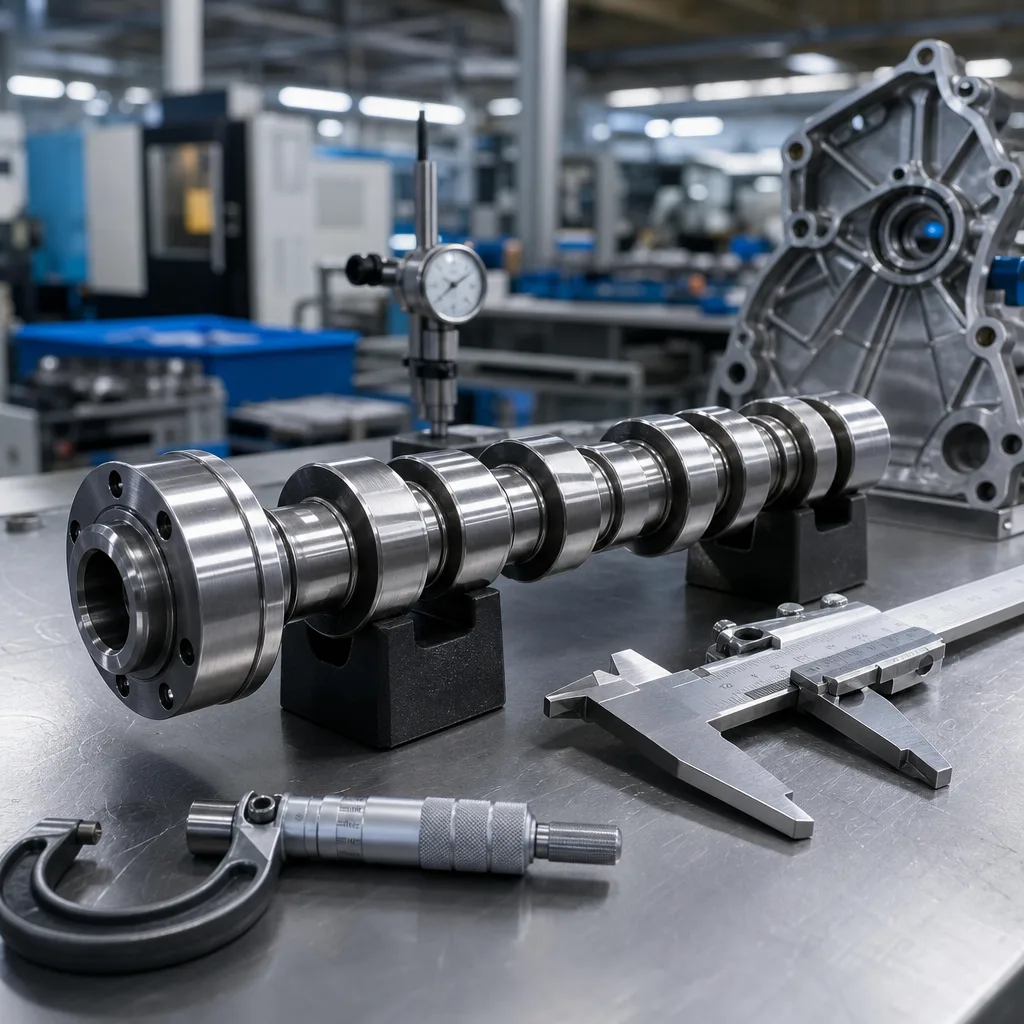
</tr></thead><tbody> </tbody></table>Visual similarity is not enough. Two camshafts can look interchangeable on a bench yet differ in lobe centreline, nose radius, oil groove position, rear sensor target offset, or actuator indexing. In a modern DOHC engine with variable valve timing, a small angular error at the cam datum can become a measurable valve-event shift. The result may be rough idle, low-speed hesitation, abnormal valvetrain noise, increased wear, or diagnostic trouble codes after installation.
Buyers should also separate catalogue fitment from engineering equivalence. Catalogue fitment confirms the intended vehicle family; engineering equivalence confirms that the part will operate within the same functional window as the reference camshaft. The purchase specification should therefore name the engine code, cam position, bank position where applicable, measured reference dimensions, accepted tolerances, inspection method, sampling plan, and required records before bulk order approval.
Vehicle And Engine Checks Before Ordering
Do not order by model name alone. Lexus IS programmes vary by generation, market, engine family, valve-train layout, cylinder-bank arrangement, cam sensor strategy, and VVT configuration. The procurement file should include the engine code, production year range, intake or exhaust position, bank position where applicable, and whether the part is used in a single-cam, twin-cam, or multi-cam timing system.
Use this checklist before sending a sample request:
Confirm the engine code from VIN data, build sheet, service record, dismantled part markings, electronic catalogue data, or the buyer's application database.
Confirm intake side, exhaust side, left bank, right bank, or full set requirement when the engine uses multiple cams.
Confirm whether the cam drives a VVT actuator, cam sensor target, trigger wheel, mechanical fuel pump, vacuum pump, distributor drive, or a combination of these features.
Match the follower type, rocker interface, tappet contact pattern, lash-adjuster arrangement, and head casting where wear pattern or oil-feed location affects geometry.
Record overall length, journal count, journal positions, nose features, dowel holes, keyways, thrust surfaces, oil grooves, oil feed holes, rear-end features, and sensor target details.
Check the existing camshaft for abnormal wear, scoring, pitting, grinding burn, broken dowels, damaged journals, blocked oil holes, or signs of oil starvation before using it as a reference sample.
Photograph all identification marks, packaging labels, timing hardware, actuator interfaces, sensor targets, dowel positions, and end features before shipping the sample for measurement.
For buyers handling returns, this step reduces one of the most common sourcing errors: a part that looks correct in the box but is wrong for the exact engine variant in the vehicle. That error is expensive because camshafts are often found to be incorrect only after labour has already been spent removing covers, timing components, VVT actuators, seals, and related hardware.
A practical ordering file combines application data with physical evidence. Application data helps identify the intended Lexus IS variant; physical evidence confirms that the sample or drawing matches the engine being repaired. When both are present, the supplier can review fitment, measurement, quality requirements, packaging needs, and commercial quotation in one pass instead of cycling through repeated clarification after the PO is issued.
Materials, Hardening, And Surface Finish
A replacement camshaft should be specified by material route, heat treatment, and finish, not by appearance alone. Depending on the OE architecture, the part may use chilled cast iron, ductile iron, forged steel, induction-hardened steel, carburised steel, or nitrided steel. For the buyer, the important outcomes are wear resistance, core strength, surface hardness, case depth where applicable, and dimensional stability after rough machining, heat treatment, finish grinding, washing, preservation, and final inspection.
Procurement teams should ask for:
Material declaration, grade reference, melt or batch traceability, and material certificate where available.
Heat-treatment method, hardness range, case depth where applicable, verification points, and frequency of hardness testing.
Lobe surface finish, journal finish, and thrust-face finish values, normally reported as Ra or Rz with the measuring instrument identified.
Grinding process controls for lobe profile, journal roundness, taper, shoulder location, chatter marks, and grinding-burn prevention.
Magnetic particle, dye penetrant, visual, or other crack-detection method where the material route and risk level justify it.
Cleanliness controls for oil passages, machined debris, abrasive residue, washing media, preservative residue, and packaging contamination.
Corrosion protection suitable for warehouse storage, export transit, humidity exposure, and long shelf life.
Handling and packaging method that prevents impact damage to lobes, journals, dowels, VVT mating faces, and sensor targets.
Lobe finish is not cosmetic. It affects oil film retention, follower wear, contact stress, break-in behaviour, and long-term noise. A lobe that is too rough can accelerate wear; a lobe that is dimensionally correct but poorly hardened may pass initial fitment inspection and still fail early in service. Journal finish matters just as much because oil-film stability depends on diameter, roundness, surface texture, straightness, and clean oil-feed paths working together.
If the camshaft ships with a preserved surface, the packaging must protect the working faces without leaving residue that interferes with first-start lubrication. For export programmes, the specification should state the rust-prevention method, VCI bag or oil paper requirement where used, carton strength, divider or sleeve protection, palletisation requirement, humidity exposure expectation, and storage duration target. These details keep the camshaft for Lexus IS OE equivalent supply chain aligned from factory inspection through distributor warehouse handling.
Validation And Documentation Buyers Should Ask For
A credible supplier should provide a dimensional report, runout check, hardness record, surface-finish confirmation, and visual inspection record for each production lot or approved control-plan sample. For larger programmes, buyers should also request PPAP-style evidence, batch traceability, change-control discipline, inspection frequency, retained master samples, and a clear nonconformance process before the first bulk shipment.
The documentation package should show how the supplier controls the features that affect engine function, not only the features that are easy to measure. Key records may include:
First-article inspection report against the reference sample or agreed drawing, including measurement method and datum definition.
Lobe lift, base circle, lift-at-angle data, phase angle, and journal diameter measurements by cam position and lobe number.
Total indicated runout, straightness, journal roundness, journal taper, thrust-face width, shoulder location, and end-feature checks.
Hardness readings at agreed points, with case-depth evidence when relevant to the material route.
Surface-finish readings for lobes, journals, thrust faces, and VVT mating faces where applicable.
Material certificate, heat-treatment batch record, or batch declaration linked to the production lot.
Final visual inspection covering nicks, burrs, grinding burns, corrosion, blocked oil holes, damaged dowels, impact marks, and handling marks.
Lot code, carton label, barcode data, packing list, and pallet identity traceable back to the inspection record.
Relevant standards and frameworks include IATF 16949:2016 and ISO 9001:2015 for quality management, plus REACH (EC) No 1907/2006 for restricted-substance control in supplied materials, coatings, and protective treatments. Where a buyer wants broader vehicle-context documentation, ECE R-83 may be referenced at the platform level for emissions context, but it does not replace part-level verification of camshaft geometry, surface condition, timing interface, and VVT compatibility.
We do not claim approval or endorsement by any vehicle manufacturer. The sourcing position is simpler and more useful: the part must be measured, tested, packed, and documented against the agreed reference specification. That is the evidence a distributor, remanufacturer, fleet buyer, or repair-chain sourcing team needs when approving a camshaft for Lexus IS OE equivalent replacement programme.
How To Source And Scale The Part
For catalogue review, start with our catalog and the related engine components range. If you need process detail, review the quality system. If the programme needs private label packing, special markings, application-specific labelling, customer part numbers, or a non-standard build, use custom manufacturing.
For distributors and repair chains, the commercial controls usually matter as much as the mechanical ones:
Minimum order quantity by part number, engine family, tooling route, or production batch.
Lead time by tooling status, sample availability, material route, heat-treatment capacity, inspection load, and stock position.
Carton labels, barcode traceability, country-of-origin marking, lot segregation, and pallet identification.
Sample approval, reference retention, golden-sample control, and sign-off process before bulk release.
Export packing for sea freight, air freight, mixed pallets, humidity exposure, and warehouse storage.
Private label artwork, neutral packaging, application labels, or customer-specific part numbering.
A useful sourcing sequence begins with one reference sample, one application sheet, and one target annual volume. From there, the supplier can confirm whether existing tooling is available, whether the part requires reverse engineering, what measurements will be controlled, what inspection records will ship with the order, and what commercial terms apply. Once the sample is measured, the buyer should review the dimensional report before approving labelling, packaging, and production quantity.
If you are consolidating supply across multiple branches or repair locations, ask for one reference sample, one dimensional report, one packaging proposal, and one commercial quotation in the same exchange. This keeps technical, quality, warehouse, and purchasing review aligned. It also reduces rework after the PO is issued, because the camshaft specification, carton identity, lot traceability, and delivery plan are agreed before production moves to bulk release.
Frequently asked questions
No. OE-equivalent means the part is designed to match the reference geometry, function, fit, timing interface, and durability requirements. It does not mean the vehicle maker approved or endorsed it. Buyers should verify dimensions, timing events, surface finish, material records, VVT interface, and lot documentation before ordering.
Send the engine code, cam position, bank position if applicable, sample photos, target quantity, packaging requirement, and any reference measurements. If you have the old part, include wear notes, timing-hardware photos, actuator or sensor-target photos, and the original supplier label so the correct variant can be matched faster.
Yes. Private label carton marks, barcode labels, corrosion protection, lot coding, divider protection, and export packaging can be specified during the quotation stage. For larger programmes, we can also align the pack format with warehouse, distributor, and repair-chain handling requirements.
If you need a validated camshaft for Lexus IS OE equivalent replacement programme, send the engine code, target quantity, cam position, and sample photos through [request a quote](/contact.html).