Camshaft for Jaguar XE OE Equivalent Sourcing Guide
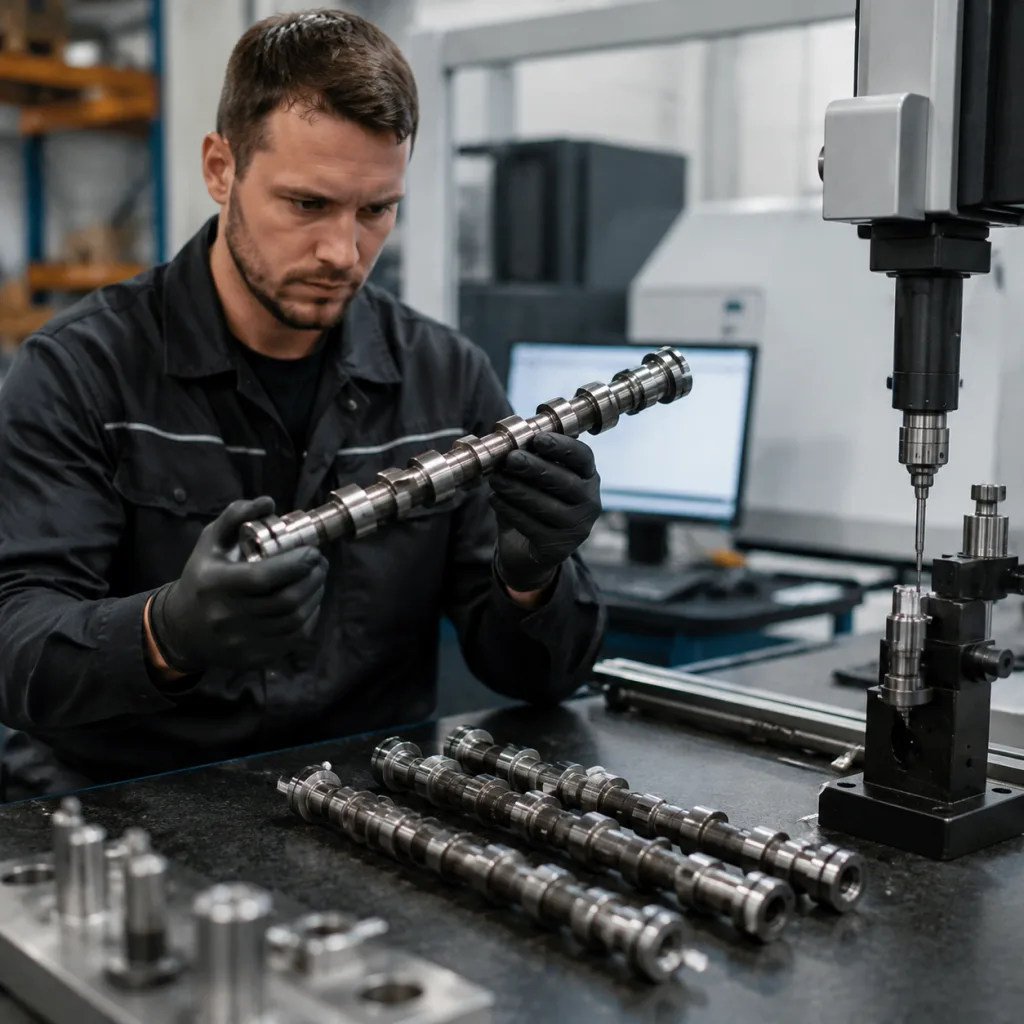
Buying a camshaft for Jaguar XE OE equivalent supply is not a catalogue exercise. A visually similar shaft can still create valve-timing errors, bearing noise, lobe wear, return spikes, or workshop distrust if the profile, hardness, runout, packaging, or fitment data are loose.
This article reframes the sourcing decision as a controlled B2B release process. It shows where buyers should demand numbers, where suppliers often fail, how validation should be staged, and which commercial rules protect distributors and repair-chain programs after launch. Driventus is an independent aftermarket manufacturer; vehicle brand names are used only to identify fitment. Buyers building a wider powertrain package can review related engine parts at /products.html and engine-component capability at /products/engine-components.html.
Decision Gate: When Is a Jaguar XE Camshaft Truly OE Equivalent?
OE equivalent means the camshaft is engineered to match the application’s required fitment geometry, working surfaces, timing relationships, and service performance. It does not mean approval, endorsement, or branding by the vehicle manufacturer.
Use four release gates before approving a Jaguar XE camshaft replacement SKU:
Dimensional interface: journal diameters, lobe lift, base circle, overall length, thrust face width, dowel or slot position, and sensor target geometry.
Material and hardness: steel grade or chilled cast iron specification, heat-treatment route, case depth where applicable, and surface hardness range.
Functional timing: angular relationship between lobes, drive features, and the phaser or sprocket interface.
Service durability: wear resistance with the correct oil specification, low scuffing risk, and stable operation through thermal cycling.
The buyer file should use measured requirements, not just application text. Practical acceptance targets for an OE-equivalent camshaft programme may include journal diameter tolerance within ±0.01 mm, lobe-to-lobe phase position within ±0.5° to ±1.0°, overall runout not exceeding 0.03 mm to 0.05 mm, and thrust width held to the agreed drawing limit. Where the engine uses an oil-splash or phaser target surface, lock the finish to a roughness range such as Ra 0.2 to 0.8 μm on journals and the buyer’s specified profile on drive faces.
Treat OE part-number cross-references as fitment references, not proof. They belong in the buyer file only when supported by reliable customer data. Driventus does not invent or publish brand-owned part numbers without dependable source information.
Spec Deep-Dive: The Dimensions and Materials That Decide Performance
Camshaft failures often start with deviations too small to catch in a quick visual inspection. The procurement drawing or supplier control plan should define each measurable characteristic, its limit, and its verification method.
Control item
Typical verification method
Procurement relevance
Journal diameter and roundness
Micrometer, air gauge, CMM
Controls oil-film stability and bearing clearance
Cam lobe lift and profile
Cam profile measuring machine
Affects valve timing, torque curve and emissions behaviour
Lobe-to-drive angular position
CMM or dedicated fixture
Prevents timing deviation and diagnostic faults
Surface roughness on journals
Profilometer
Reduces start-up wear and oil-film disruption
Hardness and case depth
Rockwell/Vickers testing, metallographic section
Confirms wear resistance after heat treatment
Straightness/runout
Dial gauge or CMM
Reduces vibration, bearing loading and assembly issues
</tr></thead><tbody> </tbody></table>For OE-equivalent Jaguar XE camshafts, Driventus agrees critical-to-quality dimensions with the buyer before tooling release. A workable specification package covers journal diameter tolerance, lobe lift tolerance, base-circle tolerance, lobe flank angle, sprocket or phaser interface position, and end-play allowance. Common engineering targets are ±0.005 mm to ±0.015 mm on precision journals, ±0.03 mm to ±0.08 mm on profile-dependent dimensions, and total indicated runout of 0.02 mm to 0.05 mm after finish machining.
Material selection must follow the engine duty cycle. Depending on the OE architecture, buyers may specify forged alloy steel, induction-hardened steel, or chilled cast iron. Heat-treatment records should state the target hardness band, for example HRC 55 to 62 on wear surfaces, or an agreed case-hardness profile with minimum effective depth. If nitriding is used, require a nitrided layer map, compound-layer control, and post-process distortion limits.
These characteristics then move into the inspection plan and production process documents under IATF 16949:2016 and ISO 9001:2015 quality-system controls. If the customer provides a drawing, the tolerance hierarchy follows the drawing first, then the agreed technical specification.
Step-by-Step Release: From Sample Agreement to Batch Approval
Routine inspection answers one question: did this shipment meet the agreed limits? Validation answers a harder one: can the design, material route, and production process keep producing a stable camshaft under expected engine conditions?
A structured release for a new Jaguar XE OE equivalent part should run in this order:
1. Confirm drawing, sample, application, and position data. 2. Complete a pilot machining run. 3. Issue first article inspection with actual measured values. 4. Review process capability on critical dimensions. 5. Sign off export packaging and label artwork. 6. Release the pilot lot before commercial batch production.
Typical validation evidence includes material certificate review, spectrometer chemical analysis, microstructure and heat-treatment verification, surface hardness and hardness-depth checks, cam profile measurement against master data, runout and straightness testing after machining and heat treatment, fixture checks for assembly interfaces, and packaging drop or vibration review when the route requires it.
For critical dimensions, buyers can request Cp/Cpk evidence on journal diameters, runout, and lobe lift, with 1.33 or higher as a practical acceptance target for stable production characteristics. Laboratory checks may include metallography on one sample per heat lot or after a process change, hardness mapping on at least two lobes and two journals per sample, and dimensional audit on the first 5 to 10 pieces of each lot or the buyer’s AQL requirement.
If heat treatment is outsourced, do not accept a certificate alone. Ask for furnace charts, quench records, and traceability back to the specific furnace load.
The camshaft itself is usually not certified as a standalone emissions component under rules such as ECE R-83. Still, incorrect valve timing, unstable lobe geometry, or poor profile control can affect emissions-related engine operation. For EU sales, buyers should also consider chemical and material compliance under REACH (EC) No 1907/2006.
Failure Modes: How to Spot a Supplier That Is Not Release-Ready
A low quote can hide a weak process. The risk is not only one defective piece; it is repeat variation across container shipments, replenishment cycles, and multi-year demand.
Before approval, ask for evidence that connects engineering control to production discipline:
IATF 16949:2016 certificate and ISO 9001:2015 certificate scope.
Process flow chart, PFMEA, and control plan for the camshaft family.
Initial sample inspection report with actual measured values.
Material and heat-treatment records for pilot production.
Traceability method by batch, furnace lot, or machining lot.
Packaging specification for sea freight and warehouse handling.
Claim-handling process, including containment timing and 8D reporting.
Warning signs are easy to miss. A supplier may offer a cross-reference but no profile data, a hardness value but no case-depth method, a sample but no change-control rule, or a carton photo but no corrosion-protection target. Any of these gaps can become a warranty cost after launch.
Set qualification gates before commercial release. A practical route is 2 to 5 sample pieces for dimensional confirmation, 20 to 50 pilot pieces for fitment and packaging validation, and first commercial batch approval only after the buyer signs the inspection report and carton label artwork. If the supplier cannot control tooling changes, heat-treatment parameters, gauges, or subcontractors, do not treat the program as release-ready.
Driventus manufactures engine and powertrain components in Taizhou, Zhejiang, and exports to more than 60 countries. For camshaft sourcing, our quality system at /quality.html can support distributor audits, while custom manufacturing at /oem-services.html is available for private-label specifications, customer-owned drawings, or application-specific packaging.
Scenario Check: The Part Is Correct but the SKU Still Fails
A Jaguar XE replacement camshaft can be manufactured correctly and still fail commercially. The usual cause is bad fitment data: wrong engine code, wrong model-year range, wrong intake/exhaust position, or an unverified cross-reference copied into a catalogue.
Separate the work into two tracks. Engineering validation confirms the camshaft geometry, material, hardness, and timing relationships for the intended engine application. Catalogue validation confirms that the SKU, engine code, model year range, fuel type, and intake/exhaust or left/right position are mapped correctly in the buyer’s database. Review both before launch, and do not let one substitute for the other.
A B2B release pack should include:
Customer SKU and supplier article number.
Application notes and exclusions.
Intake/exhaust or left/right position where relevant.
Generic OE cross-reference field, if supplied by the buyer.
Barcode label format and carton quantity.
Anti-corrosion packaging method for long-distance export.
Country-of-origin and compliance labelling requirements.
Packaging deserves the same discipline as the catalogue. A typical export pack uses rust-preventive oil, VCI film, end caps on machined faces, inner partitioning to prevent lobe-to-lobe contact, and a carton suitable for a 600 mm to 800 mm drop test depending on route risk. If warehouse dwell time may exceed 6 months, confirm the corrosion-protection system and shelf-life target in writing.
Driventus can supply neutral, buyer-branded, or agreed private-label packaging for replacement programs. Any vehicle brand names used in fitment files are compatibility references only, and Driventus remains an independent aftermarket manufacturer.
Commercial Playbook: MOQ, Lead Time and Price-Break Rules
A camshaft for Jaguar XE OE equivalent project needs commercial controls as much as technical approval. Importers and repair chains cannot absorb undocumented substitutions, inconsistent labels, or stock gaps across several warehouses.
Agree these points before launch:
Forecast volume by SKU and market.
Minimum order quantity by production batch and packaging format.
Lead time for sampling, pilot lot, and repeat orders.
Accepted inspection level for pre-shipment checks.
Spare packaging and label-change procedure.
Warranty analysis workflow and return-sample requirements.
Incoterms, consolidation options, and documentation requirements.
Typical timing is predictable when inputs are complete. Sampling normally uses 2 to 5 pieces and a 10 to 20 working day engineering cycle if drawings and references are ready. Pilot production often uses 20 to 50 pieces and may require 3 to 5 weeks of tuning when heat treatment or surface finishing is new. Production MOQ is usually 50 to 100 pieces per SKU for a standard launch; larger private-label programs may need 200 to 300 pieces per release batch to keep carton and label economics efficient.
Lead time depends on tooling status. Repeat orders on an approved camshaft often run 30 to 45 days ex-works. A first-time program can take 45 to 60 days or more if profile gauges, heat-treatment verification, or packaging artwork are still open.
Price breaks should be agreed before the first order. Low-volume batches usually carry a higher unit price, but the cost should step down once annual volume, lot size, and packaging format are fixed. Quote tooling amortization separately from piece price so buyers can compare suppliers cleanly.
Driventus can support combined shipments with pistons, crankshafts, gaskets, water pumps, turbochargers, and other powertrain components when buyers want to reduce supplier count and simplify replenishment. Buyers can review our catalog at /products.html or request a quote at /contact.html with application data, annual volume, and any existing cross-reference list.
Frequently asked questions
No. OE equivalent means the part is engineered to match required fitment, dimensions and performance characteristics for the application. It does not mean approval, endorsement or supply to the vehicle manufacturer. Driventus is an independent aftermarket manufacturer; brand names are referenced for fitment only.
Useful data includes engine code, model year range, intake or exhaust position, target OE cross-reference if available, annual volume, packaging requirement and destination market. A drawing or approved sample helps confirm profile, journal and drive-interface dimensions. For a commercial quote, buyers should also share target MOQ, requested delivery window and whether the part is for retail, workshop or distributor stock.
Yes. Driventus can discuss neutral, buyer-branded or custom packaging for qualified B2B programmes. Private-label supply should include agreed inspection standards, traceability rules, label format and claim-handling procedure before series production. Buyers should also confirm carton quantity, barcode format and corrosion-protection requirements before release.
For application review, sampling requirements or B2B pricing, send your fitment data, target volumes, MOQ expectations and required lead time to our team. You can request a quote at /contact.html