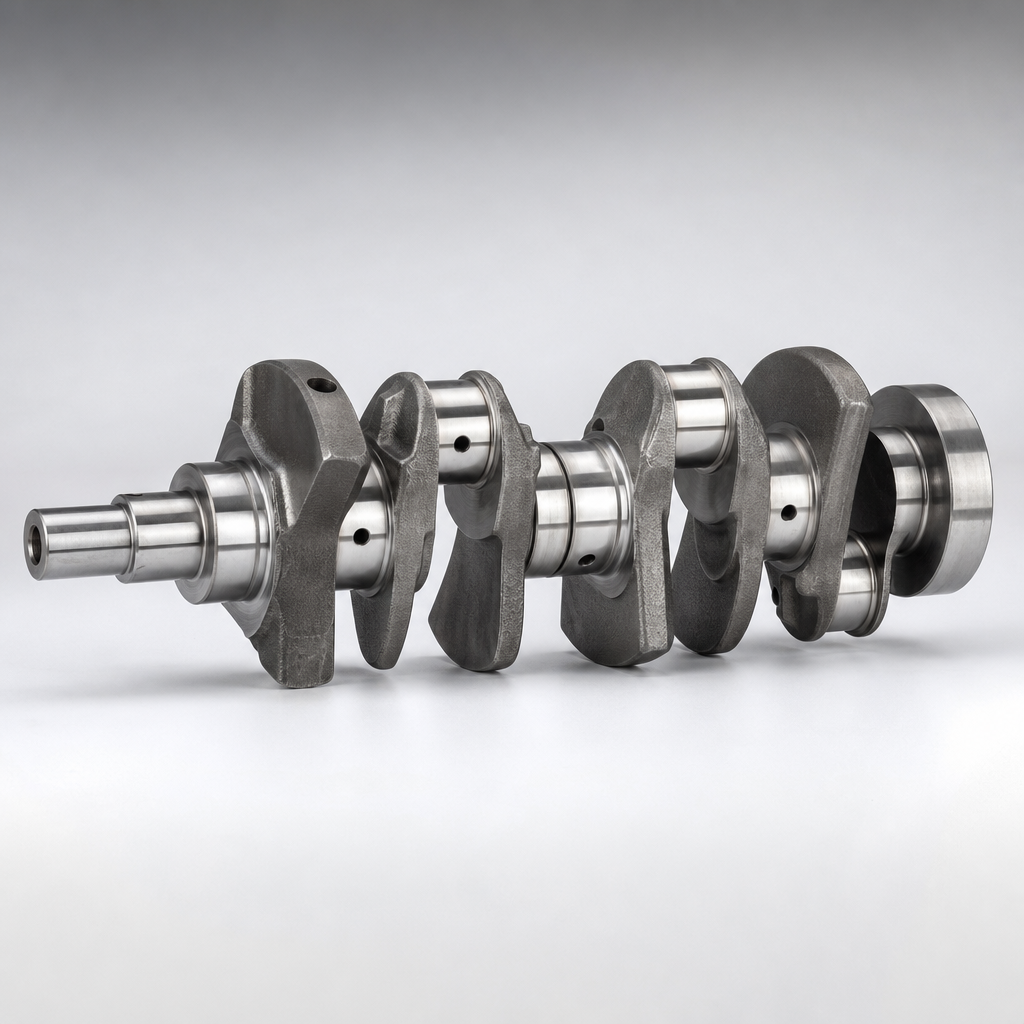
Camshaft Iveco Supplier: A Practical B2B Approval Framework
Choosing a camshaft Iveco supplier is less about finding the lowest quote and more about controlling downstream risk. Price is visible. Claims are expensive later: hardness drift, runout outside limit, unstable induction depth, wrong journal size, poor rust protection, or incomplete fitment data that turns into returns and warranty exposure.
For distributors, repair groups, and OEM-oriented buyers, supplier approval should follow the full manufacturing and logistics path: raw casting or forging source, rough machining, lobe and journal grinding, hardening control where required, washing, rust prevention, packaging, and lot traceability. The useful conversation is a numeric one. Buyers should expect clear answers on hardness range, case depth, surface roughness, runout, first-sample timing, MOQ by SKU family, and standard lead time from PO to shipment.
Driventus manufactures engine and powertrain components for international B2B customers under IATF 16949:2016 and ISO 9001:2015 controls. This article breaks the review process into practical buying angles so procurement teams can evaluate a camshaft source without relying on generic supplier claims. Driventus is an independent aftermarket manufacturer; brand names are referenced for fitment only.
Start with the risk screen, not the quotation
The first question is simple: where can this supplier fail you?
A camshaft is not a simple turned component. Service life depends on material integrity, heat-treatment consistency, lobe profile accuracy, journal finish, post-grinding cleanliness, and packaging that prevents corrosion in transit. So the first screen for a camshaft Iveco supplier should be a risk screen, not a price comparison.
Use these checks early:
- Process ownership: confirm which operations are done in-house and which are subcontracted. Grinding, induction hardening, washing, and final inspection matter most. If these steps sit outside the supplier's direct control, ask how records and accountability are managed.
- Material route: require the declared base material, such as chilled cast iron or alloy steel depending on application, plus the heat-treatment method and hardness window for lobes and journals.
- Dimensional control: ask for limits on runout, journal diameter, lobe lift variation, base-circle variation, phase angle, and surface roughness. In many B2B reviews, buyers expect runout around 0.03-0.05 mm, journal tolerances in low hundredths of a millimetre, and surface roughness commonly around Ra 0.2-0.8 um depending on feature.
- Heat-treatment proof: ask for target hardness and effective hardened depth by feature, plus how those values are verified. Batch sectioning, hardness mapping, and metallographic checks are stronger answers than a general hardness claim.
- Traceability: every lot should connect to material records, machining date, operator or machine data, heat-treatment records, washing status, and final inspection results.
- Export readiness: confirm oiling, VCI use where needed, separators, carton construction, pallet pattern, and shipping marks. Sea freight protection should be treated as part quality, not packing afterthought.
- Compliance records: confirm support for REACH (EC) No 1907/2006 communication where applicable and the quality records needed for customer audits.
A credible supplier can also explain likely field failures in plain terms: premature lobe wear, journal scoring, timing-profile error, transport corrosion, edge chipping, or contamination from poor washing. If the supplier cannot explain how those issues are prevented and contained, the RFQ review is incomplete.
At this stage, ask for three concrete numbers: sample lead time, repeat-order lead time, and MOQ by reference. Many suppliers quote samples at about 15-30 days, repeat production at about 30-45 days after PO and deposit, and MOQ from 20-50 pieces per SKU for established references or 100+ pieces for slower custom-packed items. The exact answer should depend on stock of semi-finished blanks and packing format, not guesswork.
Which technical controls actually separate a strong supplier
Not every process detail matters equally. A buyer does not need a lecture on the entire plant. What matters is whether the controls that affect wear, interchangeability, and claim risk are defined and recorded.
The short list that deserves attention
- Material structure: the supplier should define whether the part is chilled cast, ductile-iron based, or steel-based, and why that route fits the target engine family.
- Heat treatment: induction depth and hardness distribution should be documented by batch. Useful evidence includes hardness maps, microstructure photos, and cut-section validation from approval lots.
- Lobe profile accuracy: profile grinding must hold the specified geometry so timing and lift remain within design limits. Final overall size is not enough; profile inspection data matters.
- Straightness and runout: weak control here leads to noise, accelerated wear, and installation rejection. Runout should be checked with dedicated fixtures and reported on first articles.
- Surface finish: journal and lobe roughness affects lubrication film stability during running-in. Ask for Ra targets by feature and inspection frequency.
- Cleanliness: residual abrasive or metallic particles after grinding can damage bearings at first start. The supplier should define how post-wash cleanliness is checked.
A practical comparison matrix helps force specific answers:
| Evaluation point | Minimum acceptable evidence | Why it matters |
|---|---|---|
| Quality management | IATF 16949:2016 and ISO 9001:2015 certificates | Confirms system control and audit discipline |
| Material and hardness | Mill certs, hardness report, heat-treatment record, target HRC/HB range | Reduces wear and fracture risk |
| Dimensional validation | First article report with key dimensions, runout, lobe lift, journal size, phase angle | Confirms interchangeability |
| Surface and cleanliness | Roughness readings and washing or cleanliness standard | Lowers first-start wear risk |
| Traceability | Lot code on part or box linked to records | Speeds containment if a defect appears |
| Packaging standard | VCI, oiling, separators, export carton spec, pallet pattern | Prevents rust and transit damage |
| Sampling support | PPAP-style package or equivalent customer dossier | Supports OEM, Tier-1, and large distributor approval |
| Lead-time reliability | Written production and shipping schedule with buffer assumptions | Avoids stock gaps in fleet channels |