Camshaft for Honda Accord Replacement Sourcing Guide
Sourcing a camshaft for Honda Accord replacement is usually part of a repair programme for worn lobes, scored journals, oil-starvation damage, timing-drive failure or cylinder-head refurbishment. For distributors, repair-chain buyers and engine rebuild suppliers, the decision should go beyond catalogue fitment claims. The critical questions are whether the shaft repeats the required valve timing and lift profile, whether the material and surface treatment suit the valve train, and whether each batch can be traced, inspected and packed for export without damage.
Honda Accord applications cover several engine families, model years and regional catalogues, so buyers should confirm the engine code, intake or exhaust position, valve-train layout, cam sensor trigger configuration and existing OE or aftermarket cross-reference before releasing an order. Driventus manufactures replacement engine components in Taizhou, Zhejiang, and supplies B2B customers in the EU, UK, US, Canada, Australia and Brazil. This guide explains the main sourcing checks for aftermarket camshafts intended for Honda Accord repair and distribution programmes, including fitment confirmation, metallurgy, machining control, validation records and import packaging.
Fitment Scope and OE-Equivalent Requirements
Accord camshaft demand is commonly tied to petrol engine repair, cylinder-head rebuilding and recovery after timing-system damage. A replacement part should match the original camshaft function in geometry, timing reference and operating durability, while avoiding any claim of vehicle manufacturer approval or endorsement. Before comparing quotations, buyers should define the application by engine code, intake or exhaust position, cylinder-head configuration, production period and sales region.
For a camshaft for Honda Accord replacement, procurement specifications normally include:
- Intake or exhaust camshaft position, where the engine uses separate shafts.
- Number of lobes, journal count and thrust-control design.
- Cam sensor trigger pattern, tooth form and timing reference geometry.
- Overall length, journal diameters, lobe base circle, lobe lift and lobe phasing.
- Heat treatment depth, surface hardness, surface finish and runout limits.
- Compatibility with the specified rocker arm, tappet, lash adjuster or follower system.
- Oil-hole position and end-feature design where lubrication or timing hardware depends on it.
OE part-number cross-references should come from buyer files, original samples, drawings or verified catalogue data. Generic examples such as OE 06A... or OE 11251... should only be used where a customer has supplied that reference. Driventus does not invent or imply brand-owned OE numbers. Honda and Accord names are referenced only to identify vehicle fitment scope for independent aftermarket sourcing.
Material, Machining and Surface Control
Camshafts work under high contact stress, boundary lubrication during start-up and repeated torsional loading. Material choice and surface treatment must therefore match the valve-train design rather than be selected only by price. Chilled cast iron, ductile iron and selected alloy steel routes may be used depending on the application, production volume, follower type and buyer specification.
| Control point | Procurement relevance | Typical verification method |
|---|---|---|
| Raw material grade | Wear resistance, machinability and core strength | Mill certificate and incoming inspection |
| Lobe profile | Valve lift, duration and timing repeatability | Profile measurement against drawing or master sample |
| Journal diameter | Oil film stability and bearing clearance | Micrometer, air gauge or CMM inspection |
| Surface hardness | Resistance to scuffing, pitting and premature lobe wear | Rockwell or Vickers hardness test |
| Surface roughness | Bearing life and follower contact behaviour | Roughness tester on journals and lobes |
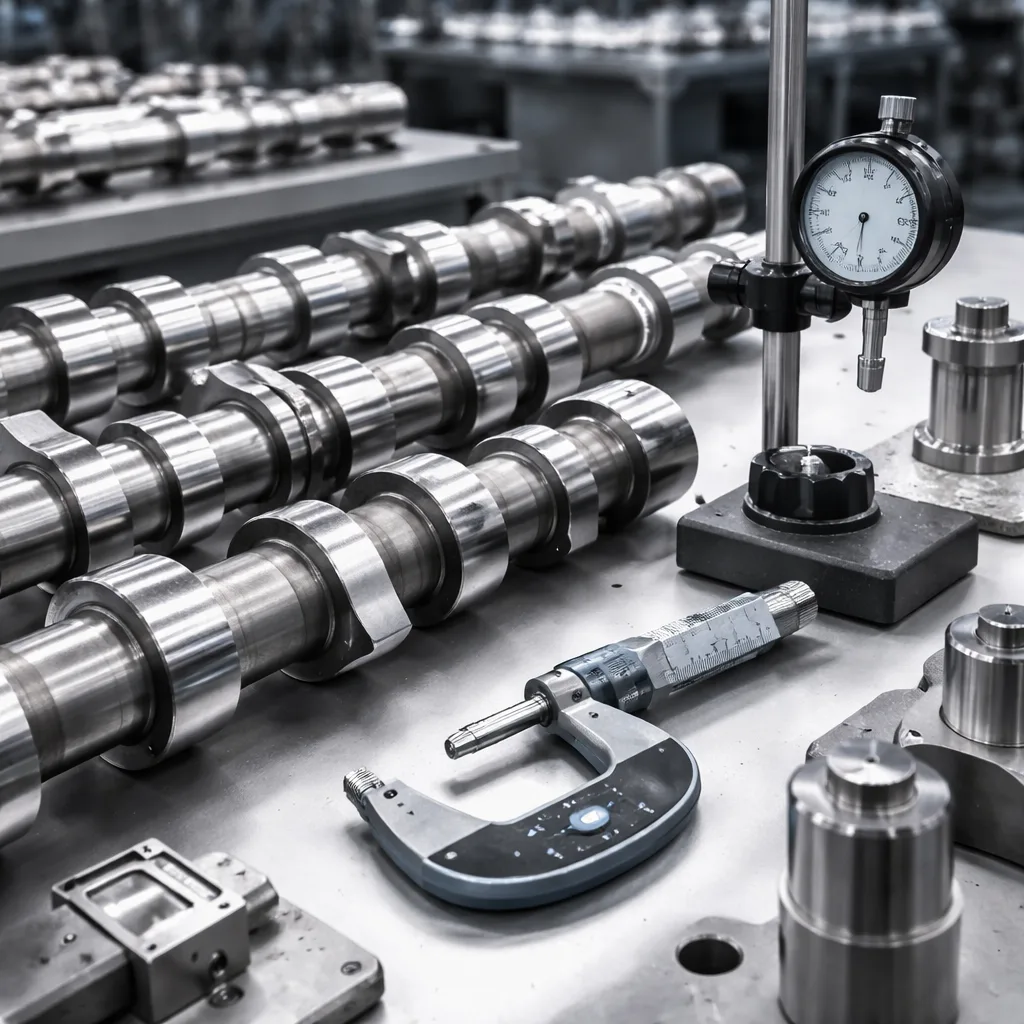
| Straightness and runout | Noise, vibration, oil-film control and bearing load | V-block and dial indicator check |
| Trigger feature position | Cam sensor synchronisation and startability | CMM or dedicated angular fixture measurement |