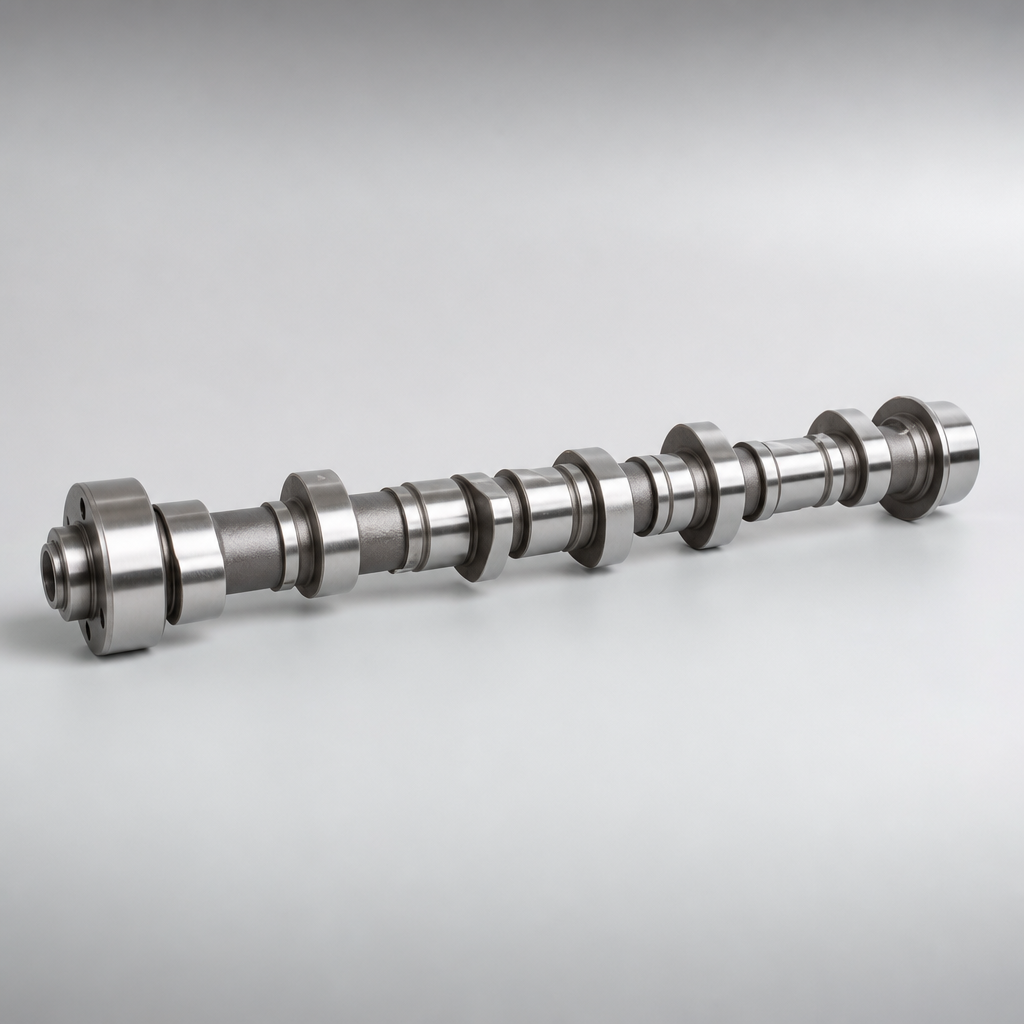
Buying a **camshaft for Subaru Forester replacement** is rarely a simple fitment decision. The part may bolt in, yet still create warranty exposure if lobe profile, journal finish, runout, hardness, or heat-treatment stability drifts from target. For distributors, repair-group buyers, and private-label programmes, that batch-to-batch variation is usually the real commercial risk.
A useful sourcing review starts with three questions: is the application mapping correct, does the supplier have numerical proof of OE-equivalent geometry and material control, and can that result be repeated at production volume? The sections below approach those questions from different angles: approval criteria, common failure modes, process controls, documentation, and repeat-order comparison. Driventus is an independent aftermarket manufacturer; brand names are referenced for fitment only.
Start with the approval gate, not the quote
For any camshaft for Subaru Forester replacement, the first decision point is application accuracy. Forester models span multiple engine families, model years, and valvetrain layouts, so the buyer should confirm engine code, intake or exhaust position, SOHC or DOHC configuration, left-hand or right-hand bank where relevant, sensor trigger features, and any market-specific variation before a part number is approved.
Once application is confirmed, the next gate is functional geometry. Overall size tells very little. The dimensions that matter are the ones that control valve timing, lubrication, and bearing stability. Typical approval points include:
Lobe lift and base circle control: many buyers request checks within about +/-0.02 to +/-0.05 mm against drawing target, depending on feature importance
Journal diameter consistency: commonly reviewed in the +/-0.01 to +/-0.02 mm range to protect oil clearance and bearing fit
Camshaft runout control: often targeted at <=0.03 to 0.05 mm TIR on key journals for stable rotation
Surface hardness and case depth: frequently checked in the range of HRC 55-62 on hardened working surfaces, with hardened depth verified where the process requires it
Surface finish on journals and lobes: buyers often ask for Ra <=0.4-0.8 um on journals and controlled lobe finish to support break-in
End-face and thrust dimensions: typically held to drawing tolerances in the +/-0.03 to +/-0.10 mm range to prevent axial play issues
For aftermarket purchasing, it also helps to request cross-reference support by engine application and any OE-style reference format the supplier can provide. Commercially, separate a stocking-line decision from a project order. Approval flow and pricing usually differ. A common aftermarket structure is sample quantity 1-5 pcs, trial order 20-50 pcs, and production MOQ 100-300 pcs per part number. Lower MOQs are possible, but setup, grinding, and inspection costs push unit pricing upward. If you are reviewing a wider engine-parts range at the same time, related lines can be checked through our catalog and the broader engine components section.
Where replacement camshafts usually go wrong
A camshaft can pass a visual check and still be a poor replacement. That is why camshaft for Subaru Forester replacement sourcing should be framed around failure modes, not appearance.
What to compare before approval
Check item
Why it matters
Typical procurement concern
Lobe lift and timing geometry
Controls valve event accuracy
Power loss, rough idle, emissions deviation
Journal diameter tolerance
Affects oil clearance and wear
Premature scoring or seizure
Straightness/runout
Influences rotation stability
Noise, uneven wear, seal issues
Hardness range
Determines wear resistance
Lobe pitting or galling
Metallurgical consistency
Supports fatigue life
Batch-to-batch durability variation
Surface roughness
Affects lubrication film and break-in
Accelerated wear during early service
</tr></thead><tbody> </tbody></table>In practice, each line in that table maps to a predictable field problem. Profile drift changes valve events. Excessive runout creates unstable rotation. Weak hardness shortens lobe life. Poor finish can damage break-in behavior even when the drawing dimensions look acceptable.
That is why buyers should ask for inspection records with actual values: measured lobe height, base circle, journal diameters by position, thrust-face dimension, trigger-feature position where applicable, and runout data taken on V-blocks or dedicated fixtures. If the supplier only says "OE quality," there is still no useful evidence.
Commercial comparison also needs to be normalized. Review EXW/FCA unit price, tooling or fixture cost if any, sample cost, packaging cost, and freight assumption separately. In many programmes, unit price improves once order quantity moves past setup absorption points such as 100 pcs, 300 pcs, or 500 pcs per SKU. Ask what is actually driving that change: raw material grade, grinding cycle time, outsourced heat treatment, 100% inspection, or export packing. Lead-time should be broken out the same way. Sample lead time often runs 15-30 days, while repeat production is commonly 30-45 days after deposit, drawing confirmation, or sample approval, assuming no tooling change.
For regulated markets, stable valve timing characteristics also reduce downstream repair risk. Replacement components themselves are not certified under vehicle emissions rules, but standards such as ECE R-83 remain a useful reference because valve event accuracy can influence emissions behavior after repair.
If the programme requires private-label or market-specific variants, custom manufacturing can support packaging, marking, or controlled specification changes.
Read the process backwards from service life
If the concern is durability, the best review method is to work backward from field life to the manufacturing steps that control it. The service life of a camshaft for Subaru Forester replacement depends heavily on substrate choice, heat treatment, grinding quality, and handling after final inspection.
Process points worth checking
Base material specification and incoming material traceability
Heat treatment method and recorded hardness range by feature
Case depth or hardened layer verification, where applicable
Journal grinding process capability
Lobe profile measurement method, including inspection frequency
Corrosion-prevention oil and packaging protection for sea freight
A supplier review is more useful when it follows the real production sequence: raw casting or forging receipt, normalizing or pre-heat treatment, rough machining, semi-finish turning, oil-hole drilling and deburring, finish grinding of journals and lobes, induction hardening or equivalent where required, tempering, straightening, washing, anti-rust treatment, final inspection, and export packing.
Each stage carries its own failure pattern. Oil-hole burrs can interrupt lubrication. Poor straightening can leave runout above target. Unstable heat treatment can produce mixed hardness in the same lot. Weak corrosion protection can damage journals before the parts ever reach a warehouse shelf.
Typical control values buyers request include hardness mapping at several lobe and journal locations, case depth checks by microhardness section, and journal roundness/cylindricity reports where the supplier has that capability. For finish quality, many procurement teams ask for journal roughness in the Ra 0.2-0.4 um band on premium programmes or Ra <=0.8 um on standard programmes, provided break-in behavior has been validated. For anti-corrosion protection, the supplier should define whether the part uses a light protective oil for short transit or a heavier rust-preventive coating suitable for 30-90 days of sea freight and warehouse exposure.
Low-cost sourcing often fails on surface integrity rather than headline dimensions. Burrs at oil holes, poor chamfer control, and inconsistent grinding marks create avoidable warranty claims. For that reason, procurement teams commonly ask for process-control evidence aligned with IATF 16949:2016 and ISO 9001:2015, especially for critical machining and final inspection stages.
If parts are exported into the EU or UK, material and coating declarations may also need to align with REACH (EC) No 1907/2006. That becomes relevant when anti-rust oils, packaging materials, or marking inks are part of the delivered configuration.
What a serious sample package should contain
A weak sample submission creates delays later. For replacement-focused purchasing, a supplier package should do more than show photos and claim fitment. It should reduce ambiguity before tooling release or first bulk shipment.
Recommended supplier documentation includes:
Dimensional report for critical-to-function features
Hardness test records by batch
Material certificate or conformity statement
Runout and straightness inspection result
Surface roughness data for journals and lobes
Visual standard for appearance and edge condition
Packaging specification for corrosion and transit protection
Traceability method for lot identification
Where possible, define the inspection format before samples are made. A useful first-article package for a camshaft for Subaru Forester replacement usually includes ballooned drawing references, actual measured values for all critical features, gauge identification, calibration status, sampling quantity, and pass/fail criteria.
For repeat orders, buyers often shift to a control plan with 100% checks on identity, appearance, and selected key dimensions, plus batch-based sampling for profile, hardness, and roughness. If the programme has high warranty sensitivity, request retained samples from each lot and lot-level linkage back to raw material and heat-treatment records.
Packaging deserves the same level of specificity. Instead of asking for "export packing," ask how many pieces go in each inner box and master carton, whether shaft-to-shaft contact is prevented, whether VCI paper or sealed bags are used, and whether the package is designed for drop, vibration, humidity, and 30- to 45-day ocean transit. A technically acceptable camshaft can still arrive with journal damage or corrosion if the packing method is weak.
Where the supplier follows an automotive process discipline, buyers should also ask how non-conforming material is segregated, how gauge calibration is maintained, and what corrective-action process is used for complaints. These are practical indicators of a mature quality system.
For high-volume aftermarket distribution, stronger validation allows incoming inspection to move toward risk-based checks rather than full remeasurement of every shipment. That improves warehouse efficiency without giving up quality control.
How to choose a supplier when the first order is not the last
The right supplier for a one-off trial is not always the right supplier for a repeat aftermarket programme. A low opening price can be erased quickly by returns, claim handling, or inconsistent batches.
A practical scorecard for repeat orders should cover four areas:
1. Fitment coverage: clear application mapping by engine and production year 2. Process capability: evidence of controlled machining, grinding, and heat treatment 3. Quality documentation: lot traceability, inspection reporting, and complaint handling 4. Supply reliability: stable lead times, export packing, and communication quality
Then compare the commercial details with the same discipline. Buyers usually want to line up MOQ, sample charge policy, unit price breaks, standard lead time, on-time delivery rate, claim response time, and warranty settlement method. One supplier may look cheaper at 500 pcs but be uncompetitive at 100 pcs. Another may handle mixed-SKU orders better, which matters more for distributors managing several Subaru references than for a single high-volume line.
Lead-time logic should be tested, not accepted at face value. Ask what portion of the schedule is consumed by raw blank availability, machining queue, lobe grinding capacity, heat-treatment outsourcing, final inspection, and packaging. A quoted 25-day lead time means little if material is not reserved and grinding capacity is shared with unrelated programmes. It is also worth asking whether emergency replenishment, safety stock, or monthly forecast locking is available for stable aftermarket demand.
The shortlist question is simple: can the supplier hold the same critical profile and hardness window across repeated shipments, not just on first samples? That matters most for distributors serving multiple regions and repair chains that need low warranty volatility. As a working benchmark, many B2B buyers look for sample dispatch in 2-4 weeks, mass production in 4-6 weeks, and documented price validity for at least 30-90 days, subject to steel or alloy cost movement.
Driventus supports B2B buyers with camshaft and related powertrain component programmes, including standard aftermarket supply and custom manufacturing for defined project requirements. Product range details are available through our catalog.
Frequently asked questions
The main risk is variation in functional geometry or hardness rather than obvious fitment error. Lobe profile drift, excessive runout, poor journal finish, or unstable heat treatment can all reduce service life and increase warranty claims. Buyers should ask for actual measured values, not only a fitment promise.
At minimum, ask for a dimensional report, hardness results, material declaration, runout data, traceability method, and packaging specification. For long-term programmes, process-control and corrective-action information should also be reviewed, along with sample lead time, MOQ, unit price breaks, and standard production lead time.
Yes. IATF 16949:2016 and ISO 9001:2015 indicate structured production and quality control, while REACH (EC) No 1907/2006 may apply to materials, coatings, oils, and packaging supplied into EU markets. These requirements do not replace dimensional and metallurgical validation, but they are relevant for supplier qualification.
If you are qualifying a **camshaft for Subaru Forester replacement** or adjacent engine programmes, send the required fitment, target specifications, MOQ, and delivery requirement details to [request a quote](/contact.html).