Camshaft for MINI Clubman Replacement: Buyer Checklist
Sourcing a camshaft for MINI Clubman replacement is a fitment-controlled, validation-led job—not a generic parts swap. The engine family, intake or exhaust position, variable valve timing hardware, cam sensor trigger pattern, journal geometry, thrust control, and oil-feed layout all have to match the original specification. Driventus is an independent aftermarket manufacturer; brand names are used for fitment identification only. For B2B buyers, the real question is straightforward: will the shaft install without machining, maintain the intended oil clearance, and preserve lobe-profile accuracy through thermal cycling and mixed-duty use? Answering that takes more than a catalogue match. Buyers should confirm OE-equivalent dimensions, lobe lift and phasing, journal runout, lobe and journal surface finish, hardness or case-depth data, cleanliness, rust protection, and packaging control before purchase. Supplier documentation matters too, including production controls under IATF 16949:2016 and ISO 9001:2015, plus material and chemical compliance mapped to REACH (EC) No 1907/2006 where applicable. The sections below outline the fitment checks, quality controls, and sourcing routes procurement teams can use to reduce installation risk and secure repeatable batch supply.
What Must Match on a Clubman Camshaft
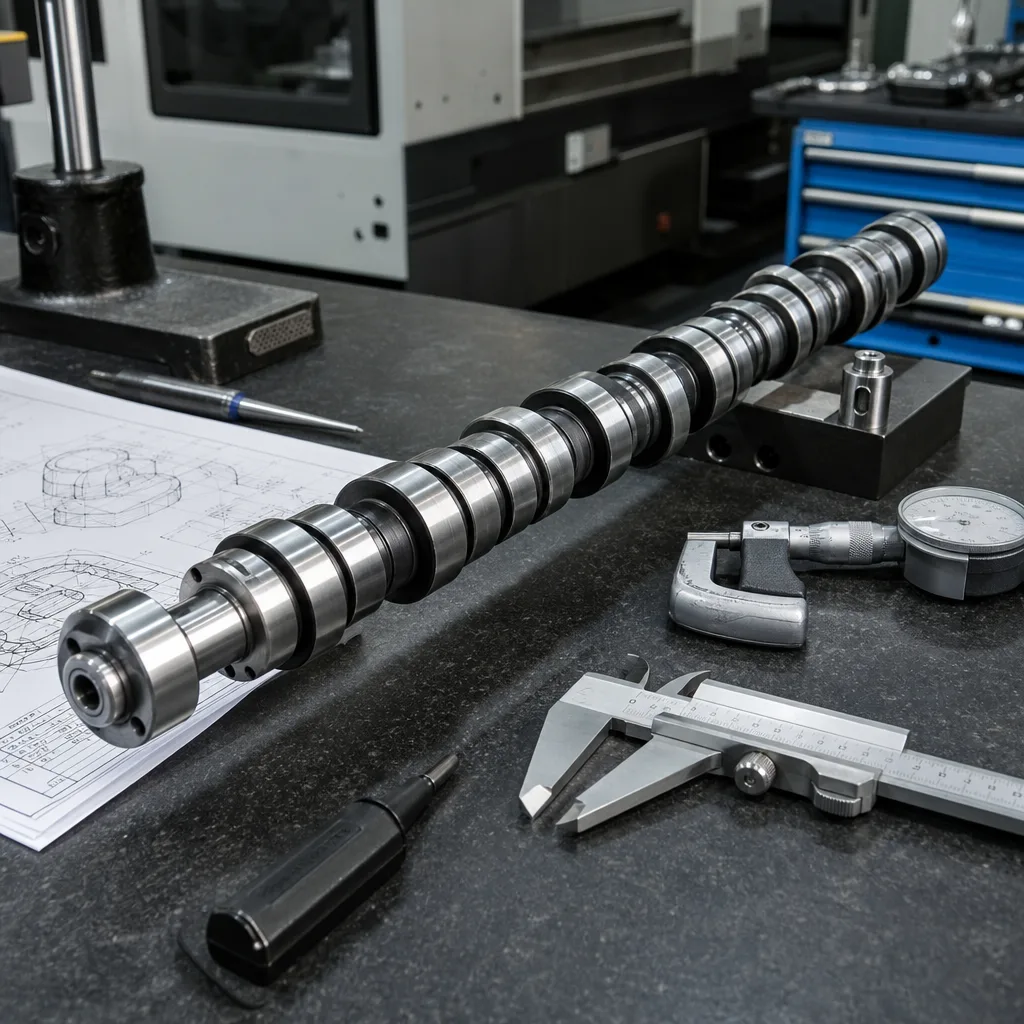
When specifying a camshaft for MINI Clubman replacement, buyers should use the OE sample, OE reference, or approved technical drawing as the control baseline. Overall length is only the beginning. Journal diameters, bearing spacing, lobe lift, base circle, lobe phasing, thrust face width, end features, oil galleries, and the trigger-wheel or phaser interface must all align with the engine management strategy and the cylinder-head machining. A small error in indexing or base circle can shift valve timing, change hydraulic lash adjuster position, increase valvetrain noise, reduce vacuum stability, or trigger cam/crank correlation faults after installation.
The first split is intake versus exhaust. On engines with variable valve timing, the camshaft also has to match the correct actuator interface, oil-control passages, locating dowel, bolt pattern, and sensor reference geometry. Two shafts may look similar on the bench and still be different in service if the phaser mounting face, dowel clocking, sensor tooth index, or end-slot geometry is not the same as the original unit. Procurement teams should also confirm whether the part is supplied as a bare camshaft or with matched accessories. Reusing stretched torque-to-yield bolts, worn phasers, damaged sprockets, or contaminated followers can undermine an otherwise correctly manufactured shaft.
Check
Why it matters
Procurement note
Journal diameter
Controls bearing fit, oil clearance, and oil film stability
Confirm against OE drawing or measured master sample; request actual inspection values, not only pass/fail
Journal spacing
Aligns the shaft in cylinder-head saddles and caps
Check CMM or fixture inspection report for datum-based spacing
Journal roundness and taper
Prevents local oil-film collapse and cap loading
Require tolerance confirmation on each bearing journal where available
Lobe lift
Sets valve lift and cylinder filling
Compare measured lobe height and base circle to the approved profile
Base circle
Affects hydraulic lash adjuster range and follower contact pattern
Verify against a serviceable reference part before approval
Lobe phasing
Defines valve timing and ECU correlation
Require intake/exhaust position confirmation and phase-angle inspection
Axial location
Controls thrust load and end play
Verify thrust face width, groove location, and installed clearance guidance
Sensor trigger geometry
Provides cam sensor synchronization
Match tooth count, index position, slot shape, and end-face geometry
Lubricate journals, lobes, and VVT components where applicable
Check hole diameter, position, deburring, and cleanliness requirements
Surface hardness
Provides wear resistance at lobes and journals
Require hardness range and, if induction hardened or carburized, case-depth data
Surface finish
Protects follower life and supports oil retention
Review Ra/Rz values for lobe contact areas and journals
Runout/straightness
Limits vibration, bearing load, and uneven follower contact
Request datum method and maximum measured total indicator reading
</tr></thead><tbody> </tbody></table>If the original engine uses variable valve timing, order the correct intake or exhaust version rather than relying on visual similarity. This is particularly important on mixed-year applications, where the same nameplate can span different engine families, emissions packages, turbo and non-turbo variants, and regional specifications. A complete fitment check protects both buyer and installer: it reduces wrong-part returns, helps prevent avoidable labor claims, and gives the supplier a clear basis for confirming the replacement before shipment.
Fitment Checks Before Ordering
Before issuing a purchase order, confirm the engine code, model year range, intake or exhaust position, VVT actuator type, cam sensor style, and whether the camshaft is supplied bare or with matched hardware. The same vehicle badge can cover several petrol and diesel variants, so badge data alone is not enough. For B2B sourcing, the strongest enquiry combines vehicle details with physical evidence from the removed camshaft and, when available, a verified OE or aftermarket cross-reference.
Useful request data includes:
Vehicle year, body code if available, and sales market
Engine code, displacement, cylinder count, and aspiration type
Fuel type and emission standard if available
Intake or exhaust camshaft position
Old-part photos from both ends of the camshaft
Close-up photos of the trigger wheel, locating slot, dowel, phaser interface, oil-feed holes, and stamped or etched markings
Any OE reference from the invoice, service record, catalogue, or removed component
Measured journal diameter, overall length, thrust face width, and lobe height if available
Measured wear notes if the original part failed, including scored journals, wiped lobes, bluing, pitting, or broken timing components
Target order volume, packaging format, label language, and delivery window
Photos should show the full shaft, both end faces, the lobe arrangement, oil passages, thrust surfaces, and any stamped, cast, laser-marked, or etched identifiers. If the original part is heavily worn, cracked, overheated, or damaged by a timing failure, it is safer to check dimensions against a serviceable sample or controlled drawing rather than relying only on the failed unit. Where possible, ask the supplier to confirm the match in writing by engine code, cam position, reference number, and visible end geometry. That gives the approval trail a clear record.
If the camshaft is being replaced after chain noise, oil starvation, sludge contamination, timing failure, seized followers, or wider valvetrain damage, inspect the lifters, followers, rocker arms, chain guides, tensioner, sprockets, phasers, seals, oil-control valves, oil pump condition, and cylinder-head oil galleries before reassembly. A new camshaft will not last in a contaminated or partially repaired top end. Buyers supplying repair networks should include this point in the installation note, because many repeat failures trace back to blocked oil feeds, abrasive debris, incorrect timing setup, or reused damaged mating parts—not the shaft itself.
Distributors should also decide early whether the program will use individual boxed units, workshop kits, or bulk-packed shafts for engine rebuilders. Individual packaging supports retail, e-commerce, and branch distribution; bulk packing can lower unit cost for controlled rebuild programs. Either way, specify corrosion protection, label content, barcode format, country-of-origin marking, batch or lot identification, and packing orientation before release. Cam lobes and journals need protection from impact damage, fretting, and condensation during sea freight or warehouse storage.
A replacement camshaft should come with a quality file, not just a part number. The file should cover material certificate traceability, manufacturing route, heat-treatment records, hardness checks, runout measurement, lobe-profile inspection, surface-finish measurement, cleanliness control, and final visual inspection for burrs, scoring, rust, casting defects, blocked oil holes, or contamination. For a camshaft for MINI Clubman replacement, those records carry real weight: small geometry errors may not show up until the vehicle develops cold-start noise, rough idle, reduced power, abnormal follower wear, or cam/crank correlation faults.
Driventus structures production around quality system controls aligned with IATF 16949:2016 and ISO 9001:2015. In practice, this means approved process routing, controlled drawings, calibrated gauges, defined inspection frequency, batch traceability, nonconforming-product segregation, corrective action, and change-control records when tooling, material, heat treatment, or supplier source changes. If the buyer needs chemical compliance for packaging, labels, rust-prevention materials, coatings, or related supplied components, REACH (EC) No 1907/2006 should be named in the compliance pack.
Inspection points
Spectrometer or certified mill-test verification of alloy chemistry against the approved material specification
Verification of casting, forging, chilled-cast, or billet source depending on the manufacturing route
Datum-based dimensional inspection of journals, lobes, thrust faces, end features, locating slots, dowels, threads, and oil holes
Lobe-profile measurement against an approved master cam, CAD model, or profile chart, including lift curve and opening/closing flank shape
Lobe phasing and index inspection against the cam sensor trigger or timing datum
Runout or straightness measurement to control rotation accuracy and bearing load
Hardness verification at defined lobe and journal locations using the agreed scale, such as HRC, HRB, HV, or HB depending on material and process
Effective case-depth or heat-treatment validation where induction hardening, nitriding, carburizing, or chill hardening is specified
Surface-finish review on lobe contact areas, journals, thrust faces, and sealing or phaser mounting faces
Magnetic particle, visual, dye-penetrant, or other defect checks where specified by the control plan
Deburring and cleanliness inspection of oil holes and internal passages
Rust-prevention packaging check, including VCI paper, oil film, bagging, desiccant, or other agreed protection method before shipment
For commercial sourcing, the inspection record should identify the part number, drawing revision, batch or heat number, inspection date, measuring equipment or method, acceptance criteria, and actual measured result where appropriate. Pass/fail wording is weaker than a dimensional record because it gives the buyer less to work with during incoming inspection, warranty analysis, and supplier scorecard reviews. If the buyer has its own incoming AQL plan, the supplier release report should be structured around the same datum points and functional dimensions.
Good documentation helps distributors, rebuilders, fleet repair groups, and repair networks reduce repeat faults across multiple branches. It also speeds up incoming inspection: the buyer can compare the delivered batch with a defined release record instead of relying on visual similarity. For private-label programs, the same records protect the brand. If a field issue occurs, the buyer can trace the production lot, review release data, determine whether the problem is isolated or systemic, and separate installation-related failures from manufacturing risk.
Sourcing Options for Replacement Programs
Procurement teams generally work with one of three sourcing models. The best route depends on urgency, annual volume, catalogue strategy, warranty exposure, and the level of engineering control the buyer wants over the replacement part. A workshop handling one urgent repair has different needs from a distributor building a repeatable camshaft range; a brand owner planning a private-label engine program will need even tighter control over packaging and release documentation.
Private-label, non-standard, or controlled engineering programs
Drawing review, material specification, agreed tolerances, first-article inspection, test plan, target MOQ
</tr></thead><tbody> </tbody></table>For stock replacement, fitment error is the main risk. Buyers should prioritize quick confirmation of the engine code, cam position, sensor trigger form, phaser or sprocket interface, and visible end geometry. With OE-equivalent batch sourcing, repeatability becomes the focus: golden-sample approval, batch inspection records, packaging consistency, carton labeling, barcode control, and stable part numbering matter because the part may move through multiple branches or markets. For custom manufacturing, buyers should expect a formal APQP-style approval flow where appropriate, including drawing control, first-article inspection, material confirmation, heat-treatment validation, packaging artwork review, and agreed production tolerances.
If the part requires a modified lobe profile, alternate heat treatment, different surface finish, laser marking, bundled hardware, private-label packaging, or regional documentation, use custom manufacturing rather than forcing a catalogue item into an unsuitable application. This is the safer route for a controlled version tied to a specific engine family, repair program, or sales channel. It also prevents confusion between standard catalogue stock and a buyer-specific version with different release criteria.
Commercial terms should match the technical route. Ask early about minimum order quantity, sample lead time, production lead time, payment terms, inspection documents, warranty handling, carton labeling, and replenishment forecasts. For export programs, confirm the invoice description, HS code handling, country-of-origin marking, corrosion-protection period, pallet configuration, carton drop protection, and any customer-specific labeling before shipment. These details are not secondary when the part may pass through several warehouses before installation.
For teams building a broader line, start with the replacement camshaft, then align related engine parts such as followers, rockers, timing kits, phasers, oil-control valves, gaskets, and seals so the top-end package is consistent across the order line. That reduces split shipments, avoids mixed-spec assemblies, and makes warehouse picking simpler on repeat orders. A structured sourcing plan also gives the buyer a clearer path from first enquiry to sample approval, batch release, and ongoing replenishment.
Frequently asked questions
It can be, provided the buyer confirms engine code, cam position, OE reference, and visible end geometry. We validate dimensional match, phasing, hardness or heat-treatment data, and release records before shipment; brand names are referenced for fitment only.
Send the vehicle year, engine code, intake or exhaust position, old-part photos, any OE reference, and target volume. If available, add measured journal diameter, lobe height, thrust width, and notes on wear or failure mode. That shortens the fitment check.
Yes. Use [custom manufacturing](/oem-services.html) for modified profiles, alternate finishes, special marking, bundled hardware, or regional packaging. We can build to an agreed drawing, material specification, and inspection plan.
If you need a replacement camshaft matched to a specific Clubman engine family, send the engine code, cam position, OE reference, and sample photos through [request a quote](/contact.html).