camshaft · 2026-06-05

Camshaft for Hyundai Sonata Aftermarket Replacement: B2B Buyer Guide

A camshaft for Hyundai Sonata aftermarket replacement must be selected by engine data, not by model name alone. The correct part has to match the Sonata engine family and engine code, intake or exhaust position, valve-timing profile, journal dimensions, thrust geometry, sensor trigger features, oil-feed layout, and variable valve timing hardware before it is suitable for procurement or distribution. For B2B buyers, the main risk is not the quoted unit price; it is a mismatch between the replacement camshaft and the actual engine code, cylinder head revision, actuator configuration, or regional vehicle application. A wrong match can create installation delays, valvetrain noise, cam/crank correlation DTCs, warranty claims, and avoidable returns across an entire sales channel.

Driventus manufactures engine components for export markets under controlled processes aligned with IATF 16949:2016 and ISO 9001:2015. Driventus is an independent aftermarket manufacturer; brand names are referenced for fitment identification only. For Hyundai Sonata sourcing programmes, procurement teams should validate OE cross-reference data, confirm the target engine family, review incoming inspection requirements, and agree heat-treatment, surface-finish, marking, corrosion protection, and packaging standards before placing volume orders. This guide explains the technical and commercial checks that matter most for distributors, repair chains, importers, and catalogue teams that need dimensional consistency, traceable production, and reliable pack-out for repeat aftermarket replacement supply.

What a replacement camshaft must match

For a camshaft for Hyundai Sonata aftermarket replacement, fitment accuracy is the first procurement requirement. The replacement camshaft must reproduce the functional geometry of the target OE-style part closely enough to install correctly, maintain hydrodynamic oil film at the journals, operate the valves at the intended events, and communicate correctly with timing and position-control systems.

The most important variables to confirm before purchase include:

  • Engine code, displacement, induction type, production date range, and sales market
  • Intake or exhaust camshaft position; these are not interchangeable on VVT applications
  • Variable valve timing compatibility, including phaser interface, oil-feed location, dowel position, and actuator mounting features
  • Cam profile, base circle, lobe lift, opening/closing events, and ramp design against OE data or an approved master sample
  • Overall length, journal spacing, journal diameter, oil holes, oil grooves, and chamfer layout
  • Thrust face width, thrust shoulder location, and end-play control surface
  • Sensor trigger wheel, reluctor, or cam position reference pattern, including angular index to the drive end
  • Drive-end configuration, sprocket interface, dowel pin, keyway, bolt thread, or phaser locating detail
  • OE cross-reference number and supersession history, when available
  • Cylinder head casting revision, bearing cap arrangement, and cap sequence requirements

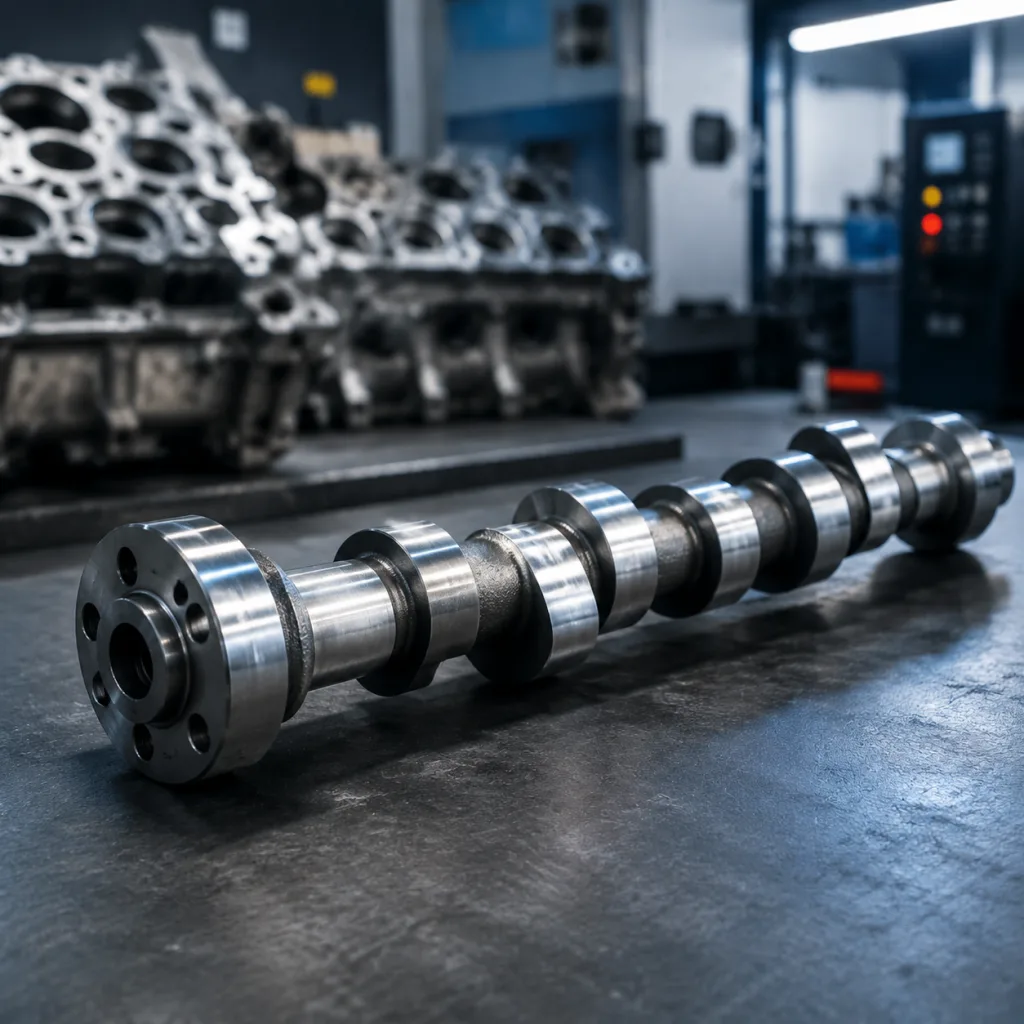
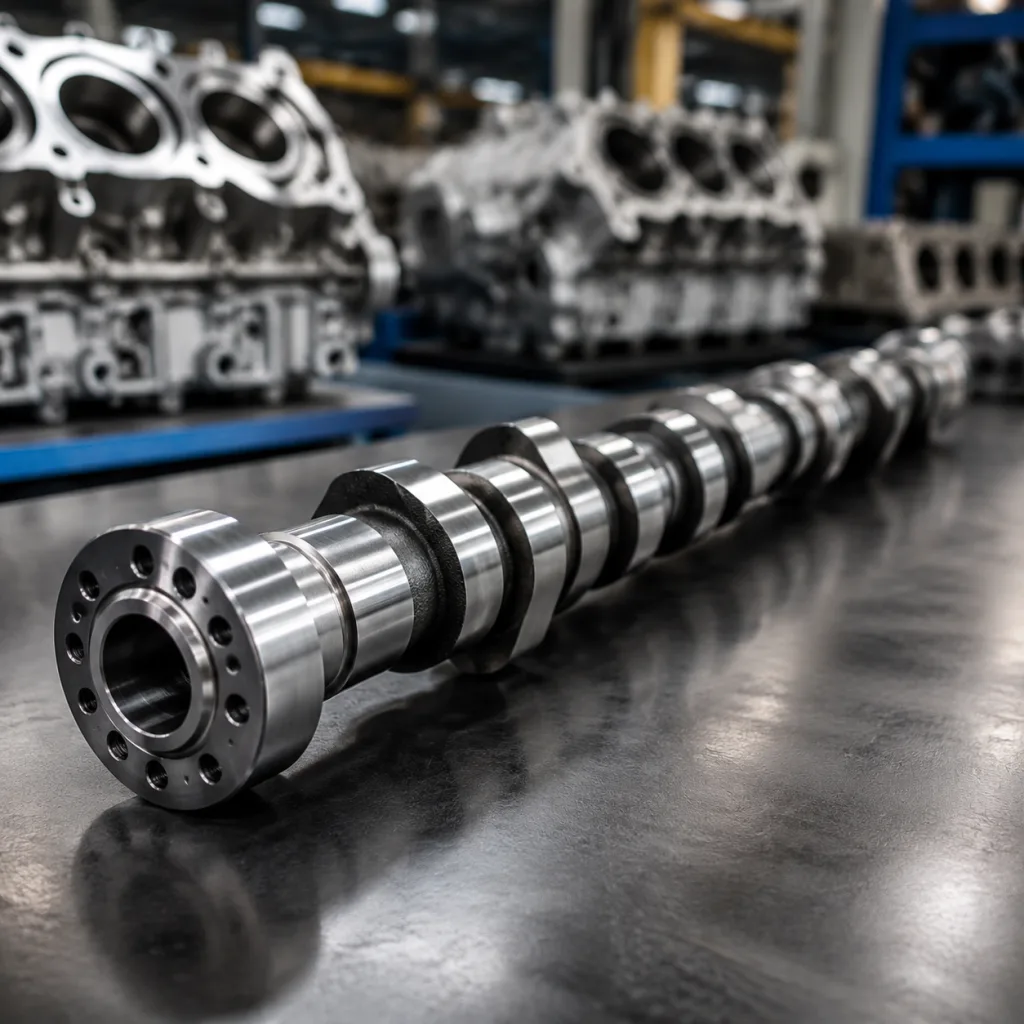
A camshaft can look visually similar and still fail during installation if journal spacing, thrust control surface, oil-feed position, or trigger pattern differs from the original application. In production-style validation, critical dimensions should normally be controlled with defined tolerances rather than photo comparison. For example, journal diameters should be matched to the cylinder head bearing bore and oil-clearance target, runout should be checked across the journal set, and lobe lift should be verified at the nose-to-base-circle differential. Small dimensional differences can create larger downstream issues: insufficient oil film can accelerate journal scoring, an incorrect trigger feature can cause P0016/P0017-style cam/crank correlation faults, and a mismatched lobe profile can change idle quality, emissions behaviour, or torque delivery.

For replacement programmes, buyers should ask for dimensional drawings, material specifications, inspection records, and sample approval data tied to each batch or production lot. Where the programme covers more than one Sonata generation or sales region, application data should be controlled by engine family and OE reference rather than by vehicle name only. Sonata model years may share the same nameplate while using different valvetrain hardware, especially across regional engine options, GDI/MPI variations, turbocharged applications, and production updates.

Driventus supplies engine components with process control suitable for export distribution and OEM-adjacent aftermarket channels. For catalogue development, the strongest starting point is one internal record per engine family, supported by OE number, engine code, side of installation, end-feature photos, journal-layout images, and any known market restrictions.

OE-equivalence checks procurement teams should require

OE-equivalence should be verified by measurement and documented process control, not by supplier description alone. A replacement camshaft is a precision rotating component, and its suitability depends on dimensional accuracy, material performance, surface condition, and compatibility with the surrounding cylinder head, followers, timing drive, cam sensor, and VVT system.

</tr></thead><tbody> </tbody></table>Published quality standards are useful for governance, but they do not replace part-specific validation. Buyers can ask for conformity to IATF 16949:2016, ISO 9001:2015, and REACH (EC) No 1907/2006 documentation where applicable to supplied materials, coatings, rust preventives, and finishing processes. The supplier should also be able to explain which dimensions are checked on every lot, which are validated during first-article approval, which use statistical process control, and which are locked by tooling, fixtures, or master gauges.

For volume procurement, request a first-article sample with a measured report before order release. The report should include critical dimensions, lobe profile comparison, journal runout, hardness results where required, and agreed surface-finish data. For higher-risk applications, add a retained master sample and pre-shipment inspection plan. A short delay at this stage is usually less expensive than returns, workshop disputes, or relabelling and repacking work after distribution.

How Driventus validates replacement camshafts

Replacement parts for engine valvetrain systems must remain stable across batches, not only pass one sample review. Driventus uses controlled machining and inspection steps designed to support repeatable output for export buyers that need consistent fitment, predictable claim rates, and documentation suitable for multi-market distribution.

Typical validation steps include:

1. Incoming material verification against approved material specification, purchase lot, and mill or foundry record where applicable 2. Review of casting, forging, billet, or assembled-shaft condition before machining, including visible defect and datum checks 3. CNC turning, milling, grinding, and finishing to controlled dimensions for journals, lobes, end features, oil features, and thrust surfaces 4. Profile measurement for lobe geometry, base circle, lobe height, lift consistency, and angular index to a defined datum 5. Inspection of journal diameter, journal spacing, straightness, total indicated runout, and oil-hole or oil-groove position 6. Surface-finish inspection on journals, lobes, thrust faces, and other contact areas using calibrated measuring equipment 7. Hardness and microstructure checks where specified by the programme, such as lobe surface hardness, effective case depth, or chilled-layer verification 8. Verification of sensor trigger, reluctor, dowel, keyway, threaded hole, locating pin, phaser, or sprocket interface details 9. Final dimensional audit against approved drawings, OE-style references, reverse-engineered data, or retained master samples 10. Batch traceability, part marking, label review, anti-corrosion protection, sleeve or separator fit, and export carton verification

For buyers managing multi-country supply, batch consistency matters as much as the nominal specification. Once a camshaft programme is approved, the next concern is whether later shipments maintain the same profile, finish, dimensional tolerance, heat-treatment condition, and installation behaviour. That is why our quality system is part of the commercial discussion, not only the technical one. A documented process helps distributors manage claims, support customers with traceable data, and compare later shipments against the approved reference.

Driventus can also support programme-specific requirements such as custom inspection plans, AQL-based pre-shipment inspection, private-label packaging, laser or mechanical part-number marking, batch coding, VCI or oil-based corrosion protection, foam/sleeve separators, and export carton specifications. If you need a Sonata camshaft mapped to a specific OE-style cross-reference format for your internal database, send the engine code, model year, market region, intake/exhaust side, and any available OE number with your enquiry.

Driventus is an independent aftermarket manufacturer; brand names are referenced for fitment identification only.

Common sourcing mistakes on Sonata applications

The most frequent procurement errors are caused by model-name matching instead of engine-code matching. Hyundai Sonata vehicles can use different engine families, cylinder head assemblies, timing systems, fuel systems, and camshaft layouts across production years and sales regions. A catalogue entry that appears correct at vehicle-name level can still be wrong for the actual engine on the repair bay floor.

Common mistakes include:

  • Ordering by vehicle name only instead of engine code, production date, market, and OE reference
  • Mixing intake and exhaust camshaft listings, especially when both sides have VVT hardware
  • Ignoring VVT actuator compatibility, oil-control feed location, phaser locating features, or dowel orientation
  • Assuming one model-year range covers all trims, markets, emissions packages, and engine options
  • Skipping trigger wheel, reluctor, or sensor-reference verification against a known datum
  • Overlooking cylinder head casting revisions, bearing cap differences, or cap-thrust arrangements
  • Failing to confirm journal diameter, thrust geometry, end play, oil passage layout, and bearing-cap seating
  • Accepting parts without a dimensional report, lobe-profile check, or first-article approval sample
  • Using a generic catalogue photo when drive-end, sensor-end, or thrust-face features differ between applications
  • Releasing stock without clear packaging labels for side of installation, engine family, and batch code

If your team supplies workshops, repair chains, or retail distribution, a wrong-fit camshaft can create valvetrain noise, no-start complaints, misfire issues, cam/crank correlation DTCs, poor idle quality, oil-pressure concerns, delayed VVT response, or installation labour disputes. These problems often cost more than the original part value because they involve diagnosis time, return freight, customer compensation, technical reporting, and loss of trust in the catalogue listing.

To reduce returns, keep application notes linked to engine code, OE reference, intake/exhaust position, production market, and photos of the drive end, sensor end, thrust face, oil features, and journal layout. A simple internal rule helps: no order release without engine code, side of installation, and OE cross-reference or approved sample confirmation. For catalogue teams, store superseded OE numbers and market exclusions in the same record so sales staff do not quote an obsolete or region-specific fitment as universal.

For broader engine coverage, see our catalog and the related engine components section.

Commercial considerations for B2B buyers

For distributors, importers, and repair chains, the value of a replacement camshaft is determined by availability, consistency, documentation, and claim rate. Unit price matters, but total landed cost is affected more by wrong-fit returns, packaging damage, slow replenishment, mixed stock, and unresolved technical disputes. A reliable camshaft for Hyundai Sonata aftermarket replacement programme should therefore be evaluated as a supply-chain item as well as a machined engine component.

What to ask before purchase:

  • MOQ and batch-size flexibility for initial market testing, stocking programmes, and repeat replenishment
  • Standard lead time, production window, safety-stock options, and stock availability for fast-moving references
  • First-article sample process, retained sample policy, and approval criteria
  • Dimensional report format and inspection records supplied with each batch or upon request
  • Packaging method for long-shaft protection during export transport, warehouse handling, and courier shipment
  • Anti-corrosion treatment, VCI sleeve or oil film, separators, end protection, and carton specification
  • Traceability label format, barcode requirements, batch code, manufacturing date, and private-label options
  • Custom marking, kit options, accessory inclusion, installation-note insert, or market-specific label requirements
  • Claim-handling process, evidence requirements, response time, and technical documentation needed for review
  • Forecast support for annual volume, seasonal demand, SKU rationalisation, and catalogue expansion

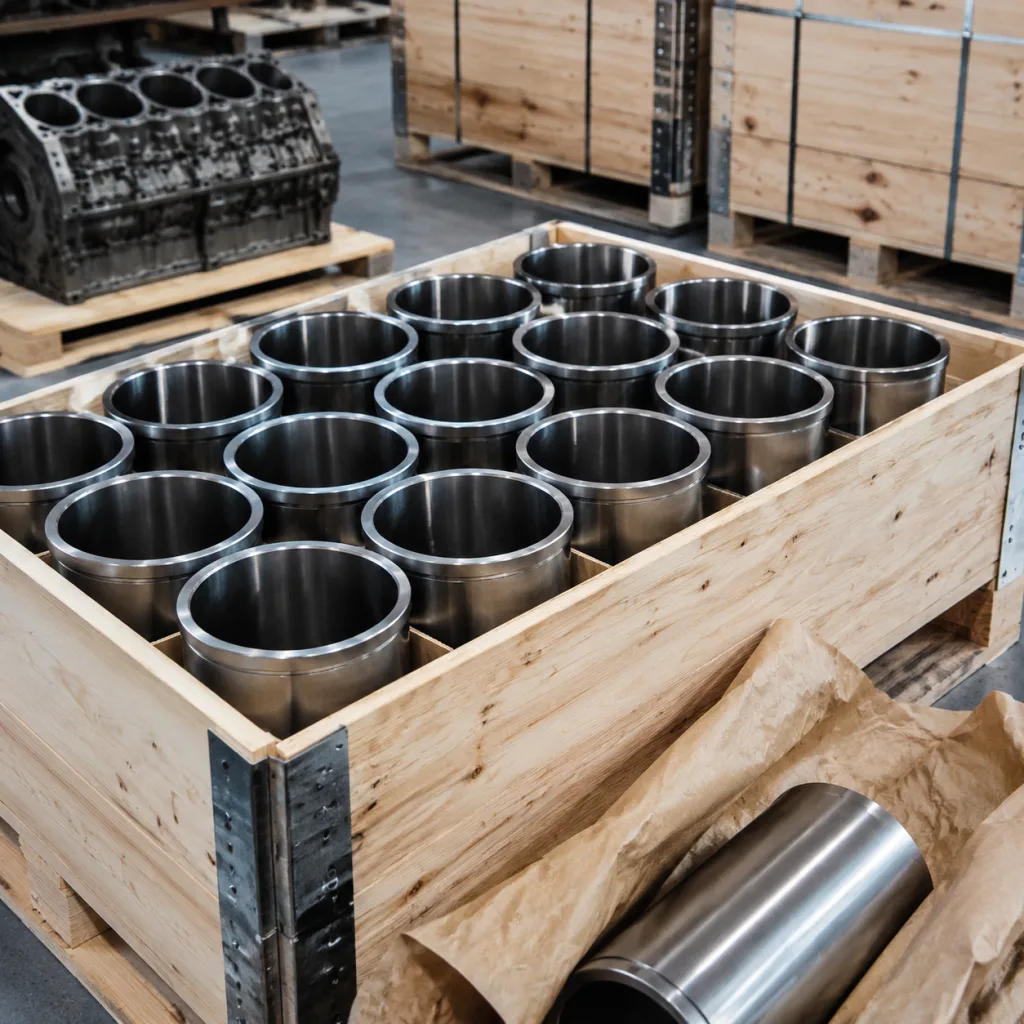
Packaging deserves special attention because camshafts are long, machined, and sensitive to surface damage. Journals and lobes must be protected from impact, moisture, and abrasion during ocean freight, warehouse handling, and last-mile shipment. Typical export pack-out should prevent metal-to-metal contact, immobilise the shaft inside the carton, and protect machined edges from denting. Clear labels should identify the part number, engine application, side of installation, batch code, quantity, and any private-label reference so warehouse teams do not mix similar intake and exhaust parts.

If you manage private label or regional catalogue programmes, custom manufacturing can align the camshaft package, marking, inspection plan, and documentation set with your market requirements. Driventus can support programme development for aftermarket distributors, OEM / Tier-1 supply chains, and repair network buyers that need repeatable quality and controlled export supply.

For pricing, stock confirmation, or technical matching, request a quote with the engine code, OE reference, intake or exhaust position, target market, expected annual volume, packaging requirements, and any inspection-report requirements. A complete enquiry reduces back-and-forth, shortens quotation time, and improves the accuracy of both fitment matching and commercial terms.

Frequently asked questions

Match the engine code, production market, intake or exhaust position, VVT type, oil-feed layout, trigger or reluctor arrangement, cylinder head revision, and OE cross-reference where available. A model name alone is not enough. Dimensional data or an approved master sample should be checked before order release.

Yes, if the supplier controls material, machining, heat treatment, surface finish, final inspection, packaging, and traceability. Ask for first-article approval, measured reports, batch records, hardness or surface-finish data where required, and quality-system documentation before placing volume orders.

Yes. Driventus supports programme-based development when the buyer provides engine code, OE reference, drawings or samples, target market, inspection requirements, packaging requirements, and annual volume. See /oem-services.html for details.

If you need fitment support or a programme quote for a Sonata camshaft, send your engine code, OE reference, installation side, target market, inspection needs, and annual volume target through our enquiry form at /contact.html.

Request a Quote
Check item What to verify Why it matters
Journal diametersMatch to OE drawing, approved sample, bearing-bore stack-up, and agreed tolerance rangePrevents seizure, low oil-film margin, low oil pressure, or excessive oil leakage
Journal spacingConfirm distance between bearing surfaces and cap locations using CMM, fixture, or calibrated gauge methodEnsures the shaft seats correctly in the cylinder head without cap binding
Lobe lift and timingConfirm lobe height, base circle, lift, and angular position against target valve-event data or approved master samplePreserves engine output, idle quality, emissions behaviour, and ECU adaptation range
Base circleVerify consistency with hydraulic lash adjuster, bucket tappet, finger follower, or rocker geometryMaintains correct lash, preload, contact pattern, and follower travel
Material gradeConfirm casting, chilled cast iron, ductile iron, steel billet, or assembled shaft specification as suppliedAffects stiffness, machinability, torsional stability, and wear resistance
Heat treatmentCheck induction pattern, chilled surface, case hardness, core hardness, or specified effective depth where applicableControls lobe and journal durability under repeated Hertzian contact load
Surface finishVerify journal and lobe Ra specification by profilometer, not visual inspectionInfluences break-in behaviour, oil retention, friction, and wear rate
Straightness and runoutMeasure total indicated runout across journals after machining and finishingReduces binding, uneven bearing load, rotational friction, and timing variation
End play / thrust geometryMatch thrust shoulder location, face finish, and head/cap stack-up requirementsAvoids axial noise, phaser misalignment, timing variation, and premature thrust wear
Oil-feed featuresVerify oil holes, grooves, annulus width, and alignment to cylinder head oil galleriesMaintains VVT response, journal lubrication, and follower oil supply where applicable
Trigger or reluctor featuresVerify tooth count, missing-tooth pattern, orientation, and angular location to datumPrevents sensor signal errors, no-start conditions, and cam/crank correlation faults
Marking and traceabilityConfirm batch code, part number, label format, and carton traceabilitySupports claims handling, recalls, and distributor inventory control