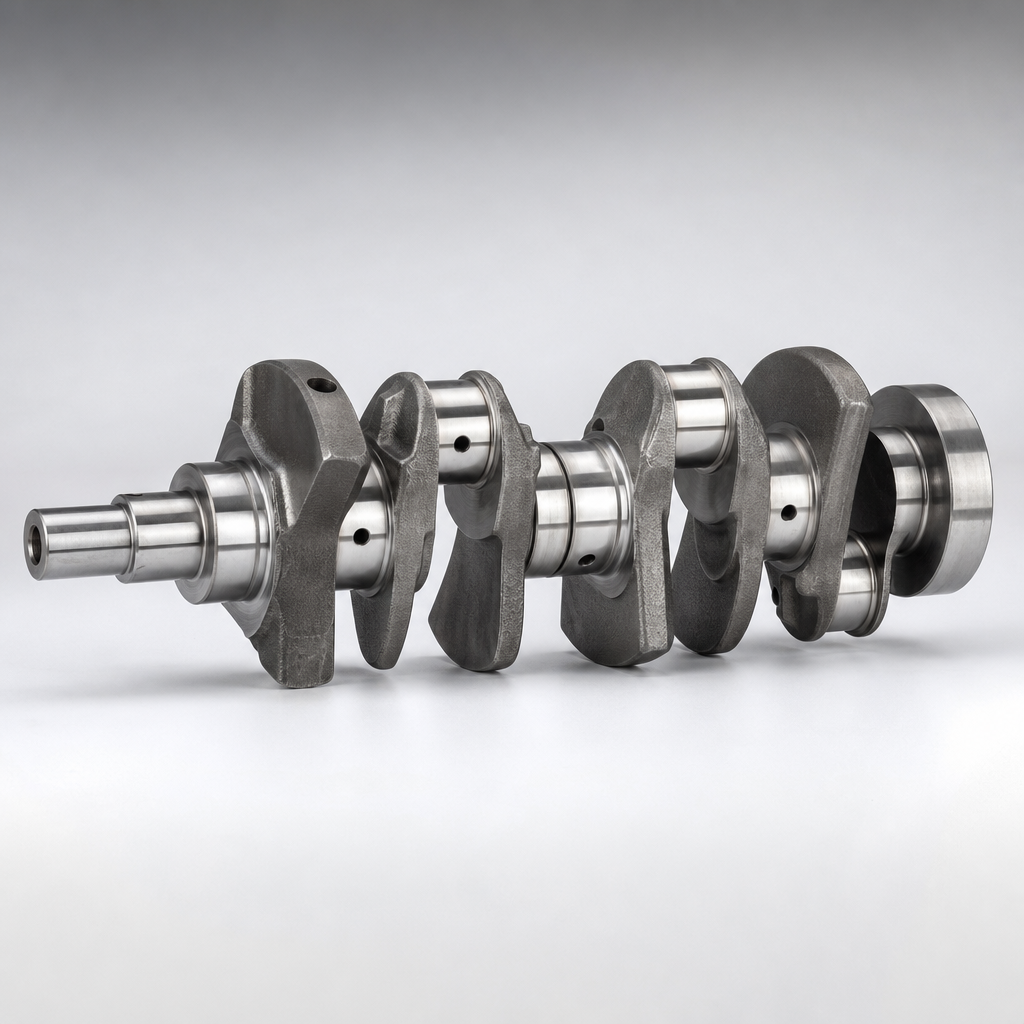
When a buyer asks for a **camshaft for Ford Explorer OE equivalent** supply, the real question is not whether the part looks similar on paper. It is whether the camshaft will install correctly, hold valve timing where it should, and perform consistently across repeat orders. For distributors, rebuilders, and service networks, the downside of getting that wrong is bigger than one return. A mismatched lobe profile, unstable hardness, poor journal finish, or weak process control can trigger noise, wear, timing issues, and avoidable warranty cost. So the sourcing review has to go deeper than catalogue matching. It should cover geometry, material, hardness, finish, traceability, and production discipline, plus the commercial terms that decide whether the programme is sustainable. This guide breaks down how to judge an OE-equivalent camshaft, where sourcing programmes usually fail, and what to ask before releasing volume. Driventus is an independent aftermarket manufacturer; any brand names mentioned are for fitment reference only.
Start with the decision standard: what counts as OE-equivalent
For a replacement camshaft, OE-equivalent is a performance standard, not a visual one. A buyer should treat it as a fit-and-function requirement: the part must install correctly, control valve events correctly, and keep doing so over time.
For a camshaft for Ford Explorer OE equivalent programme, the practical review should cover at least these points:
Base material: chilled cast iron, alloy cast iron, or forged steel aligned with the engine family requirement
Lobe profile accuracy: intake and exhaust geometry produced to the intended lift curve and timing window, often controlled within <= 0.02-0.05 mm against approved master data
Journal dimensions: diameter, roundness, and taper held to drawing tolerance, commonly around +/- 0.005-0.015 mm depending on design
Hardness depth and consistency: wear resistance at lobe and journal surfaces, with hardened lobes often controlled around HRC 52-62 where required
Surface finish: journal finish often targeted around Ra 0.2-0.8 um and lobe finish around Ra 0.4-0.8 um, depending on process route
Oil passage integrity: no burrs, blockage, or flash that could restrict lubrication flow
Runout control: total runout frequently held to <= 0.03-0.08 mm over defined datum points
Those numbers matter because they connect directly to field behaviour. A camshaft can look acceptable, pass a casual visual check, and still create unstable idle, excess noise, or accelerated wear if the profile or journals drift.
OE-equivalent also has a supply-chain meaning. If first samples pass but production lots drift after a few months, the programme is not truly equivalent in commercial terms. Buyers should therefore check not only the part itself, but also the supplier's control plan, traceability system, and consistency across repeat lots.
If the supplier works under IATF 16949:2016 and ISO 9001:2015, that gives buyers a stronger basis for process control and non-conformance handling. You can review Driventus quality system and our catalog for related engine components.
Where buyer programmes usually fail before the first shipment
Most sourcing problems do not start in the factory. They start in the approval logic.
Here are the common failure modes:
Vehicle-only matching: approving by model name without confirming engine family, year split, valve train configuration, or VIN-related variation
Single-number validation: checking peak lift but not the full lobe contour, ramp behaviour, or phasing
Sample-only thinking: approving one good sample without locking the production control standard behind it
Weak packaging definition: assuming camshafts can be shipped like low-risk metal parts, even though edge damage and corrosion are common in transit
No traceability discipline: discovering too late that field claims cannot be tied back to machining date, heat-treatment batch, or final inspection records
This is especially relevant for Ford Explorer-fit applications because the platform spans multiple engine generations. A broad interchange assumption is risky. The more the programme depends on aftermarket cross-reference logic instead of drawing-level confirmation, the more likely returns become.
A buyer evaluating a camshaft for Ford Explorer OE equivalent supply should ask one hard question early: what would cause a field failure even if the part number appears correct? That question usually reveals the weak point faster than a generic checklist does.
Compare suppliers by evidence, not by catalogue language
A catalogue entry can get a supplier onto the shortlist. It should not get them approved.
Use the RFQ and sample stage to compare suppliers on documented evidence:
Check point
What to request
Why it matters
Material declaration
Base alloy, heat treatment route, and hardness target
Confirms wear resistance and core strength
Dimensional report
Journal diameter, lobe lift, overall length, phasing, and runout
Verifies fitment and operating geometry
Hardness report
Lobe and journal hardness values by batch and test location
Reduces premature wear risk
Surface data
Roughness values on journals and lobes
Supports lubrication performance
Traceability
Lot code, production date, and inspection linkage
Simplifies claim analysis and recall isolation
Packaging standard
Rust prevention, separator protection, VCI bag or oil wrap, label control
Prevents transit damage and picking errors
Compliance statement
REACH (EC) No 1907/2006 where applicable
Supports EU import documentation
Capacity and lead time
Monthly capacity, standard lead time, and rush-order policy
Confirms supply continuity
Commercial terms
MOQ by part number, price break table, tooling assumptions
Helps compare real landed cost
</tr></thead><tbody> </tbody></table>Two suppliers may both claim OE-equivalent status. One sends a pass/fail sheet and a price. The other sends actual journal readings, hardness by location, process route, packaging definition, and lot traceability. They are not offering the same risk profile.
For EU and UK buyers, documentation tied to coatings, corrosion inhibitors, and packaging substances under REACH (EC) No 1907/2006 may be necessary. For North American buyers, repeatability in geometry and hardness often matters more commercially than a small difference in unit price.
It is also worth comparing how pricing changes with volume. A supplier may look competitive at 50-100 pcs, then only become operationally efficient at 300-500 pcs once setup, profile grinding, heat treatment, washing, and packaging costs are spread properly. Standard aftermarket MOQs can range from 50 pcs for stocked references to 200-500 pcs for programme-specific supply, while lead times often sit in the 30-45 day range after sample approval and deposit.
If private-label supply is part of the programme, a supplier with custom manufacturing capability can align packaging, labels, and validation requirements with your channel.
Spec deep-dive: the camshaft details that actually change field performance
Not every specification has the same consequence. Some features are paperwork-heavy but low risk. Others decide whether the part survives in service.
Lobe geometry
This is one of the first places to look. Small deviations in lobe shape can alter lift progression, timing behaviour, idle quality, combustion stability, and valvetrain noise. Buyers should ask whether the supplier checks only peak lift or the full contour at multiple angular positions. Full profile comparison is far more meaningful.
Journal accuracy
Journal diameter, cylindricity, and concentricity affect oil film stability and bearing load distribution. If these values drift, wear can accelerate quickly. Ask for actual readings by journal position, not just a final pass statement, and confirm how inspection is done: micrometer, air gauge, or roundness tester.
Heat treatment quality
Too soft, and lobe wear becomes the problem. Too brittle, and crack risk rises under cyclic load. The supplier should define target hardness, effective depth where applicable, and inspection frequency by lot. For hardened lobes, buyers often ask for an effective depth in the approximate 0.8-2.0 mm range depending on material and design.
Surface roughness
Cold-start lubrication and wear behaviour are both affected by finish. Values should remain stable from lot to lot, not just on first articles. If the route includes grinding and superfinishing, ask whether roughness is checked piece by piece, by setup, or by a sampling plan such as 1 per 20-50 pcs.
Cleanliness and burr control
Blocked passages, sharp residues, and debris can turn into immediate installation or lubrication issues. The supplier should be able to explain the process clearly: rough machining, heat treatment, finish grinding, deburring, passage cleaning, washing, anti-rust oiling, drying, and protected packing.
Where the product range covers more engine hard parts, buyers may also review /products/engine-components.html to consolidate sourcing.
Step by step: how to validate a camshaft before you release volume
A useful approval process is simple, documented, and hard to misunderstand.
For a camshaft for Ford Explorer OE equivalent sourcing programme, buyers should ask for these validation steps:
Material verification: chemical composition and mechanical property confirmation by batch, ideally linked to mill certificate or incoming spectroscopy record
Hardness testing: lobe and journal values recorded against internal specification with defined test points
Runout inspection: straightness and rotational stability checks on V-blocks or dedicated fixtures
Profile measurement: lobe contour comparison against approved master data or CAD-derived inspection standard
Metallographic review: where required, to confirm heat-treatment structure, chill depth, or hardened layer condition
Corrosion and packaging checks: especially for export or sea-freight programmes
Installation trial: sample fitment in the target engine family or a validated fixture
PPAP-style submission: when requested, including balloon drawing, dimensional layout, process flow, control plan, and material or hardness records
A practical approval flow often looks like this:
1. Request 3-10 pcs for first-article review. 2. Review critical dimensions, hardness, finish, and markings. 3. Lock the approved sample and inspection standard. 4. Run a pilot lot of 20-50 pcs. 5. Check that the pilot lot matches the sample, not just the print. 6. Release production only after packaging and traceability are also confirmed.
That last point is easy to overlook. A technically acceptable camshaft can still fail commercially if packaging causes corrosion or if lot coding breaks down in warranty analysis.
For broader system context, regulations such as ECE R-83 relate to complete-vehicle emissions compliance, not standalone camshaft approval. Buyers should be cautious when suppliers imply vehicle-maker approval without evidence. The correct approach is to verify that the part maintains intended fit and function in the target application.
Driventus supplies engine and powertrain components under controlled production processes with documented inspection stages. Buyers can use the sample phase to define acceptance criteria before full release.
Scenario planning: how to cut returns on Ford Explorer-fit programmes
Imagine the part fits on arrival, but returns start after the first few months. What usually happened?
In most cases, one of four gaps was left open.
First, the application scope was too broad. Ford Explorer platforms cover multiple engine combinations, so buyers should confirm year range, displacement, valve train configuration, and any relevant VIN or engine code split before approving interchange.
Second, the sample was approved, but the process was not. A strong programme uses the approved sample as the benchmark for dimensions, hardness, finish, marking, and packaging. Many buyers formalise this with a signed master sample and golden-label packaging reference.
Third, packaging was treated as an afterthought. Camshafts are vulnerable to corrosion and edge damage during long transit cycles. Protective dividers, anti-rust treatment, and clear labels are baseline controls. For export shipments, specify inner wrap, corrosion protection duration, units per carton, maximum carton weight, and pallet protection. A practical standard might be 1 pc per protective sleeve or divider, plus desiccant or VCI where needed.
Fourth, traceability was incomplete. When a field claim appears, lot isolation determines how expensive the response becomes. At minimum, the lot code should connect the finished part to machining date, heat-treatment batch, and final inspection data.
A buyer who wants fewer returns should also look at ordering behaviour. Very low-volume mixed orders can encourage rushed substitutions, unstable packaging, or inconsistent setup conditions. If annual demand is fragmented, a blanket order with scheduled releases, such as quarterly call-offs, often produces more stable supply over a 12- to 36-month window.
A capable supplier should also support PPAP-style documentation when requested, even for aftermarket rather than direct OE production.
RFQ Q-and-A: what procurement teams should include up front
A strong RFQ makes the quote cleaner, the review faster, and the risk lower.
Include these items from the start:
Application and engine code details
Target annual volume and MOQ expectations
Required material or equivalent performance level
Dimensional report requirements for first samples
Hardness and heat-treatment record requirements
Surface protection and packaging specification
Label format, barcode, and traceability needs
Destination market compliance needs, including REACH documentation where relevant
Any OE cross-reference already used in your internal system
Required Incoterm, destination port, and target lead time
Sample quantity, approval timeline, and whether pilot-lot validation is required
Warranty expectation or claim-handling framework
A few RFQ questions are especially useful:
Can you quote by volume band? Ask for pricing at levels such as 100 pcs, 300 pcs, and 500+ pcs.
What is included beyond unit price? Separate unit price, tooling or fixture cost, sample cost, and standard production lead time.
Is private-label packaging included? Clarify whether artwork, barcode labels, colour cartons, and master carton marks are included or quoted separately.
What reference logic are you quoting against? If you already manage a cross-reference database, list part references exactly as held internally. Use formats such as OE 06A107065 only when they are already part of the sourcing brief.
For buyers comparing multiple sources, the most reliable offer is rarely just the lowest FOB number. The stronger position usually comes from the supplier that can document process control, hold dimensional consistency, and respond quickly when corrective action is needed.
If you need support on a current programme, you can request a quote with your application details.
Frequently asked questions
It should match the required material, lobe profile, journal dimensions, runout, hardness, and surface finish for the target engine application. In practical sourcing terms, buyers should look for measurable controls such as journal tolerances in the micron range, defined hardness windows, stable roughness values, and traceable batch records that prove repeatability.
No. Buyers should confirm the engine family, production variant, and any relevant cross-reference data. A broad model description can lead to incorrect interchange and costly returns, especially where one vehicle line spans multiple engines, timing configurations, or year-range changes.
At minimum, ask for dimensional reports, hardness records, material information, batch traceability details, and certification status such as IATF 16949:2016 and ISO 9001:2015. For programme-based supply, it is also useful to request sample approval records, process flow or control plan summaries, packaging specification, MOQ, and standard lead-time confirmation.
If you are reviewing replacement camshaft supply for Ford Explorer-fit applications, Driventus can assess your drawing, sample, or cross-reference list and respond with a practical quotation including technical review, MOQ, lead-time, and packaging requirements. Contact our team here: /contact.html