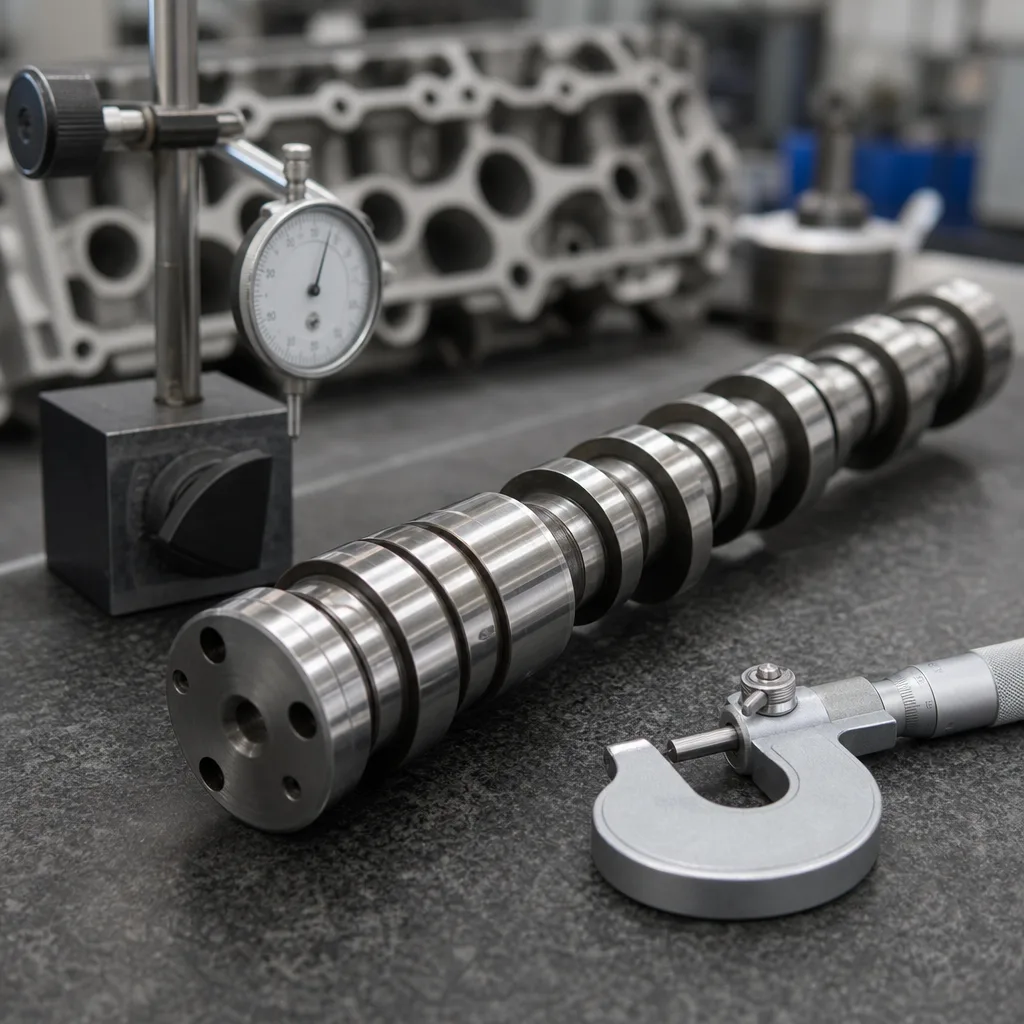
Buying a camshaft for Fiat applications is a sourcing task, not a simple parts purchase. Procurement teams need consistent casting or forging quality, correct lobe geometry, stable heat treatment, and traceable inspection records. For aftermarket distribution, workshop supply, and OEM or Tier-1 programmes, the supplier must support dimensional control, packaging discipline, and repeatable delivery. Driventus is an independent aftermarket manufacturer; brand names are referenced for fitment only. We manufacture engine and powertrain components in Taizhou, Zhejiang, and export to more than 60 countries. Our programmes are built around IATF 16949:2016 and ISO 9001:2015 quality controls, with material and process checks suitable for international sourcing teams. If you are evaluating a camshaft Fiat manufacturer China option, the key questions are lead time, MOQ, validation data, and whether the factory can support OE 06A… or 11251… cross-reference work where applicable.
What buyers should verify before shortlisting a supplier
For camshafts, the supplier file should go beyond a catalogue page. Ask for the following data before audit or sample approval:
Base material specification and incoming mill traceability
Hardening method and surface hardness range
Journal and lobe runout values
Journal diameter tolerance and bearing surface finish
Lift, duration, and lobe centre data on the inspection sheet
Packaging standard for rust prevention and transit protection
Lot traceability and batch coding format
A serious camshaft Fiat manufacturer China candidate should be able to supply dimensional reports, material certificates, and process flow information. For B2B purchasing, that reduces the risk of hidden variation between pilot samples and mass production. If you are mapping several engine variants, link the part family in your internal system and confirm whether the supplier can support OE cross-references without claiming OEM approval.
Manufacturing controls that matter on camshafts
Camshaft performance depends on geometry and heat treatment. Small deviations affect valve timing, idle stability, and high-speed durability.
Control item
Typical sourcing requirement
Why it matters
Lobe profile accuracy
Per drawing and functional gauge
Affects valve lift and duration
Journal diameter
Tight tolerance on bearing surfaces
Controls oil film and wear
Runout
Low axial and radial deviation
Reduces vibration and timing drift
Surface hardness
Process-defined range after hardening
Supports wear resistance
Surface finish
Controlled on journals and lobes
Improves break-in and oil retention
</tr></thead><tbody> </tbody></table>Common production routes include forged or cast blanks, rough machining, induction hardening or equivalent surface treatment, finish grinding, and final inspection. For export programmes, request the actual control plan rather than a summary sheet. It should show in-process checks, calibration status, and final acceptance criteria. Driventus works under IATF 16949:2016 and ISO 9001:2015 systems, which helps buyers align supplier records with internal APQP and PPAP expectations.
Fitment, cross-reference, and replacement risk
Fiat engine families can share similar external dimensions while differing in lobe timing, journal layout, or sensor interfaces. That is why OE cross-reference work must be verified on the technical drawing, not by appearance alone.
Driventus can support replacement programmes where the buyer needs a stable aftermarket part that matches the functional requirements of the target application. When a listing uses OE references such as OE 06A107065, the correct workflow is:
1. Confirm engine code, displacement, and valve train type. 2. Match the camshaft drawing against the reference sample. 3. Check sensor trigger features, keyway position, and thrust face geometry. 4. Validate with a physical fitment sample and dimensional report. 5. Approve the packaging and labelling format for your market.
Driventus is an independent aftermarket manufacturer; brand names are referenced for fitment only. No statement here should be read as vehicle-maker endorsement or approval.
Lead time, MOQ, and supply model for procurement teams
For import managers, supply continuity is often more important than the lowest unit price. A camshaft programme should be assessed on MOQ, tooling status, and replenishment cadence.
Typical procurement questions include:
What is the MOQ for first order and repeat orders?
Can the factory hold safety stock for key references?
What is the standard production lead time after sample approval?
Can the supplier consolidate camshafts with other engine components for shipment?
Are carton labels, barcodes, and pallet formats customisable for your warehouse?
A supplier in China can be practical for Europe, North America, and South America when the factory has stable machining capacity, export packing discipline, and clear communication on lead times. If your programme includes multiple engine parts, review our catalog and engine components to align camshafts with related items such as gaskets, water pumps, and crankshafts.
Quality documents and audit readiness
Buyers in the EU, UK, US, Canada, Australia, and Brazil usually need more than product photographs. The supplier should be able to provide a document pack aligned with compliance and warehouse intake.
Common document requests
IATF 16949:2016 certificate copy
ISO 9001:2015 certificate copy
Material certificate and heat-treatment record
Inspection report with key dimensions
Country-of-origin declaration
Packaging and labelling specification
REACH (EC) No 1907/2006 declaration where applicable
If your programme requires broader business review, use the supplier audit to check traceability from raw material to finished goods, calibration control, and nonconformance handling. Our quality system outlines the controls used across machining, inspection, and export packing. For programmes that need revised geometry, sensor features, or special packaging, custom manufacturing can be used to define the required specification before pilot production.
When to move from sampling to production
Move to production only after the sample has passed dimensional, functional, and packaging checks. For camshafts, the minimum approval set should include:
Visual inspection under controlled lighting
Critical dimension report
Surface hardness verification
Fitment confirmation on the target head or test fixture
Corrosion protection and packaging validation
Label scan and carton drop-check review
If your supply chain uses catalogue replenishment, define a reorder point and keep the reference list stable. If you manage fleet or workshop demand, standardise one approved part number per engine application wherever possible. That reduces mis-picks and returns. For a supplier discussion, request a quote with the engine code, OE cross-reference, annual volume, target market, and any special packing requirements.
Frequently asked questions
Yes. We manufacture camshafts and related engine components in China for B2B export programmes. Fitment must be confirmed by engine code, drawing, and sample verification. Brand names are referenced for fitment only.
Our programmes are managed under IATF 16949:2016 and ISO 9001:2015. Depending on the application, buyers may also request REACH declarations, material certificates, and dimensional inspection reports.
Send the engine code, OE cross-reference if available, annual volume, target market, and packaging requirements. We can then review feasibility, MOQ, and lead time before sampling.
If you are qualifying a camshaft supply route for Fiat applications, send your drawing, sample, or reference details and we will review the fitment and commercial terms. Start here: /contact.html