Camshaft Chevrolet Supplier: Sourcing Guide for Buyers
Choosing a camshaft Chevrolet supplier is not just a part-number exercise. Buyers need the correct application match, stable lobe geometry, controlled surface hardness, reliable packaging, and traceability records that can stand up to a customer or factory audit. Driventus supplies aftermarket engine components from Taizhou, Zhejiang, and exports to 60+ countries under IATF 16949:2016 and ISO 9001:2015 management systems. Driventus is an independent aftermarket manufacturer; Chevrolet and other brand names are referenced for fitment identification only.
If you are qualifying a new source, begin with the engineering details: application, engine family, journal size, lift, phasing, material route, heat treatment, and packing requirements. Then compare the supplier’s inspection data with your incoming quality standard and expected service life. This guide explains what to request before sampling, how to compare sourcing routes, and when custom manufacturing is a better procurement decision than buying a standard replacement part.
What to verify before you request samples
A camshaft is defined by its operating profile and manufacturing control, not by vehicle make alone. Before requesting samples, lock the specification so the supplier can quote the same part you intend to approve.
Engine family, displacement, model years, and valve train layout
Journal diameter, overall length, nose geometry, and drive interface
Base circle, lobe lift, duration, lobe separation angle, and phasing
Material route, heat treatment method, and surface finish on lobes and journals
Oil hole position, thrust face detail, keyway or gear interface, and sensor features where applicable
Required documents, including dimensional report, hardness check, and batch traceability
If you only have a fitment reference, treat it as the starting point rather than final approval. Cross-check the reference against a physical sample, drawing, or measured dimensions before you release volume production. Browse our catalog to compare standard engine-component coverage before sending a drawing or sample. For sourcing teams, this reduces avoidable back-and-forth on price, tooling, packaging, and lead time.
Supply options and trade-offs
The best sourcing path depends on demand stability, engineering ownership, approval time, and how much validation your team wants to control. A qualified camshaft Chevrolet supplier should explain the limits of each option instead of pushing every buyer toward the same production route.
Option
Best use case
MOQ and lead time
Procurement risk
Standard catalogue camshaft
Routine aftermarket replacement and fast replenishment
Lower MOQ, shorter lead time
Works best when the application is stable and already validated
OE-reference matched production
Buyers replacing an established part number across multiple markets
Medium MOQ, balanced lead time
Needs dimensional, material, and packaging sign-off
Fleet programmes, export variants, discontinued parts, or design revisions
Higher MOQ, longer lead time
Requires drawing control, sample approval, and defined validation criteria
</tr></thead><tbody> </tbody></table>For factory audit planning, request process flow, control plan, incoming-material checks, and final inspection records before placing a trial order. That documentation shows whether the source is simply reselling parts or managing a repeatable production process. It also helps your purchasing, quality, and warehouse teams align expectations before the first shipment leaves the factory.
Materials, heat treatment, and wear control
Material choice affects fatigue life, wear resistance, machining stability, and the camshaft’s ability to hold its profile through the service interval. Many production camshafts use chilled cast iron or alloy steel, while billet steel is usually reserved for special duty cycles, performance-oriented profiles, or design changes that require tighter control over strength and machinability.
Ask whether the lobe surface is hardened by induction, nitriding, chill casting, or another approved heat-treatment route
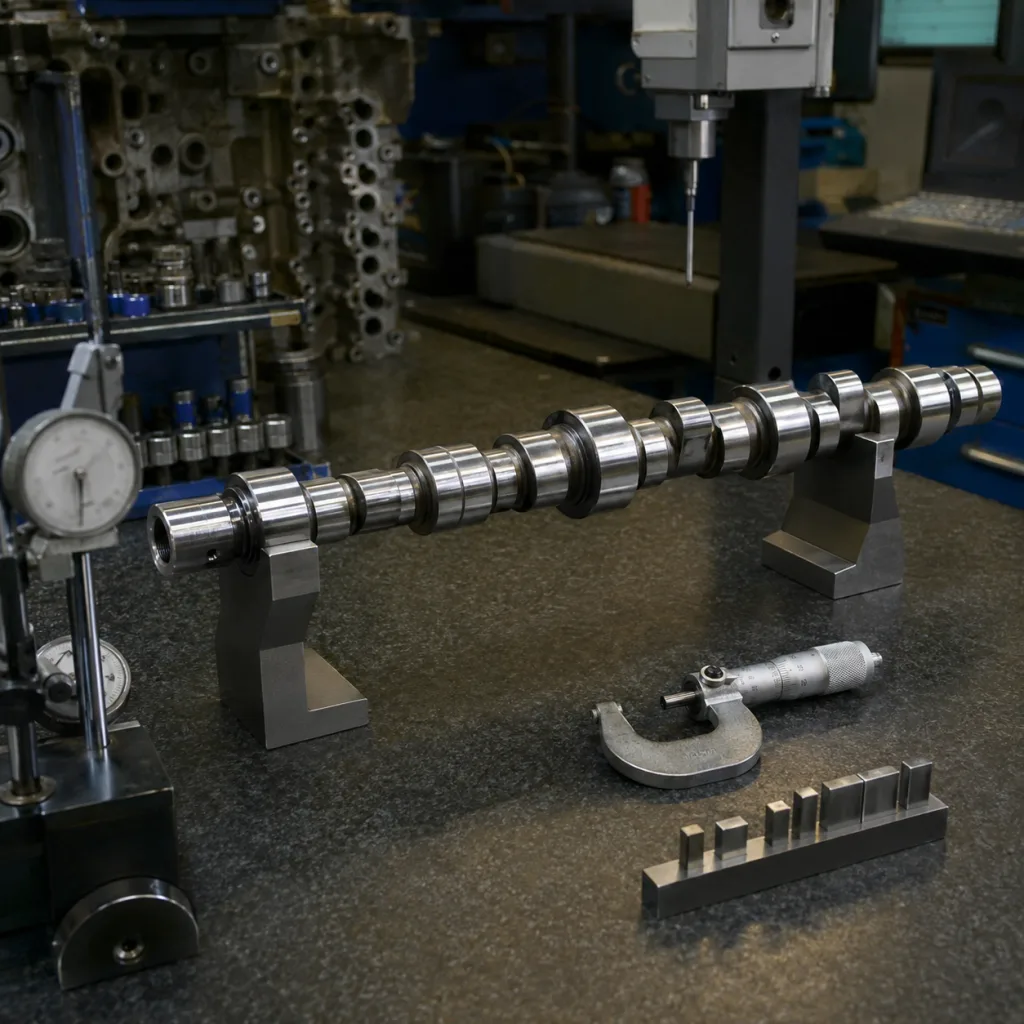
Confirm that journal diameters, runout, straightness, and lobe height are checked batch by batch, not only on the first sample
Review the grinding finish across intake and exhaust lobes, especially if the engine has known follower or tappet wear sensitivity
Verify that coatings, rust-preventive oils, and packing materials comply with REACH (EC) No 1907/2006 for EU shipments
For harsh climates or long sea freight routes, request corrosion data aligned with SAE J2527 or an equivalent internal method
Ask how nonconforming parts are isolated, marked, and prevented from returning to the export packing flow
For emissions-sensitive programmes, any cam profile change should be reviewed against the vehicle programme plan. Depending on the destination market and engine application, downstream compliance checks may include ECE R-83 review. The practical point is that a camshaft can look correct on a quick visual check and still fail the duty-cycle target if hardness depth, surface finish, or profile repeatability is not controlled.
Quality documents buyers should request
Strong sourcing control is visible in records. Promises about precision or durability are not enough; the supplier should connect material, process, inspection, and packing data to each approved lot.
Current IATF 16949:2016 and ISO 9001:2015 certificate copies
Material certificates tied to heat numbers or controlled production batches
First article or sample inspection covering journal diameter, lift, runout, phasing, and critical interface dimensions
Hardness results, heat-treatment records, and process capability data where the programme requires them
Lot traceability, carton labels, packing method, and corrosion protection specification
Change-control procedure for material route, machining process, tooling, or subcontracted treatment changes
See our quality system for the controls we use across machining, inspection, traceability, and export packing.
Audit checklist
For multi-location repair chains, request part-number labels that remain readable after sea freight, transshipment, and warehouse rehandling. If your buyer team is standardising suppliers across regions, require the same measurement method, report format, sampling plan, and release criteria on every lot. Consistent records make second-source comparisons easier and reduce disputes when incoming inspection teams in different countries review the same part.
When custom manufacturing makes sense
Standard replacement is not always the lowest-risk option. Custom grinding or full custom production can be justified when the original part is discontinued, the engine variant uses a different timing strategy, the buyer needs a wider temperature or duty-cycle margin, or the programme is moving from local resale to export distribution.
Custom development also makes sense when the buyer wants stronger control over packaging, private-label presentation, inspection reports, or a coordinated engine-parts package. In those cases, send a drawing, physical sample, OE reference if available, target annual volume, destination market, and validation plan. We can align the camshaft with adjacent parts in our engine components and support private-label or direct-to-assembly supply through custom manufacturing.
For procurement teams, the main advantage is control. Once the profile, material route, surface finish, inspection plan, and release criteria are fixed, you can compare offers on a like-for-like basis instead of comparing broad claims. That makes supplier qualification more objective and helps avoid late-stage surprises in sampling, labeling, or export packing.
Frequently asked questions
Send the engine family, OE reference if available, annual volume, destination market, required finish, packaging needs, and any sample or drawing. Photos and measured dimensions help when matching an existing part.
Yes. We can review drawings, confirm feasibility, and build a validation plan for custom grinding or full manufacturing. Final approval depends on your sample sign-off, performance target, and production requirements.
Ask for material certificates, dimensional reports, hardness results, traceability data, packing specifications, and certificate copies for IATF 16949:2016 and ISO 9001:2015. For EU shipments, add a REACH (EC) No 1907/2006 declaration.
Send your drawing, OE reference, target volume, destination market, and packaging requirements, and we will confirm the fastest sourcing route. Start via [request a quote](/contact.html).